The Immortal Islands No Ship Can Find
c. 219 BCE — the imperial expeditions of the first Qin Emperor · The Eastern Sea beyond the shores of China — the mythological location of the immortal islands
Contents
Somewhere in the Eastern Sea lie three islands where the immortals live and the herbs of eternal life grow — the Emperor Qin Shi Huang sends expedition after expedition to find them, and none return.
- When
- c. 219 BCE — the imperial expeditions of the first Qin Emperor
- Where
- The Eastern Sea beyond the shores of China — the mythological location of the immortal islands
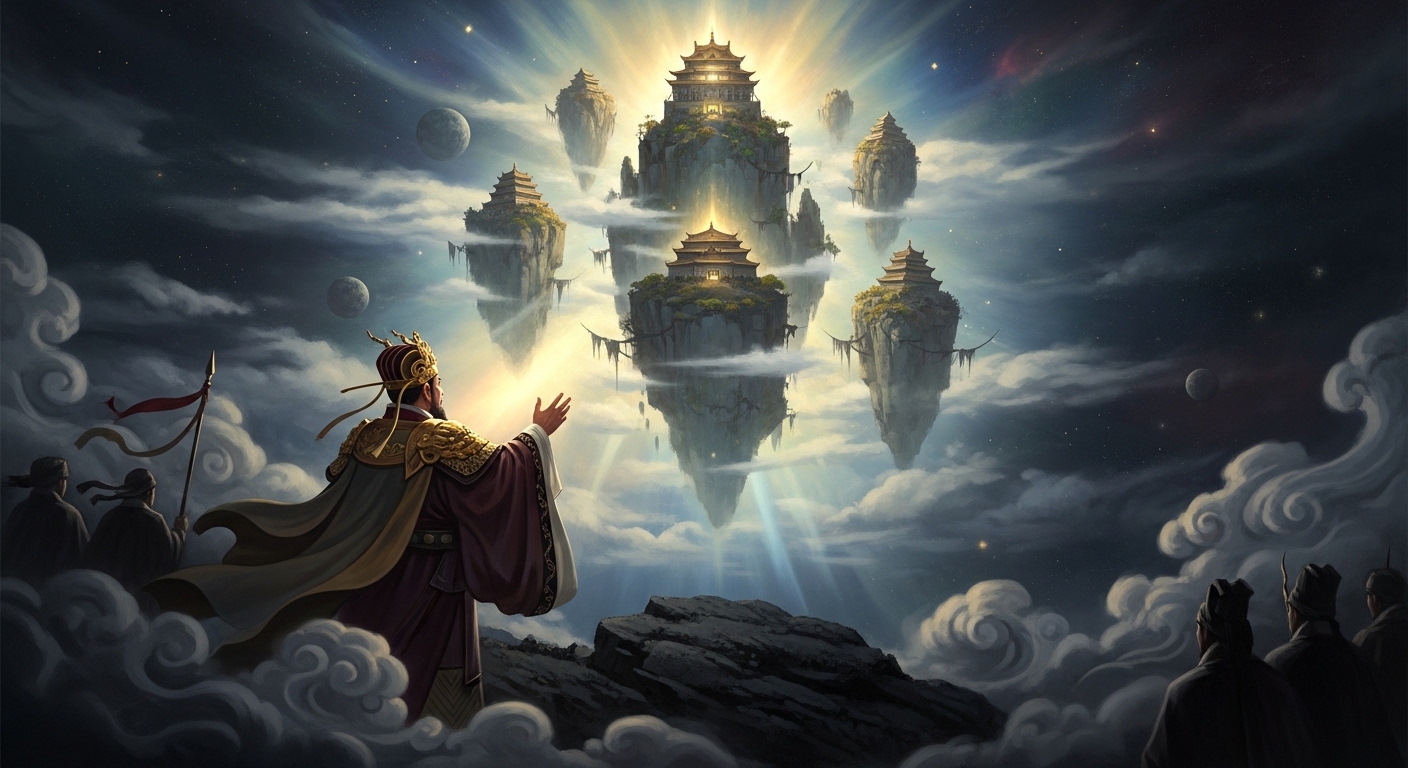
The three islands appear in the mist over the Eastern Sea.
Sailors who have come close enough to see them describe the same things: white clouds that do not move, green hills above the water, buildings on the hills that might be palaces if you squint, and a light above them that is not quite the light of the sun. The islands shimmer. They are there and then they are not there. Ships that sail toward them find the distance expanding — the closer you sail, the farther they become, as if the islands themselves are retreating.
Their names are Penglai, Fangzhang, and Yingzhou. They float in the Eastern Sea, or they are anchored to the backs of the giant turtles who swim in the eastern depths. Everything on them is white — white birds, white deer, white trees — and the herbs that grow there, if you could obtain them, would make you immortal. The immortals who live there look like ordinary people from a distance but shine with the particular luminosity of those who have stopped aging.
Emperor Qin Shi Huang wants what the islands offer.
He has unified China. He has built the Great Wall. He has standardized weights and measures and writing and the axle-widths of carts so the roads are compatible. He has the title he invented for himself: First Emperor, the first of a dynasty he intends to last ten thousand generations. He does not want to die.
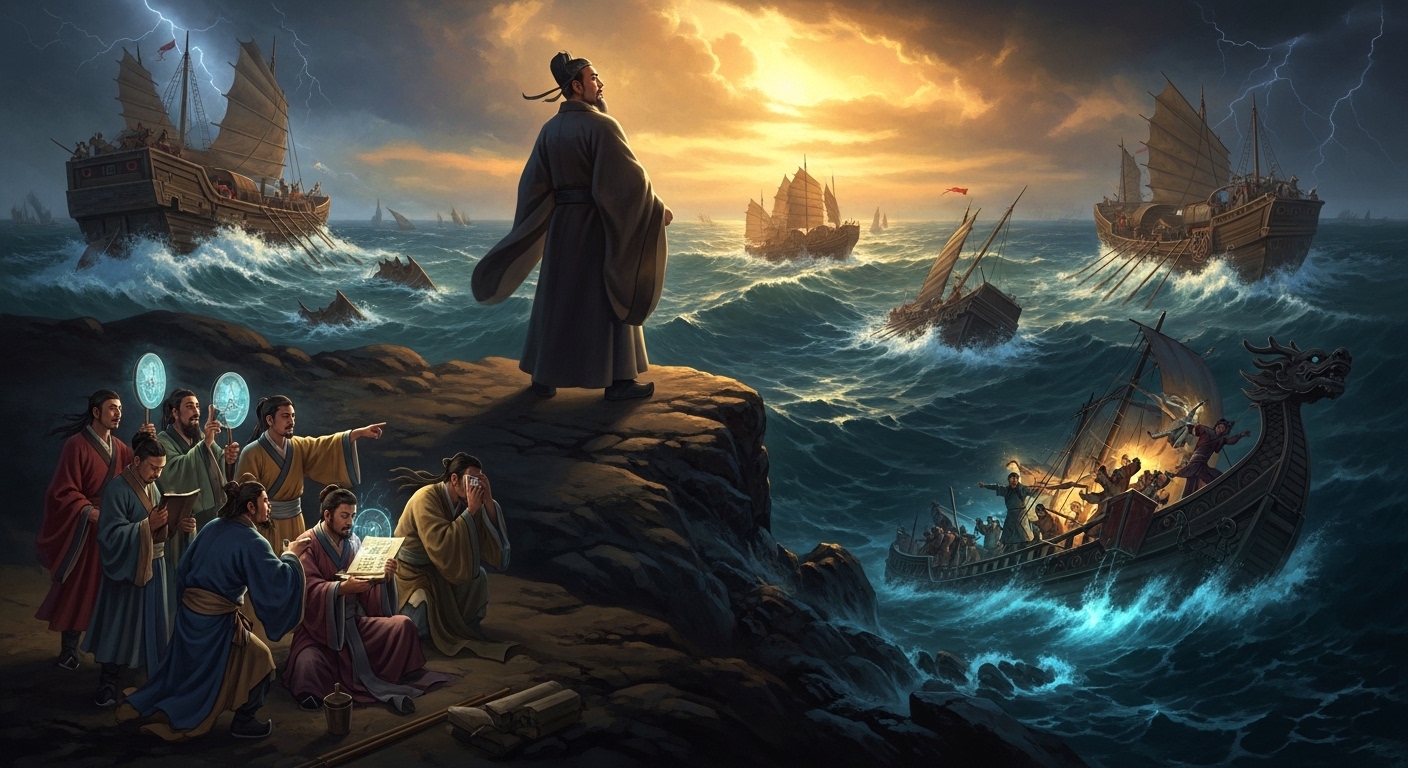
He sends Xu Fu with several thousand young men and women, with craftsmen and seeds, with money and provisions for a long voyage, to the Eastern Sea to find the islands and bring back the herbs. Xu Fu departs. He returns without the herbs but with an explanation: the sea god told him the offering was insufficient. He needs more.
The Emperor sends him again with a larger expedition. Xu Fu departs. He does not return. The traditional account says he found a fertile island — possibly Japan, the geography suggests — and stayed there, or that his expedition was destroyed, or that he found the islands and the islands did not let him come back. No one knows.
The Emperor sends other expeditions. None succeed. He consults the court diviners. They tell him that the reason the herbs cannot be found is that there is a great fish blocking the approach to the islands, and if he personally shoots it with a crossbow, the way will be clear. He sails out himself with a crossbow. He shoots at a large fish he encounters. He returns to shore satisfied. He dies shortly afterward on the road, at fifty, during a tour of the eastern provinces.
The herbs were not found. The islands were not reached. The dynasty he built to last ten thousand generations lasted fifteen years after his death.
Penglai remains. It has always remained, which is the point. The Eight Immortals cross the Eastern Sea and reach it because they are not looking for it — they arrive as a byproduct of their nature, not as the result of an expedition. The emperors who sent ships never arrived. The immortals who walked into the sea on their characteristic objects — the crutch, the fan, the sword, the flute — arrived without trying.
This is the teaching that the immortal islands encode: the paradise that can be sought by force of will and imperial provision is not the one that is there. The place where the herbs grow cannot be mapped from a harbor. The distance to it is not measured in li but in the gap between what you are and what the island requires its visitors to be. The distance contracts when you stop measuring it. The islands appear in the mist and then they do not appear, and what decides whether you see them is something the Shiji doesn’t record and the expeditions never found.
Scenes

Echoes Across Traditions
Entities
- Penglai (immortal island)
- Fangzhang and Yingzhou (the other two islands)
- Emperor Qin Shi Huang
- Xu Fu (the expedition leader)
- the Eight Immortals
Sources
- Shiji (史記), Sima Qian, 'Basic Annals of Qin Shi Huang' and the Xu Fu expedition accounts
- Liezi (列子), description of the five immortal mountains
- Shanhaijing (山海經), descriptions of eastern sea paradises
- Lihui Yang & Deming An, *Handbook of Chinese Mythology* (Oxford, 2008)