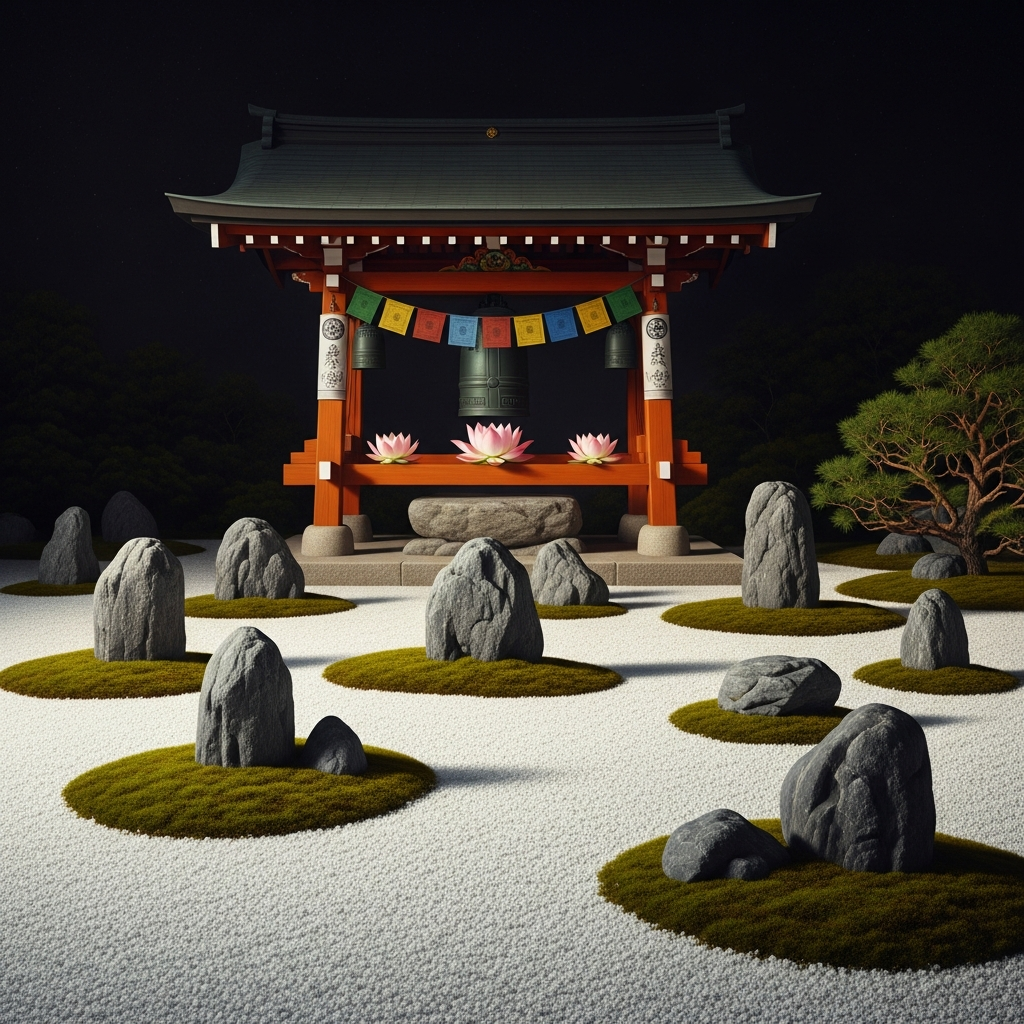
The Empty Garden at Ryōan-ji
c. 1480 CE — Muromachi period, attributed to Sōami or Zenami · Ryōan-ji temple, northwest Kyoto — the garden viewed from the abbot's veranda
Contents
The rock garden at Ryōan-ji temple in Kyoto contains fifteen stones arranged in five groups in a bed of white gravel — and from any position in the garden, exactly one stone is always hidden from view.
- When
- c. 1480 CE — Muromachi period, attributed to Sōami or Zenami
- Where
- Ryōan-ji temple, northwest Kyoto — the garden viewed from the abbot's veranda
The garden is thirty meters long and ten meters wide.
It is bounded on three sides by low clay walls stained with age — the ochre color of walls that have been absorbing weather for five hundred years — and open on the fourth side to the long wooden veranda of the abbot’s quarters. From the veranda, the garden can be seen fully. Or it can be seen as fully as it allows itself to be seen.
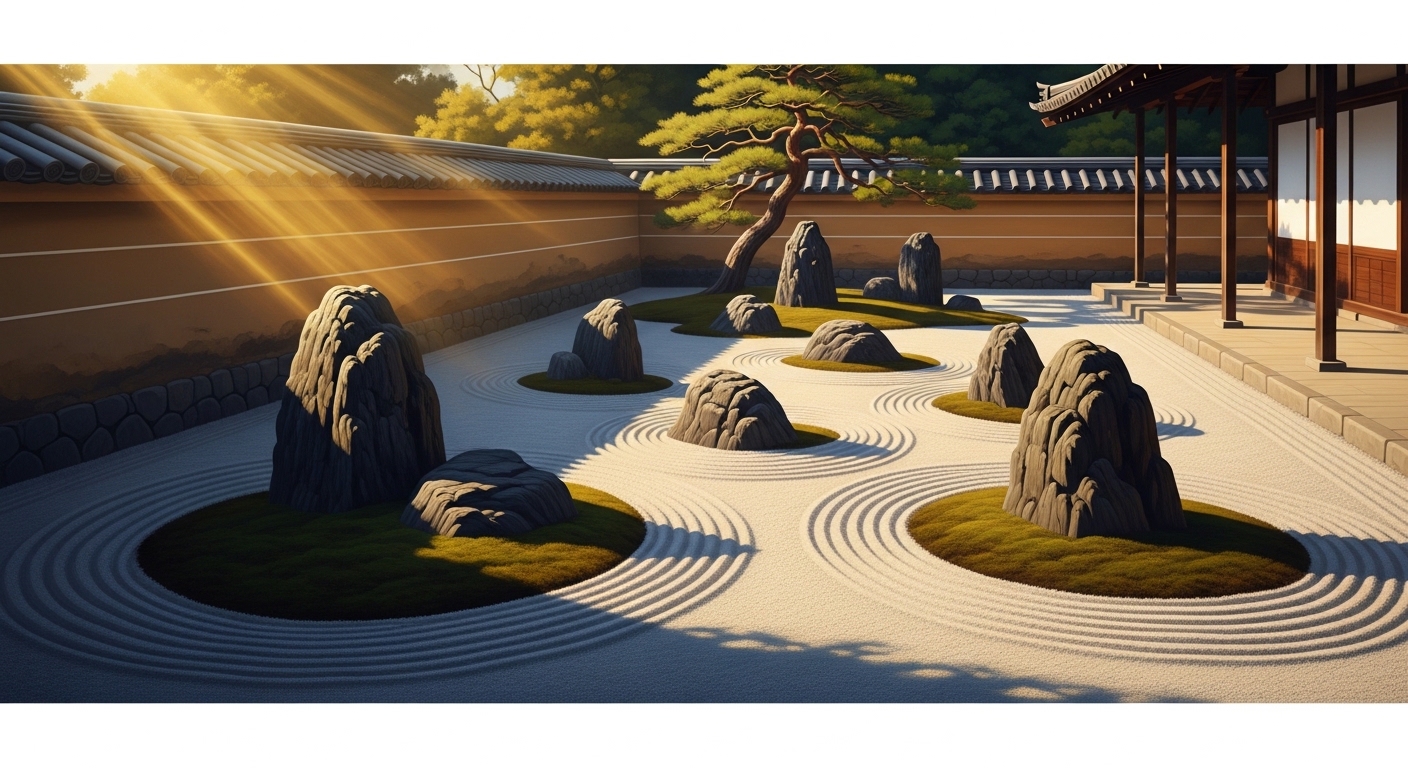
Fifteen stones. White gravel raked in parallel lines and around the stones in curves. Moss at the base of each stone. Nothing else.
The stones are arranged in five groups: five, two, three, two, three. The arrangement is not symmetrical. The groups are at different distances from the veranda, at different relationships to each other. The gravel between them has been raked into patterns that suggest — but only suggest — water, or thought, or the space between things.
From any position on the abbot’s veranda — from the far left, from the center, from the far right, from any spot along the thirty meters of wooden planking from which the garden can be viewed — exactly fourteen stones are visible. One is always hidden behind another.
To see all fifteen simultaneously, you would need to be at a height above the garden, looking down. Or you would need to not have a body, or a position, or a fixed vantage point. The stones are arranged so that full visibility is available only from a position that embodied human beings cannot occupy.
The designer — whose name has been lost, the attribution to Sōami or the painter Tōsa uncertain — created an object whose formal beauty is self-evident and whose theological content is precise. The garden is complete. The garden has all fifteen stones. But completeness, as experienced by any particular observer, is always one stone short.
This is the koan built into the garden’s geometry.
The Zen tradition that shaped this garden understands mu — emptiness, incompleteness, the fundamental openness of things — not as a deficiency but as the ground of possibility. The cup that has no bottom cannot be emptied. The garden that has one stone always hidden cannot be fully possessed by any one viewpoint. This is not a bug. It is the design.
Visitors to Ryōan-ji have been walking the veranda for five hundred years, counting stones. The garden’s patience with being counted is itself instructive. Count fourteen. Look for the fifteenth. Count fourteen again from a different position — a different one hidden this time. Move. Count again. The garden is not frustrating the observer. The garden is educating the observer in the nature of viewpoints.
The white gravel has been raked. It will be raked again tomorrow. The monks who maintain the garden rake in the early morning, before the temple opens to visitors, in the cool that comes before the Kyoto day heats up. The raking is not protective or decorative; it is the garden’s practice. The gravel raked into waves or concentric rings around stones is an act of cultivation equivalent to meditation: the precise repeated action that maintains the condition of the thing.
The stones do not need maintenance. They are stones.
But the white space between them — the ma, the interval, the emptiness that makes the stones stones rather than just rocks in a field — that requires the human practice of raking to maintain its quality.
The garden is empty.
The garden is full.
Fourteen stones and one you cannot see at once.
Scenes


Echoes Across Traditions
Entities
- the anonymous gardener (c. 1480 CE)
- the fifteen stones
- the white gravel
Sources
- Nitschke, Günter, *Japanese Gardens: Right Angle and Natural Form* (Taschen, 1993)
- Keane, Marc Peter, *Japanese Garden Design* (Tuttle, 1996)
- Pilgrim, Richard, 'Intervals (Ma) in Space and Time,' *History of Religions*, 1986
- Parkes, Graham, 'Ways of Japanese Thinking,' in *Nietzsche and Asian Thought* (University of Chicago, 1991)