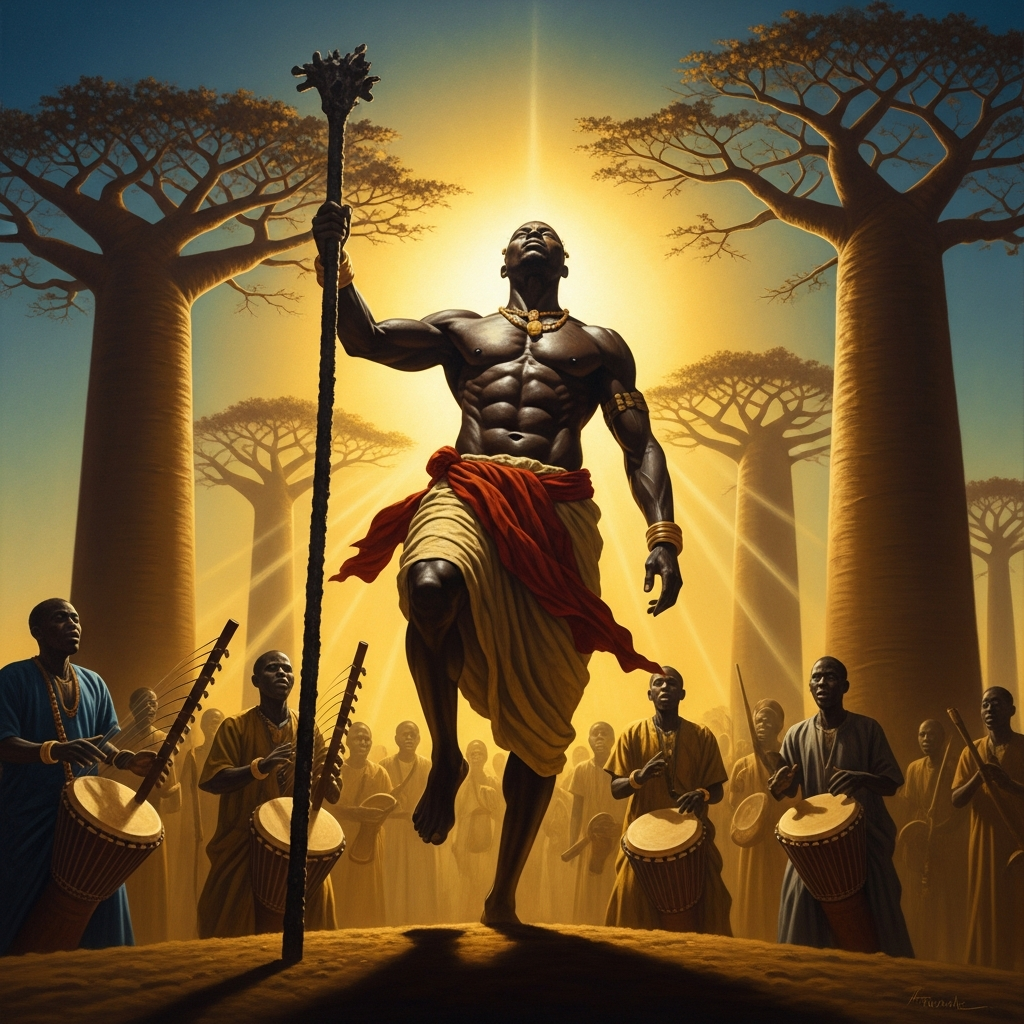
Sundiata: The Lion Who Could Not Walk
The historical Sundiata Keita c. 1217-1255 CE; the Battle of Kirina c. 1235 CE; the oral tradition of the *Sundiata* epic has been performed continuously since the 13th century · The Mande heartland in what is now Guinea and Mali; the court of the Keita kings at Niani; the exile in Mema; the battlefield of Kirina
Contents
Sundiata Keita cannot walk as a child. Jeered and exiled, he rises to defeat the sorcerer-king Soumaoro Kanté and found the Mali Empire. His story is kept alive by the griots who have recited it for eight centuries.
- When
- The historical Sundiata Keita c. 1217-1255 CE; the Battle of Kirina c. 1235 CE; the oral tradition of the *Sundiata* epic has been performed continuously since the 13th century
- Where
- The Mande heartland in what is now Guinea and Mali; the court of the Keita kings at Niani; the exile in Mema; the battlefield of Kirina
The griots begin like this.
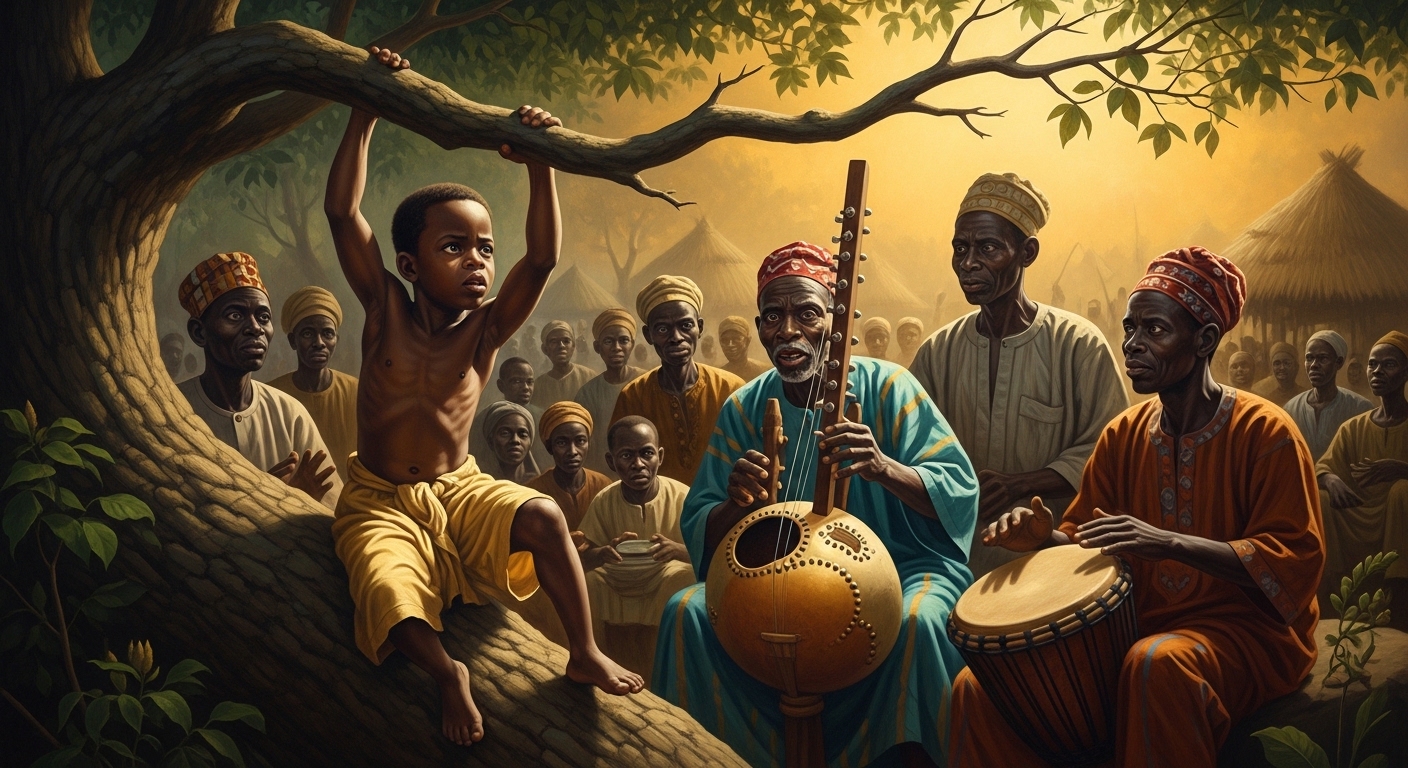
I am a griot. It is I, Djeli Mamoudou Kouyaté, son of Bintou Kouyaté and Djeli Kedian Kouyaté, master in the art of eloquence. Since time immemorial the Kouyatés have been in the service of the Keita princes of Mali. We are the vessels of speech, we are the repositories which harbor secrets many centuries old. The art of eloquence has no secrets for us; without us the names of kings would vanish into oblivion, we are the memory of mankind.
This is the voice in which the story arrives: not a narrator who stands outside the tale, but a griot who is inside the tradition that produced it, who is himself part of what the story is about. The griots are not merely telling a story. They are the institution that makes the story real. They are the reason Sundiata’s name has not vanished.
His mother is Sogolon.
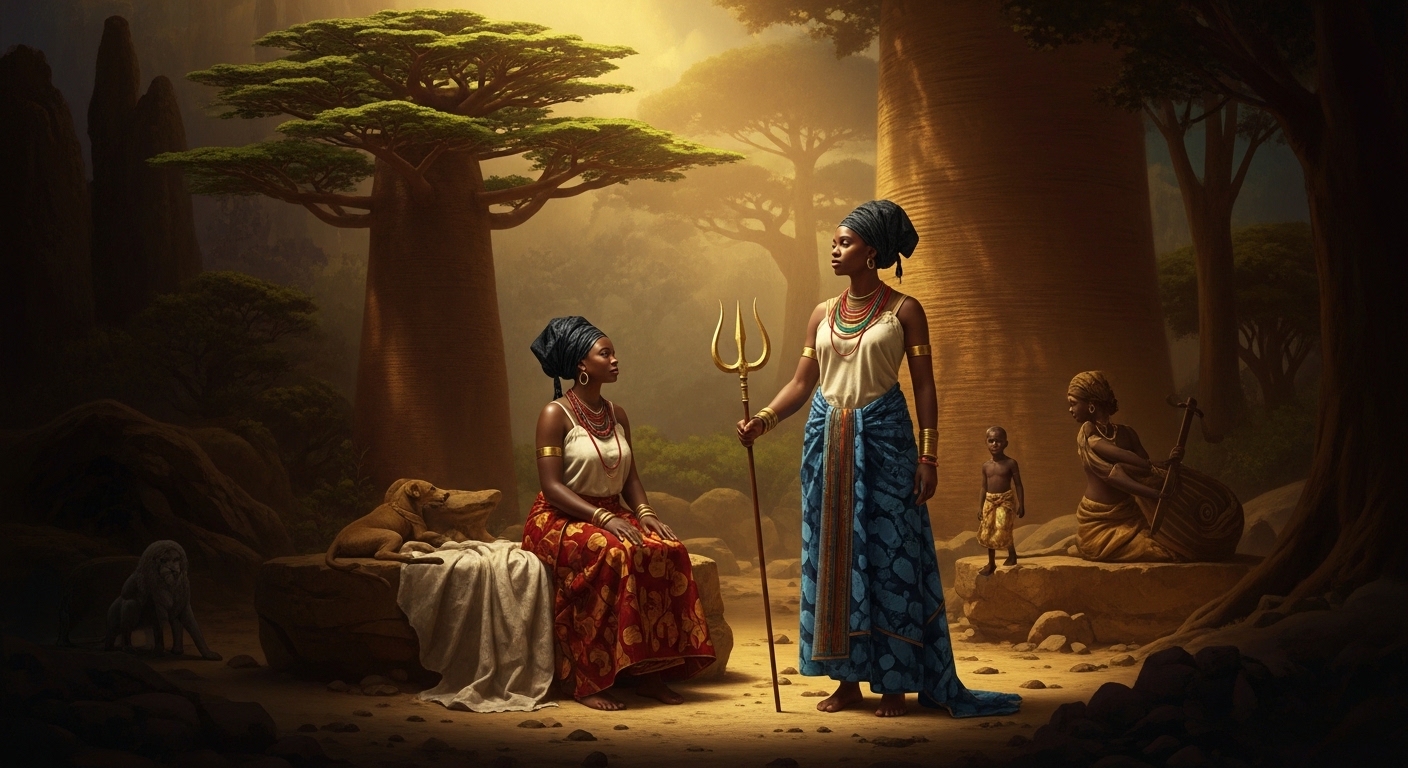
She is brought to King Naré Maghan Keita of Niani from a distant kingdom, carried by hunters who say she is a special woman. She is a hunchback. She is described as ugly. The king’s first wife, Sassouma Bereté, is beautiful and already has a son, and she watches Sogolon’s arrival with the attention of a woman who understands that this awkward stranger may be a threat.
Sogolon gives birth to a boy: Mari Djata, who will be called Sundiata, the Lion King.
The boy cannot walk.
He is three years old, seven years old, still crawling. Sassouma Bereté’s mockery grows into open humiliation: her son is heir apparent, her son stands on his own feet, her son does not require carrying. Sogolon weeps. She asks her son to rise. He cannot.
One day Sogolon needs baobab leaves for seasoning. Sassouma sends her to beg from the royal garden, knowing she will be refused and knowing the humiliation will be visible. Sogolon comes back empty-handed. Sundiata sees his mother cry.
He asks for his father’s iron staff.
The griot Balla Fasséké, who is Sundiata’s assigned griot from birth, watches. The men of the court watch. His mother watches. The iron staff is placed in the boy’s hands.
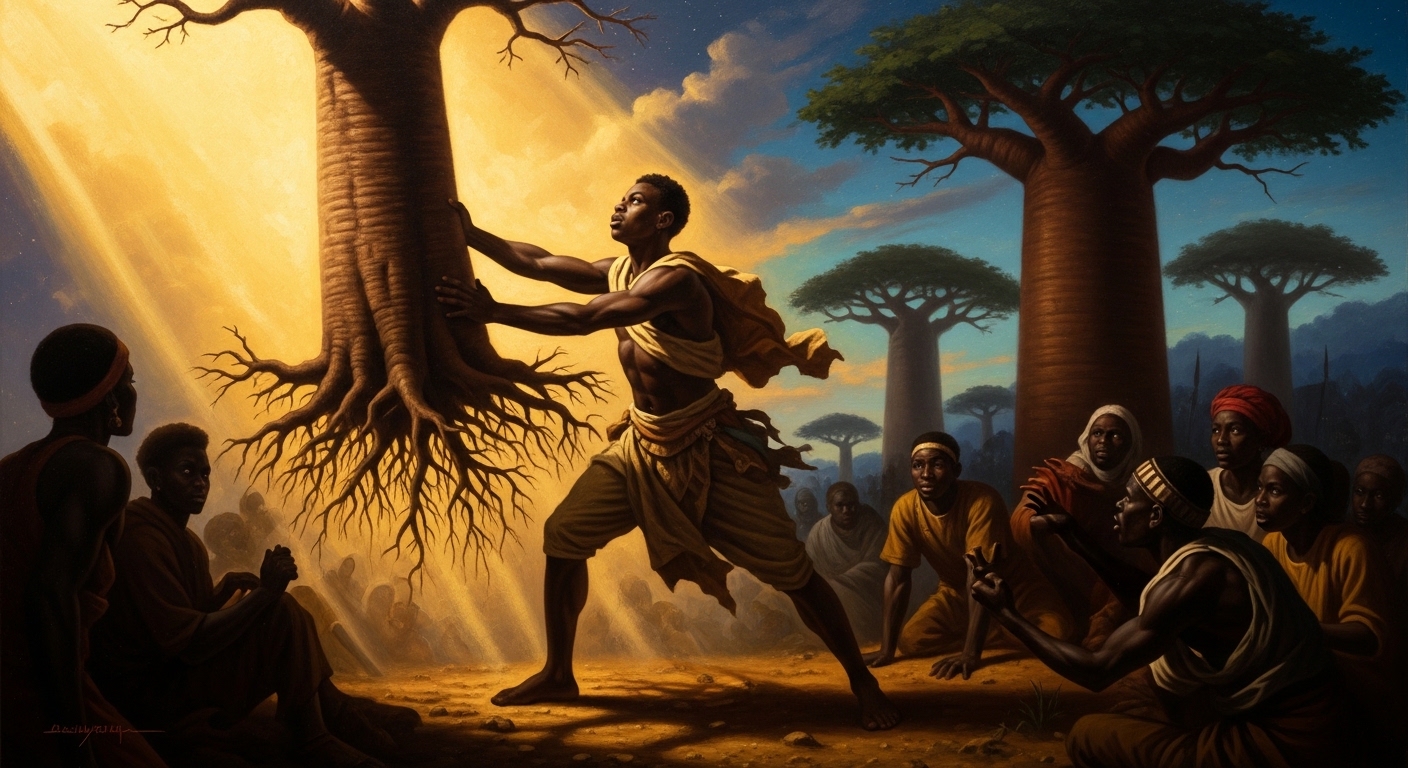
The Sundiata gives this moment without theatrical inflation: he grasps the staff, leans on it, tries to rise. The staff bends under the force he applies. His muscles strain. Then he straightens — slowly, completely — to his full height. He takes a step. He walks to the baobab tree. He pulls it out of the ground by the roots and carries it to his mother.
She will never need to beg for baobab leaves again.
His enemies immediately understand what this means.
Sassouma moves against Sogolon and Sundiata. The threats become real. Sogolon takes her children — Sundiata, his sisters, his younger brother — and goes into exile. They travel from court to court across the Mande world: to Djedeba, to Tabon, to Mema, where the king Moussa Tounkara receives them generously and watches Sundiata grow into the finest warrior he has ever trained.
Sundiata hunts lions. He learns military command. He grows famous in Mema, where people know him as the buffalo hunter, the warrior who makes the earth tremble when he runs.
In Niani, Soumaoro Kanté is destroying everything.
Soumaoro Kanté is the sorcerer-king of Sosso — a smith-king, which in Mande cosmology carries the highest spiritual power. The smiths are the masters of iron and fire, the transformers of raw material into tools and weapons, the mediators between the natural world and the human one. Soumaoro has taken this power to its extreme: he has defeated every king in the Mande world, he has taken their wealth and their wives, he has built a tower decorated with the skulls of the kings he has killed, and he maintains his power through bolon — sacred objects of occult force whose composition includes the most potent of materials.
He is not simply a powerful enemy. He is a spiritual problem. He can only be defeated by someone who finds his tana — the sacred prohibition, the specific weakness embedded in his power. No weapon forged of ordinary metal can stop him.
It is a woman who finds the weakness.
Nana Triban, one of Soumaoro’s wives, is actually Sundiata’s sister. She finds out through the intimacy of marriage what Soumaoro never intended to reveal: his tana involves the spur of a white rooster. This information reaches Sundiata through Balla Fasséké — his griot, who was taken captive by Soumaoro and who has been waiting for this moment.
Sundiata has an arrow made. The arrow is tipped with the rooster’s spur. He carries it to the Battle of Kirina.
The two armies meet. Soumaoro rides through the battle in his spiritual armor, impervious to arrows and spears. Sundiata draws the arrow tipped with the rooster’s spur and shoots. It grazes Soumaoro’s shoulder.
The graze is enough. The bolon breaks. Soumaoro’s power is interrupted. He flees. He runs into the mountains of Koulikoro, where — in some versions — he turns to stone. In others he simply disappears, as sorcerer-kings do when they are beaten: not destroyed but ended.
The battle is over.
Sundiata returns to Niani.
He is proclaimed ruler of the Mande world. The kings who submitted to Soumaoro and survived now come before him. The griots are there, singing his names and the names of his ancestors, establishing the lineage of his power in the language that lineage lives in: spoken, remembered, publicly performed.
He will found the Mali Empire, which by the fourteenth century will stretch from the Atlantic coast to the bend of the Niger River, encompassing the gold and salt trade routes that make it one of the wealthiest civilizations in the medieval world. His descendant Mansa Musa will travel to Mecca in 1324 with sixty thousand men and twelve thousand slaves, each carrying four pounds of gold, and so much gold will flow into Egypt during his visit that the Egyptian gold market will take twelve years to recover.
The epic is inseparable from the institution that maintains it.
The griots — jelilu in Mande, gewel in Wolof, guewel in other traditions — are the hereditary oral historians, musicians, praise-singers, and political advisors of West African society. They are born to the role; they are trained from childhood; they carry in memory the genealogies and histories and stories of the families they serve, going back centuries. They are present at births, deaths, marriages, coronations. They sing praises and they speak truth.
Balla Fasséké, Sundiata’s griot, is not a minor character in the epic. He is the story’s mechanism: the one who follows Sundiata into exile, who is captured by Soumaoro, who finds out the weakness, who returns at the right moment. He is also the reason the story exists at all. Without a griot following Sundiata, there is no transmission. Without transmission, there is no story. Without the story, Sundiata’s name has vanished into oblivion, as the opening says.
The griots are the memory of mankind.
The boy who could not walk bent the iron staff to pull himself upright.
This is the image the tradition keeps returning to: not the battle, not the empire, not the wealth. The child with the bent iron staff. The latent power that looked like helplessness until the moment it didn’t.
The story of Sundiata is the Mande world’s theory of hidden capacity: that what appears to be weakness is sometimes the dormant form of exceptional strength, and that the appropriate moment — the moment when strength is actually required — is when the weakness resolves. The enemies who mocked Sogolon’s crawling son were right about what they saw. They were wrong about what it meant.
You have to wait for the right moment.
The staff bends. The tree comes out of the ground. He stands up.
He is still standing.
Scenes
Echoes Across Traditions
Entities
- Sundiata Keita
- Soumaoro Kanté
- Sogolon
- Balla Fasséké
- Sassouma Bereté
- Fakoli
Sources
- Djibril Tamsir Niane, *Sundiata: An Epic of Old Mali* (1960, French; English trans. 1965)
- David C. Conrad, *Sunjata: A West African Epic of the Mande Peoples* (2004)
- Nehemia Levtzion, *Ancient Ghana and Mali* (1973)
- John William Johnson, *The Epic of Son-Jara* (1986)
- Lucy Durán, 'Jeliw: the griots of West Africa' in *The World's Great Epics* (1992)
- Ibn Battuta, *Rihla* (1355 CE) — historical Mali Empire account