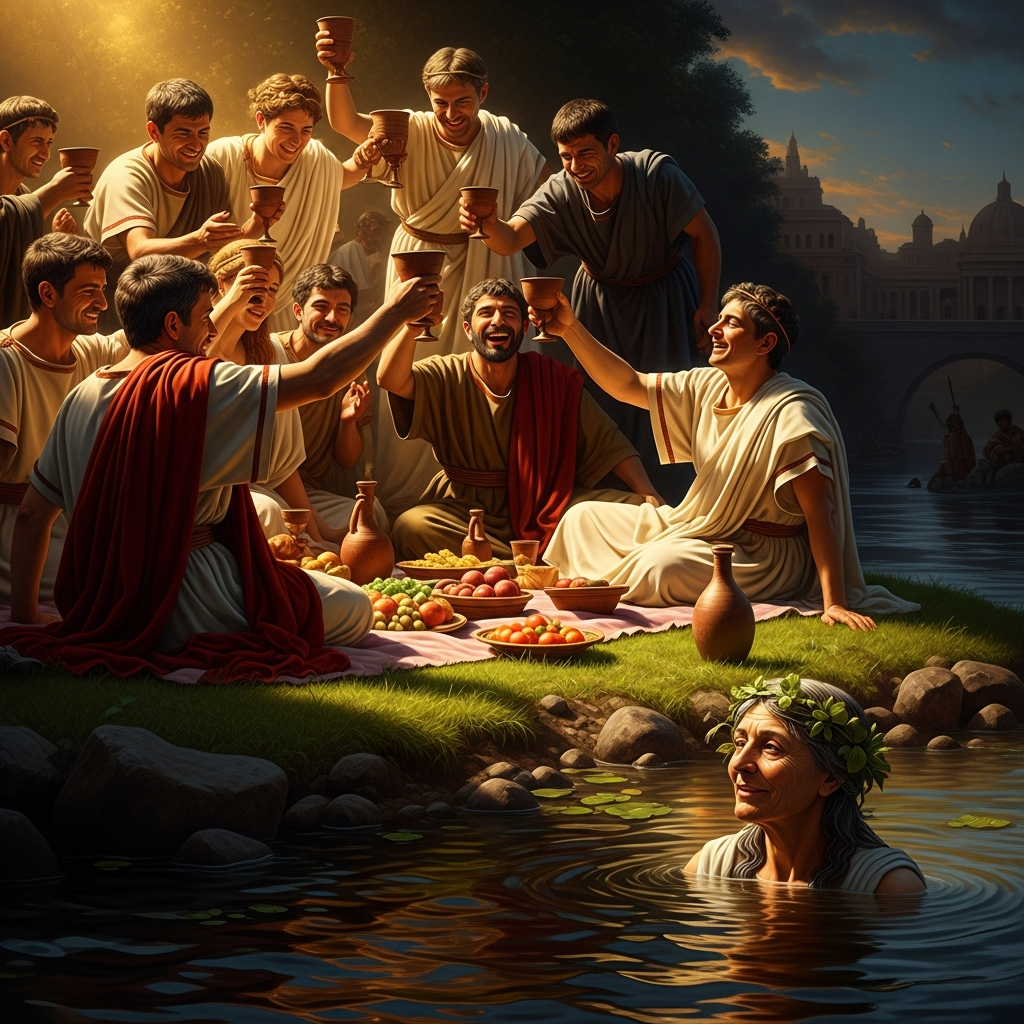
Anna Perenna by the Stream
Festival celebrated annually on the Ides of March (March 15th); Ovid composes the *Fasti* 8 CE; the secession of the plebs traditionally dated 494 BCE · A grove (*lucus*) on the bank of the Tiber river, just outside the first milestone north of Rome on the Via Flaminia
Contents
On the Ides of March the Romans walked out of the city to the riverbank, set up tents in the long grass, and prayed to Anna Perenna — goddess of the year, of the flowing stream, of old age — to grant them as many years as the cups they could drink. She had once been an old woman in a Latin village who carried bread to the Roman plebs in their starving secession. Ovid says she was also Dido's sister, washed up on the Italian coast after her sister's death, made a nymph of the river to escape Aeneas's jealous wife.
- When
- Festival celebrated annually on the Ides of March (March 15th); Ovid composes the *Fasti* 8 CE; the secession of the plebs traditionally dated 494 BCE
- Where
- A grove (*lucus*) on the bank of the Tiber river, just outside the first milestone north of Rome on the Via Flaminia
The Ides of March.
Caesar will be killed on this day in another generation, and the day will be remembered for it forever. But before Caesar — and after Caesar, all through the long Roman year — the Ides of March is the festival of Anna Perenna, and what Romans do on this day is walk out of the city.
They walk north up the Via Flaminia, past the first milestone, to a grove of trees on the bank of the Tiber. They bring tents — or they make tents out of branches and reeds and cloaks stretched over poles. They bring wine. They bring food. The married women come without their husbands or with their husbands; the unmarried girls come with the young men; the slaves come with the masters and on this day they sit on the same blanket. Ovid says you walk out of the city in the morning and you walk back into it in the evening drunk, and that the older you are when you walk back, the better — because you have prayed for as many years as cups you could drink, and you walked them back home in your own legs.
This is Anna Perenna.
The name is a phrase. Annus perennis — the year flowing through, the year that keeps coming. She is the year as a continuous river. She is also a river. She is also an old woman.
Ovid sits down to write about her in the Fasti and stops.
He does not know which version is right. He gives four. He keeps all of them, because what Anna Perenna is, in the Roman religious imagination, is the place where four different stories converge on a single old woman by a stream.
The first story.
The Roman plebs have seceded. This is 494 BCE — the patricians have refused them debt relief, and the entire plebeian class of Rome has walked out of the city to the Sacred Mount and is encamped there, refusing to come back, refusing to fight in the army, refusing to plant the fields. The patricians, suddenly without a workforce or a soldiery, panic. The plebs are starving on the Mount because they took only what they could carry.
In a small village near the Mount, an old woman named Anna gets up before dawn every day and bakes flat-cakes — libum, the simple Roman ritual cake of flour and honey — and walks them up to the camp. She does this every morning. She does not stop. The plebs eat. The secession holds. The patricians eventually negotiate, and the plebeians come back to Rome with the office of tribune in their pocket, and the Republic survives.
When Anna dies, the plebs, who have not forgotten, deify her. They make her a goddess — Anna Perenna, the year that keeps flowing — and put a grove on the riverbank in her honor.
That is the first story.
The second story.
Anna is the sister of Dido — the queen of Carthage, the woman Aeneas left, the woman who threw herself on her own sword on the pyre and called down a thousand-year curse on Aeneas’s descendants. Anna was at the pyre. Anna was the one Dido sent to fetch the kindling, not knowing why. After Carthage falls into chaos — a different chaos, internal, in the months after Dido’s death — Anna flees by sea and is shipwrecked on the Italian coast, near Lavinium, where Aeneas is now married to Lavinia and ruling.
Aeneas takes her in.
Lavinia, jealous of her husband’s old connection to Carthage, plans to murder Anna. Dido’s ghost appears to Anna at midnight — get up, get out, go now — and Anna runs from the house in her nightdress and reaches the river Numicius. The river-god takes her in, makes her a nymph, gives her a name in Italian:
Anna Perenna.
She is now a Roman river-goddess. She is also still Dido’s sister. The two stories sit side by side in the Fasti and Ovid does not pretend they reconcile.
The third story.
Anna is just an old peasant woman, no Carthaginian queen’s sister, no plebeian baker, just a country grandmother in the long memory of the Roman countryside. She is the goddess of the kind of feast that happens by the river when the weather has finally turned warm and people are tired of being indoors. She is what you pray to when you want one more spring.
The fourth story.
Anna is the moon — the cycle of the year as the cycle of the moon, the annus contained in the mensis. The festival on the Ides is on a full moon. The bank of the Tiber is full of fires. The drinking goes on until the moon has crossed the river and set behind the western hills, and Anna is the moon and the river and the year and the wine all at the same time.
Ovid keeps all four. He puts them in his book and lets them stand together. He is doing what Anna Perenna asks of her worshippers: do not narrow this. Drink the cup. Drink the next cup. Pray for the years.
The festival is loud.
This is the part the Roman moralists complain about. Married women drink with men who are not their husbands. Unmarried girls sing songs they would not sing in their fathers’ houses. The songs are obscena — obscene; specifically the kind of joking songs that ritualized obscenity, the same kind that surrounded weddings and triumphs, the laughter that the Romans believed was apotropaic, that warded off evil. There are dances. There are games. The young men carry the older women on their backs across the wet ground. Wine is poured into the river as offering and into the cups as prayer.
The prayer is specific.
You hold up the cup. You ask Anna Perenna for as many years of life as the cup contains in years — bibite, ut quot annos in vita supersint, totidem cyathos bibatis — and you drink. You hold up the next cup. You ask again. You drink again. The mathematics of the request becomes more optimistic as the afternoon wears on. By evening, the entire field on the riverbank is full of Romans of all classes who have been promised, by their own count, several centuries of life apiece.
Ovid, reporting all of this, is mostly delighted.
He is also reporting something the antiquarians around him were already starting to be embarrassed by — the festival is older than the city’s official religion, more rural than urban, more bodily than priestly. There are no temples to Anna Perenna in the official Roman sense. There is a grove. There is a stream. There is a stone with an inscription. There is a goddess who is, in some sense, just the river going by.
In 1999, Roman archaeologists excavating for an underground parking garage at the Piazza Euclide in northern Rome found her grove.
It had survived. The fountain — a small stone basin with a niche — was intact. Inside it were curse tablets (defixiones), folded lead, the names of the people whose enemies had been thrown to her keeping. There were hundreds of small lamps, dropped offerings, coins, and — strangest of all — small lead figurines of human bodies, twisted, pierced with nails, sealed inside lead containers, addressed to Anna Perenna by name.
Anna Perenna had two sides.
In the daylight, she was the picnic by the river — the cups raised, the years asked for, the obscene songs, the merging of social classes for one afternoon of wine. In the dark — by the stone basin in the grove — she was the place you came to address what you could not say in public. She kept the curses too. The same goddess of the flowing year, the same old woman, the same stream.
The stream still flows beside the modern street. The grove is now a park. The fountain has been excavated and is in the museum. The inscriptions — to ANNAE PERENNAE, in late Latin, fourth century, when the official religion was already Christian — are some of the latest pagan ritual objects ever found in the city of Rome.
She kept getting prayed to longer than the official gods did.
Anna Perenna is the deepest layer of Roman religion exposed — older than the Republic, older than the formal Olympian system, the village goddess who outlasted every emperor and most of the empire. She is what the Romans worshipped before they had a Senate. The festival on the Ides of March is what was already happening on that ridge above the Tiber when the city of Rome was a few wooden houses on a hill.
Ovid is doing something quietly important when he refuses to choose among the four versions of her. He is admitting, in the middle of the Fasti — a poem that is supposed to give the official explanation of every Roman festival — that some festivals do not have one explanation. Anna Perenna is the year, the river, the old woman, Dido’s sister, the bread-baker for the plebs, the moon over the riverbank, all at the same time. The point of her is the multiplicity. The point of her is that she is older than her own myths.
The festival is also, in a quiet way, the answer to the festival of the same day in Caesar’s afterlife. The Ides of March, after 44 BCE, becomes a black day in the Roman calendar — the day Caesar was killed, the day the Republic effectively ended. But the festival of Anna Perenna kept happening anyway, every Ides of March, on the same riverbank, with the same songs and the same cups, and the Roman people kept walking out of the city to drink with the old woman of the year. The murder of the dictator was the calendar’s blackest day. The drinking with Anna Perenna was the calendar’s brightest. Both happened on the same date for centuries, and the Romans seem to have understood — without theorizing it — that the two needed each other.
The grove is gone. The river is still there. The figure that lasts is the old woman with the flat-cake in her hand walking up the road to the Sacred Mount before dawn to feed people who do not know her name.
That is what the year flowing through actually looks like.
Echoes Across Traditions
Entities
- Anna Perenna
- Mars
- Aeneas
- Dido
- The Roman plebs

Sources
- Ovid, *Fasti* 3.523-696 (8 CE)
- Macrobius, *Saturnalia* 1.12.6
- Lydus, *De Mensibus* 4.36
- Inscriptional evidence from the Sacred Grove of Anna Perenna (excavated 1999, Piazza Euclide, Rome)


