Combat Profile
Standard of Mars
Carrying Mars's sacred standard, an army cannot be routed; even in defeat the soldiers retreat in good order, and the standard's recovery after loss restores the army to full morale
Father of Romans
Mars's protection extends to all Roman citizens by ancestral right; Roman soldiers gain bonuses to attack and defense in proportion to the legitimacy of their cause and the propriety of their pre-battle augury
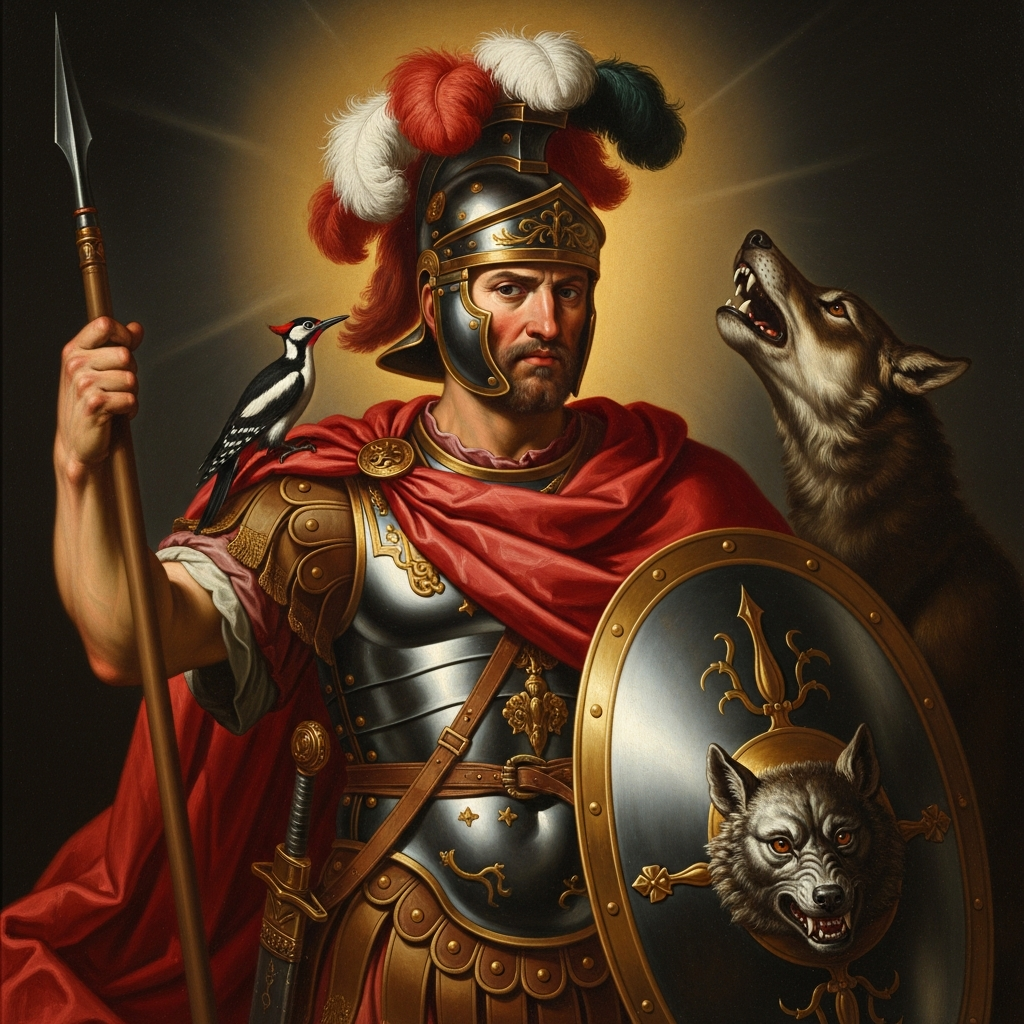
Mars is the Roman war-god, but he is not a Latin Ares. Where Ares is reckless, hated, and morally compromised — bloody-handed, cowardly, despised even by his fellow Olympians — Mars is dignified, agricultural, and a founding father of Rome. He is the father of Romulus, the protector of Rome, the second-most-important god in the Roman state cult after Jupiter. His month (March, Martius) was the original first month of the Roman year and the traditional opening of the campaigning season. His sacred animals were the wolf (which suckled his sons), the woodpecker, and the bull.
Crucially, Mars retained an older Italic identity as a god of agriculture alongside his war-function. Cato the Elder preserves a Mars-prayer for the welfare of the farm and the herds (De Agri Cultura 141), invoking Mars to protect against disease, bad weather, and crop failure. This dual war/agriculture function was unique to Mars among the major Mediterranean war-gods, and reflects the Roman reality: every Roman citizen was potentially a soldier and a farmer, and the same god protected him in both.
Biblical Parallels: Mars parallels the YHWH Tzeva’ot — “Yahweh of Hosts/Armies” — the warrior-aspect of the Hebrew God who marches with Israel into battle (Exodus 15:3, “the LORD is a man of war”). Mars’s combined war-and-agriculture function echoes the dual emphasis of Deuteronomic religion: God protects Israel in battle (Deuteronomy 20) and blesses the harvest (Deuteronomy 28). Both are protective deities of an entire people who must do both. The contrast with Greek Ares (divinely useless) is itself biblically resonant: Yahweh is presented as a competent divine warrior, not a contemptible one.
Cross-Tradition: Functionally closer to Norse Tyr (war-god of justice and oaths) and Vedic Indra (warrior-king-protector) than to Greek Ares. Cognate name with the Vedic Maruts (the storm-warrior band) and with the Indo-European war-band tradition. Hindu Karttikeya/Skanda (war-god, son of Shiva) is a parallel war-god-of-the-people figure.
1 min read