Combat Profile
Irresistible Desire
all who perceive this entity must succeed a divine save or become consumed by overwhelming attraction and compulsion
Born of Chaos
exists outside normal mortality; their very presence warps mortal judgment and binds gods and mortals alike to their will through love and lust
The same desire she inspires; her own infidelity to Hephaestus
“The people of Lystra called Barnabas Zeus, and Paul Hermes, because Paul was the chief speaker.” — Acts 14:12
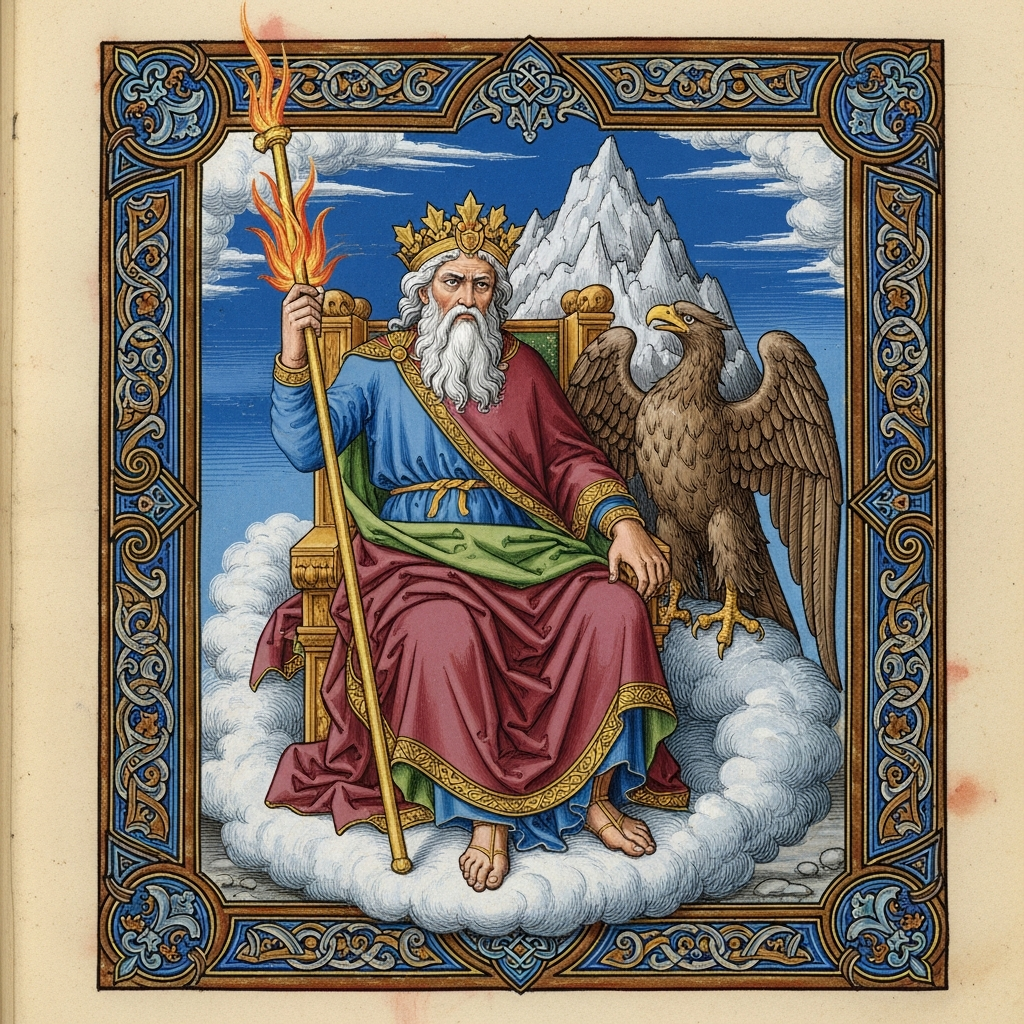
Zeus is the sky-father, thunder-wielder, king of gods and men — the closest Greek analogue to the popular image of God the Father (enthroned, bearded, commanding the heavens). But the parallels are superficial and the differences are everything. Zeus is one god among many; YHWH is the only God. Zeus is subject to Fate; YHWH ordains fate. Zeus is morally compromised — adulterous, vindictive, petty; YHWH is presented as morally perfect. The most significant biblical connection is Acts 14:12, where the citizens of Lystra witness Paul and Barnabas perform a miracle and immediately identify them as Hermes and Zeus. This reveals how deeply Greco-Roman religion shaped the cognitive framework of Paul’s audience: they could only interpret divine power through the categories they already had. Paul’s task was to redirect that recognition toward the true God.
Biblical Parallel: God the Father (popular imagery, not theology); Acts 14:12 (Barnabas mistaken for Zeus); the “unknown god” of Acts 17:23.
“On this rock I will build my church, and the gates of Hades shall not prevail against it.” — Matthew 16:18
Hades is not Satan. This is the single most important distinction. In Greek mythology, Hades is not evil — he is the god who received the underworld when the three brothers (Zeus, Poseidon, Hades) divided the cosmos by lot. He is stern, implacable, and just. The dead go to him not as punishment but as natural course. The NT uses “Hades” (ᾅδης) as the Greek equivalent of the Hebrew Sheol — the realm of the dead, not a place of punishment but a place of waiting. Jesus’s statement in Matt 16:18 uses the image of Hades as a fortified city with gates, declaring that his church will storm those gates and prevail. Revelation 1:18 declares Christ holds “the keys of Death and Hades.” In Rev 20:13-14, Death and Hades are thrown into the lake of fire — they are not demons but cosmic conditions that are abolished at the end of time.
Biblical Parallel: Sheol (Hebrew underworld); the “gates of Hades” (Matt 16:18); “Death and Hades” as a pair (Rev 6:8, 20:13-14); Christ holding the keys (Rev 1:18).
“I am Dionysus, the son of Zeus.” — Euripides, The Bacchae
Dionysus is the most debated parallel to Christ in the history of comparative religion. The overlaps are remarkable: born of a divine father (Zeus) and a mortal mother (Semele); associated with wine; died, descended to the underworld, and was resurrected; offered his followers mystical union with the divine through ritual consumption of wine; was simultaneously fully divine and connected to human flesh. The Orphic tradition holds that Dionysus (as Zagreus) was torn apart by the Titans and reconstituted — a death-and-resurrection narrative predating Christianity by centuries. However: the differences are equally profound. Dionysus’s cult is ecstatic, orgiastic, and violent; Christ’s message centers on love and self-sacrifice. Dionysus’s resurrection is cyclical (tied to the vine’s seasonal death and rebirth); Christ’s resurrection is a singular, historical, unrepeatable event. The early Church Fathers were aware of the parallels — Justin Martyr (2nd century) argued that demons planted fake resemblances in pagan myths to confuse future believers.
Biblical Parallel: Christ’s association with wine (John 2, Last Supper); death, descent, and resurrection; divine-human dual nature; Justin Martyr’s “diabolical mimicry” argument.
“They called Paul Hermes, because he was the chief speaker.” — Acts 14:12
Hermes is the divine messenger — swift, eloquent, the intermediary between gods and mortals. He is also the psychopomp, the guide of dead souls to the underworld. The parallel to the archangel Gabriel is functional: both serve as the primary channel of communication between the supreme deity and humanity. Gabriel announces to Daniel, Zechariah, and Mary; Hermes delivers Zeus’s commands to gods and mortals alike. The Acts 14:12 passage is especially revealing: the people of Lystra, hearing Paul speak with authority and eloquence, identified him as Hermes — the divine speaker — while Barnabas, the more imposing figure, was called Zeus. This tells us that the messenger-of-god archetype was so deeply embedded in Greek culture that it was the first framework people reached for when encountering Christian preaching.
Biblical Parallel: Gabriel (divine messenger); the Angel of Death / psychopomp tradition; Acts 14:12 (Paul called Hermes); Hermes’s caduceus (parallels Moses’s staff/serpent).
“From his own head he bore bright-eyed Athena.” — Hesiod, Theogony
Athena was born fully formed from the head of Zeus — wisdom emerging directly from the mind of the supreme god without a mother’s mediation (Theogony 886-900). This parallels the figure of Sophia (Wisdom) in Proverbs 8:22-31, who declares: “The LORD brought me forth as the first of his works, before his deeds of old; I was formed long ages ago, at the very beginning, when the world came to be.” Sophia is personified as female, pre-existent, present at creation, and delighting in humanity — strikingly similar to Athena’s role as the wise counselor who favors civilization and human achievement (Odyssey 1.47-48). In the later Wisdom of Solomon (a Hellenistic Jewish text), Sophia becomes even more Athena-like: she is “a breath of the power of God” who “orders all things well” (Wisdom 7:25, 8:1). The early Christians, writing in Greek, would have recognized the parallel immediately — which may be one reason John’s Gospel chose Logos (Word) rather than Sophia (Wisdom) for Christ’s pre-existent identity: to avoid the feminine personification (Gospel of John 1:1-3).
Biblical Parallel: Sophia/Wisdom (Proverbs 8, Wisdom of Solomon 7-8); the Logos concept (John 1:1) as an alternative to the Sophia tradition.
“Of all the gods who dwell on Olympus, you are the most hateful to me.” — Zeus to Ares, Iliad 5.890
Ares is war stripped of glory — raw carnage, bloodlust, the scream of the dying. Homer makes him the most despised Olympian; even his father Zeus hates him (Iliad 5.846-909). He is repeatedly defeated in the Iliad — by Athena, by Diomedes (a mortal!), and humiliated by Hephaestus. This makes Ares the anti-parallel to the archangel Michael. Both are associated with war, but Michael fights with divine authority, righteousness, and cosmic purpose (Rev 12:7); Ares fights for the joy of killing. Michael represents war as sacred duty; Ares represents war as moral failure. The contrast is deliberate in the Christian imagination: heaven’s warrior is disciplined, obedient, just; the pagan war-god is undisciplined, hated, and futile. Ares is what war looks like without God.
Biblical Parallel: Contrast with Michael (Rev 12:7); the “man of war” imagery applied to YHWH (Exod 15:3) is closer to Athena’s strategic warfare than Ares’s frenzy.
“Then the famous lame god made the shield, broad and sturdy, with cunning art.” — Iliad 18.478
Hephaestus is the only physically imperfect Olympian — thrown from Olympus by Hera (or Zeus) in disgust at his deformity, he landed on Lemnos and rebuilt himself in the volcano’s forge (Iliad 1.590-594). He is the divine artisan: he forged Achilles’s shield (Iliad 18.478-608), Zeus’s thunderbolts, Hermes’s helmet, Hades’s helm of invisibility, and the throne that trapped Hera in golden chains until she begged forgiveness for casting him out. He is married to Aphrodite, who notoriously cuckolds him with Ares; he traps the lovers in an unbreakable golden net and exposes them to the laughter of the gods (Odyssey 8.266-366). He is the patron of every limping smith in human history.
Biblical Parallel: Tubal-Cain (“forger of all instruments of bronze and iron,” Genesis 4:22), the first metalworker in scripture; Bezalel (the divinely-gifted craftsman of the tabernacle, Exodus 31:1-5); the wider mythological pattern of the wounded smith-god (Norse Wayland, Vedic Tvastar, Egyptian Ptah).
“Hecate, whom Zeus the son of Cronos honored above all. He gave her splendid gifts, to have a share of the earth and the unfruitful sea.” — Hesiod, Theogony 412-413
Hecate stands apart from the Olympian system — a Titan Zeus chose to honor rather than overthrow (Theogony 411-452). She holds power in heaven, on earth, and in the sea simultaneously, and she is the only deity who freely traverses the underworld. In the Homeric Hymn to Demeter, she is the only god (besides Helios) who hears Persephone’s abduction-cry, and she becomes Persephone’s eternal companion in Hades. By the Hellenistic era, she had absorbed every magical, ghostly, and uncanny association in the Greek imagination: triple-formed (one face for each direction at the crossroads), torch-bearing, attended by spectral hounds, summoned by the Greek Magical Papyri for love spells and curses alike.
Biblical Parallel: The medium of Endor (1 Samuel 28) — a witch summoning the dead, exactly Hecate’s domain; the broader biblical prohibition of necromancy (Deuteronomy 18:10-12); Acts 19:19 (the Ephesian magicians burning their books) suggests the kind of Hecate-adjacent practice early Christianity confronted directly.
“He sent a deadly plague upon the army, and the people were perishing.” — Iliad 1.10
Apollo is the most multifaceted Olympian: god of the sun (after absorbing Helios in later mythology), prophecy (Delphi was his oracle), music (he plays the lyre), poetry (the Muses serve him), healing (his son is Asclepius), and plague (his arrows brought the Iliad’s opening epidemic, Iliad 1.43-52). He killed the Python at Delphi, established the Pythian Games, and was the patron of Greek civic and intellectual life like no other god. The Delphic injunctions — Know thyself, Nothing in excess — are his.
Biblical Parallel: Acts 16:16 — Paul exorcises a slave girl with “a Pythian spirit” (literally a “Python-spirit,” referring to Apollo’s oracle), explicitly framing Apollo’s prophetic apparatus as demonic; the Sun of Righteousness (Malachi 4:2) is a Christian appropriation of solar imagery Apollo had owned in Greece.
“Great is Artemis of the Ephesians!” — Acts 19:28 (the riot in Ephesus)
Artemis is virgin huntress, lady of wild places, and bringer of the sudden, painless death of women in childbirth (where her brother Apollo brings the equivalent for men). She turned Actaeon into a stag and let his own hounds tear him apart for glimpsing her bathing (Ovid, Metamorphoses 3.138-252). She demanded the sacrifice of Iphigenia before the Greek fleet could sail to Troy. At Ephesus, her cult merged with an Anatolian mother-goddess, producing the multi-breasted “Artemis of the Ephesians” whose silver shrines made the silversmiths rich — until Paul’s preaching threatened the trade and triggered a city-wide riot (Acts 19:23-41).
Biblical Parallel: Acts 19:23-41 (the Ephesian riot is the most direct NT confrontation with a named Greek deity); the broader pattern of “the queen of heaven” cults (Jeremiah 7:18, 44:17-25) which Hellenistic Judaism associated with the Artemis-Astarte-Cybele complex.
“Father Zeus, none of the gods can equal Poseidon; only the sea-god holds against him.” — Homeric tradition
Poseidon received the sea when the three brothers cast lots after dethroning Kronos (Iliad 15.187-193). He wields the trident, drives a chariot of seahorses across the waves, and shakes the earth when angry — earthquakes are his fingerprints. He is Odysseus’s chief antagonist throughout the Odyssey, refusing to let the hero return home after Odysseus blinded his son Polyphemus. He created the horse, contested Athens with Athena (offering a saltwater spring; she offered the olive tree and won), and fathered countless monstrous offspring including Pegasus.
Biblical Parallel: YHWH’s mastery of the sea (Psalm 89:9, “You rule the raging of the sea; when its waves rise, you still them”); Christ stilling the storm (Mark 4:39) and walking on water (Matthew 14:25) — direct claims to authority Greeks would have attributed to Poseidon; Acts 27 (Paul’s shipwreck) is set in waters Greco-Roman culture saw as Poseidon’s domain.
“White-armed Hera was angered, and she shook on her throne, and the high Olympus quaked.” — Iliad 8.198
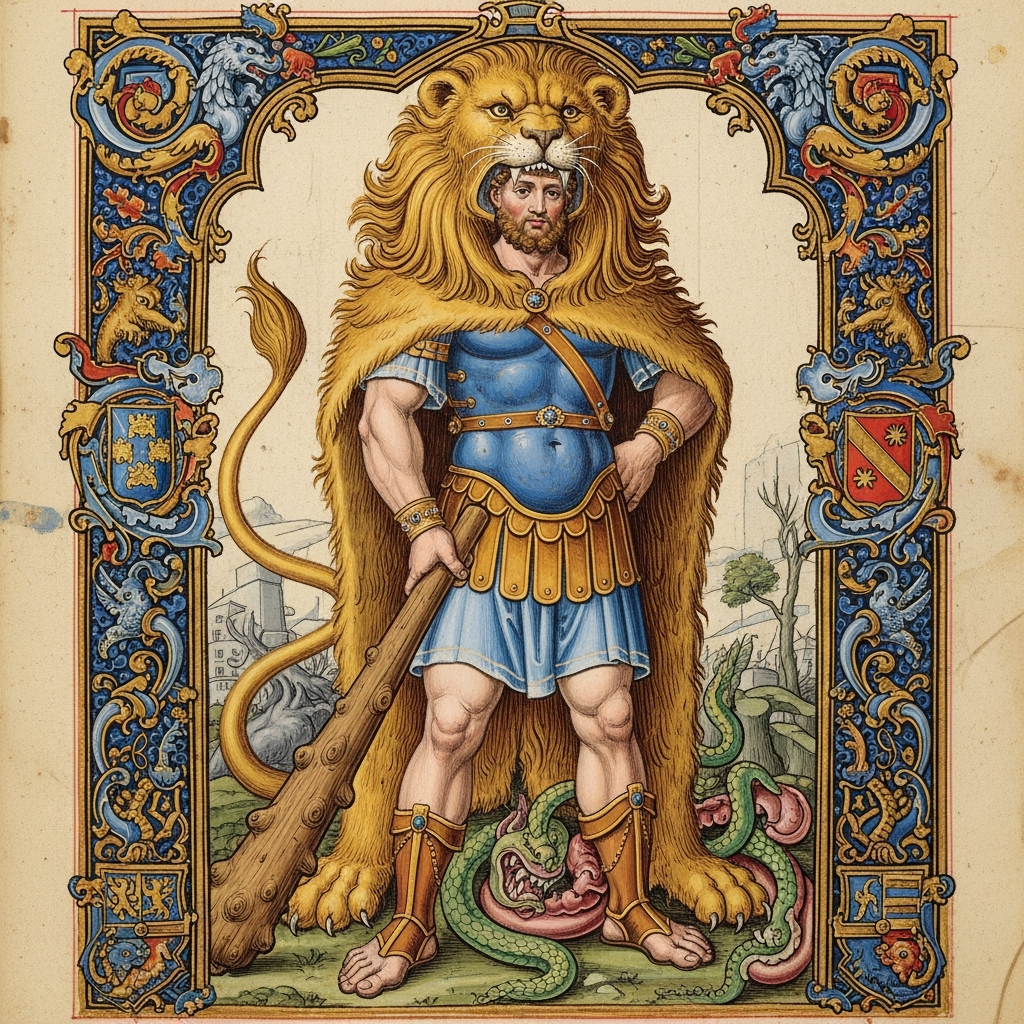
Hera is the goddess of marriage and the divine sovereign-queen, but her surviving mythology is dominated by her vengeance against Zeus’s countless infidelities and the children produced from them. She drives Heracles mad and engineers his Twelve Labors, persecutes Leto until no land will accept her (forcing the floating island of Delos to host Apollo and Artemis’s birth), and turns Io into a cow. Yet she is also the patron of legitimate marriage, the protector of wives, and one of only three Olympians (with Athena and Hestia) who oversee the binding social contracts that hold civilization together.
Biblical Parallel: The Bride / Wife of YHWH imagery applied to Israel and the Church (Hosea 2; Ephesians 5:22-32; Revelation 21:9) inverts Hera’s pattern — the divine husband is the faithful party in scripture, while Hera’s husband is the unfaithful one; the “queen of heaven” condemnations in Jeremiah 7:18 likely refer to Astarte/Ishtar but echo Hera’s title.
“I am Demeter, who has bestowed the greatest gifts upon mortals.” — Homeric Hymn to Demeter 268
Demeter is the goddess of the grain, the cycle of planting and harvest, and the central figure of the Eleusinian Mysteries — the most important mystery cult of the ancient Mediterranean, lasting nearly two millennia until Theodosius shut it down in 392 CE. The myth is grief incarnate: when Hades abducted her daughter Persephone, Demeter refused to let anything grow until her daughter was returned. Zeus brokered the compromise: Persephone spends part of the year underground (winter) and part with her mother (spring/summer). The Mysteries reenacted this myth and promised initiates a blessed afterlife. Cicero said the Mysteries gave Athens not only “the principles of life” but “the grounds of dying with hope.”
Biblical Parallel: Christ as “the grain of wheat that falls into the ground and dies, but if it dies, it bears much fruit” (John 12:24) — the agricultural death-and-rebirth pattern that Demeter and Persephone had owned for centuries; the harvest imagery applied to the Kingdom of God (Matthew 13:24-30, the parable of the wheat and tares); 1 Corinthians 15:36-38 (Paul on resurrection: “what you sow does not come to life unless it dies”).
“Sweet desire seized hold of him, and he longed to lie in love with her.” — Homeric Hymn to Aphrodite 91
Aphrodite is born from violence: when Kronos castrated his father Ouranos and cast the severed genitals into the sea, the foam (aphros) produced the goddess of love (Theogony 188-206). Her power is the compulsion of desire itself — not romance but the irresistible, often destructive pull. She causes the Trojan War by promising Helen to Paris. She has affairs with Ares (caught in Hephaestus’s golden net), Anchises (producing Aeneas), and Adonis (whose death by boar she cannot prevent). Her chief Greek cult center was Corinth, where her temple housed sacred prostitutes — and where Paul wrote 1 Corinthians, including its extensive teaching on sexual ethics, addressing a city saturated in her cult.
Biblical Parallel: Paul’s teaching on porneia in 1 Corinthians 6:12-20 directly confronts Aphrodite’s Corinth (“flee from sexual immorality… your body is a temple of the Holy Spirit”); the contrast between eros (Aphrodite’s domain) and agape (Christian love, 1 John 4:8); Solomon’s “do not arouse love until it pleases” (Song of Songs 8:4) is the Hebrew wisdom tradition’s response to the Aphrodite archetype.
11 min read
Hephaestus's net (the only thing that ever held her down)
Hesiod, *Theogony* 188-206; Homer, *Iliad* & *Odyssey*; Homeric Hymn to Aphrodite; Acts 18:1-18 (Corinth, her cult center)