Combat Profile
Eternal Binding
traps souls and entities in inescapable cosmic prisons from which even gods struggle to break free
Abyss Incarnate
all within this domain are subject to absolute judgment and cannot escape through mortal means
None -- it is the final containment
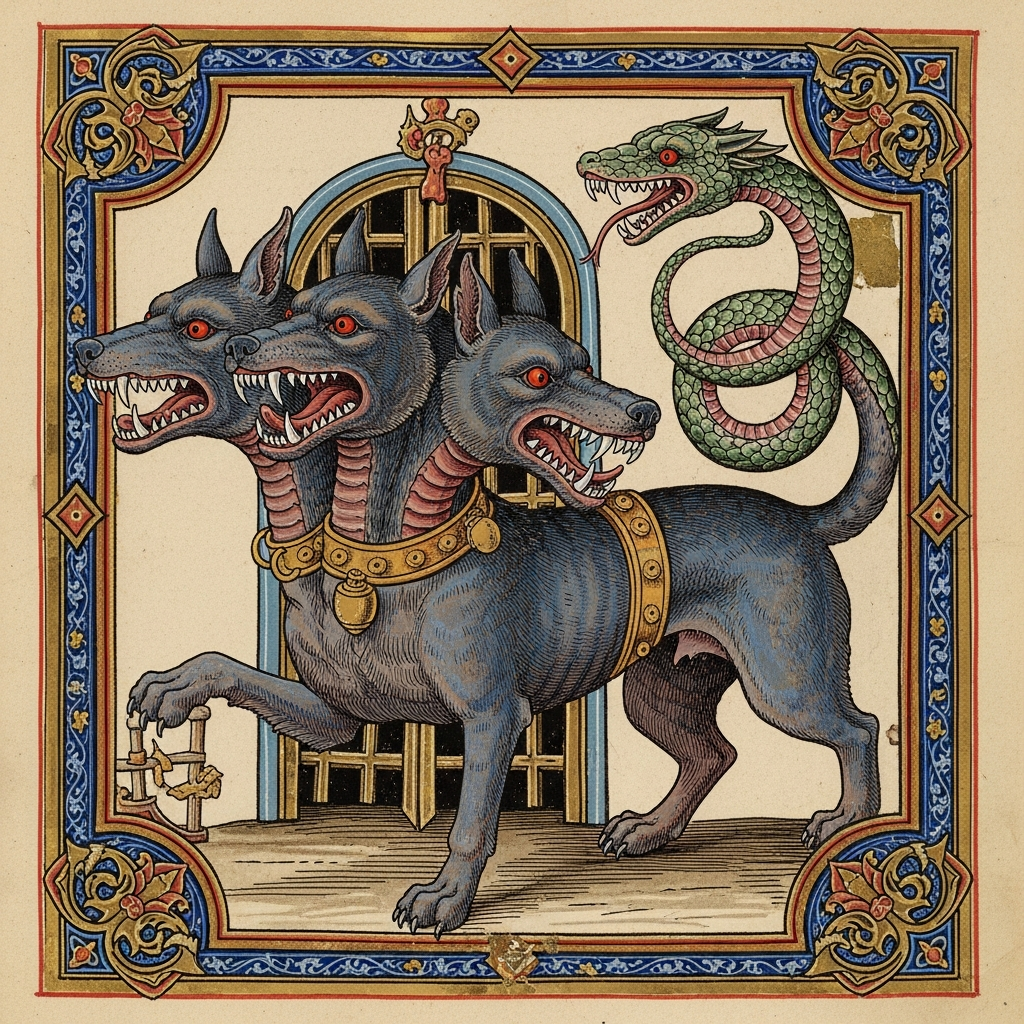
“The monstrous hound of Hades, fifty-headed, relentless and strong.” — Hesiod (later tradition settled on three heads)
Cerberus guards the gates of Hades, ensuring the dead cannot leave and the living cannot enter unbidden (Theogony 311-312). He is the mythological threshold guardian — the entity posted at the boundary between realms. The biblical parallel is the Cherubim with the flaming sword guarding the entrance to Eden (Genesis 3:24). Both serve identical functions: they enforce divine boundaries. Humans were expelled from paradise (Eden/the surface world) and a terrifying guardian ensures they cannot return by their own power. The three-headed motif may also connect to the multiplied faces of the Cherubim in Ezekiel 1 (each has four faces — human, lion, ox, eagle). Both Cerberus and the Cherubim are composite, monstrous, and placed at the most sacred of thresholds.
Biblical Parallel: Cherubim guarding Eden (Gen 3:24); the guarded thresholds of sacred space (the Temple veil, the sealed tomb).
“The grim ferryman guards the waters, terrible in his squalor.” — Virgil, Aeneid
Charon ferries the dead across the River Styx (or Acheron) to the realm of Hades (Aeneid 6.298-316). The Greeks placed coins on the eyes of the dead to pay his fare; those without payment wandered the shores for a hundred years. Charon is a psychopomp — a guide of souls to the afterlife. This function parallels the Angel of Death in Jewish tradition, who separates the soul from the body at the moment of death (Exodus 12:23), and the angel Dumah, who in the Talmud guards the dead in Sheol. The broader psychopomp tradition (Hermes, Charon, Valkyries, the Angel of Death) reveals a near-universal human intuition: dying is a journey, and you do not make it alone (Luke 16:22). Someone — or something — comes for you.
Biblical Parallel: The Angel of Death (Exodus 12:23); Dumah (Talmudic guardian of the dead); Abraham’s bosom (Luke 16:22, where angels carry Lazarus).
“We are the Furies. We hunt those who spill kindred blood.”
The Erinyes (Alecto, Megaera, Tisiphone) are born from the blood of Ouranos when Kronos castrated him — vengeance as old as creation itself (Theogony 185-187). They pursue anyone who murders family, breaks sacred oaths, or offends the natural order. They do not judge; they punish. They are relentless, incapable of mercy, and cannot be bargained with (Oresteia 1.65-140). This parallels the avenging angels of biblical tradition — the destroying angel sent against Egypt (Exodus 12:23), the angels who destroy Sodom (Genesis 19), the seven angels with seven plagues (Revelation 15-16). It also parallels the concept of divine wrath (orge theou) in Paul’s letters (Romans 1:18): “The wrath of God is revealed from heaven against all ungodliness.” The key difference: in Aeschylus’s Eumenides, Athena tames the Furies into the “Kindly Ones” through civic law and persuasion — vengeance is transformed into justice (Eumenides 794-807). In Christianity, the parallel transformation is the cross: God’s wrath is satisfied not by pursuing the sinner but by absorbing the punishment himself.
Biblical Parallel: The destroying angel (Exod 12:23); angels of Sodom’s destruction (Gen 19); the wrath of God (Rom 1:18); the seven plague-angels (Rev 15-16).
“For if God did not spare the angels who sinned, but cast them into Tartarus [ταρταρώσας], and committed them to chains of gloomy darkness…” — 2 Peter 2:4
Tartarus is the deepest pit of the Greek underworld — as far below Hades as heaven is above the earth (Iliad 8.13-16). It is where Zeus imprisoned the Titans after the Titanomachy (Theogony 713-735) and where the worst offenders against the gods are eternally punished (Sisyphus, Tantalus, Ixion). This is the single most important entry in this section, because 2 Peter 2:4 actually uses the Greek verb tartaroo (ταρταρώσας) — “to cast into Tartarus.” It is the only time a term from Greek mythology is used in the New Testament (2 Peter 2:4). The author of 2 Peter, writing to a Greek-speaking audience, chose a word his readers would understand viscerally: the place where the Titans are imprisoned is where God cast the fallen angels. This is not a casual borrowing — it is a deliberate theological statement that maps the Greek cosmic prison onto the biblical framework. The Titans rebelled against Zeus and were imprisoned in Tartarus; the Watchers rebelled against God and were imprisoned in Tartarus. Same crime, same sentence, same word.
Biblical Parallel: 2 Peter 2:4 (the only use of “Tartarus” in the NT); Jude 1:6 (angels kept in chains); the Abyss (abyssos) of Revelation 9:1-2, 20:1-3; 1 Enoch 10:4-6 (Azazel bound in darkness).
3 min read
None -- nothing escapes Tartarus
Hesiod, *Theogony* 713-735; Homer, *Iliad* 8.13; **2 Peter 2:4**