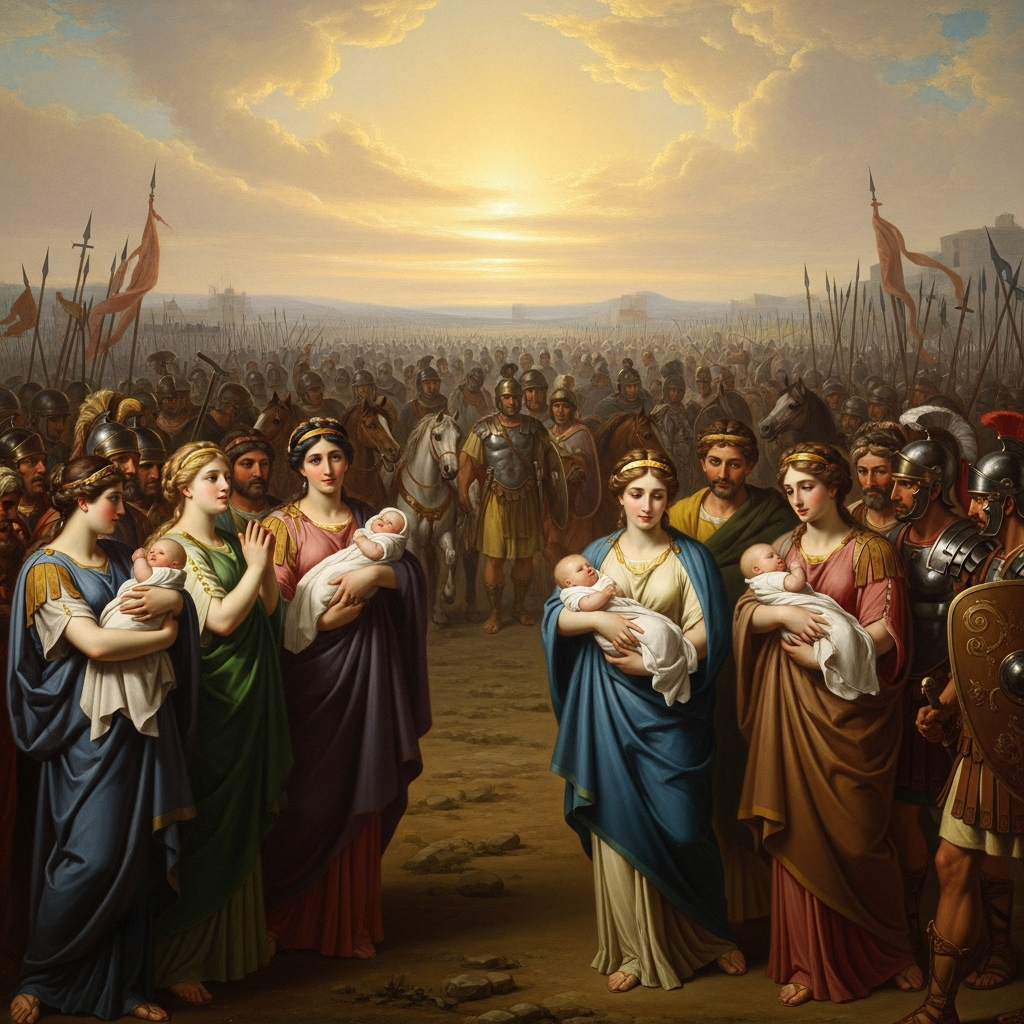
The Sabine Women Between the Armies
Mythic founding period — traditionally placed in the first generation of Rome's existence, c. 750 BCE · The valley between the Palatine Hill (the Roman settlement) and the Capitoline Hill (held by the Sabines), which would become the Roman Forum
Contents
The Romans, a city of men with no wives, hold a festival and invite their Sabine neighbors. At Romulus's signal the young men seize the unmarried Sabine women and carry them off into Rome. Years later the Sabine fathers come back armed for war. The two armies meet in the Forum — and the abducted women, now mothers, walk between them with their babies in their arms and refuse to let either side strike.
- When
- Mythic founding period — traditionally placed in the first generation of Rome's existence, c. 750 BCE
- Where
- The valley between the Palatine Hill (the Roman settlement) and the Capitoline Hill (held by the Sabines), which would become the Roman Forum
In the first year, Rome has no women.
Romulus has built his city — drawn the line of the wall, killed his brother for crossing it, opened the gates to fugitives and slaves and the unwanted men of every neighbouring tribe — and the population is now a few thousand men with weapons. There are almost no women. The neighbouring peoples — the Sabines on the next ridge, the Latins south, the Etruscans north — refuse to give their daughters to a city of bandits. Romulus sends embassies to ask for marriage alliances. Every embassy comes back with the same answer: we do not give our daughters to outlaws.
Without women the city is one generation away from being a memory.
So Romulus plans a festival.
He proclaims the Consualia — games in honour of Consus, the god of stored grain, with horse races and gymnastic competitions. He invites the surrounding peoples, generously. He sends out heralds. He puts the word out for weeks. The Sabines, whose town is closest, come in great numbers — whole families, mothers and fathers and unmarried daughters in their festival clothes, with picnic baskets and flutes, expecting an afternoon of horse-racing and harvest games.
They are seated in the open ground that will one day be the Forum.
The signal is a fold of Romulus’s cloak — Livy says he raises and re-folds it on his shoulder, a gesture you would not notice unless you had been told to watch for it. The young men of Rome, scattered through the crowd, all see it. They all move at once.
The unmarried Sabine girls are seized.
They are picked up bodily — sometimes by the men who have been sitting next to them watching the races, sometimes by men who have been waiting at the edges of the crowd — and they are carried, kicking and screaming, up the slope of the Palatine and into the houses of Rome. Their fathers and brothers, unarmed at a religious festival, run after them and find the gates closed. The Sabine men are pushed back down the hill by Roman soldiers who have appeared, suddenly armed, from inside the festival.
Within an hour Rome has its wives.
The Sabine families flee back across the country with the news. War is unavoidable. War is delayed only because the women are inside Rome — to attack Rome is to attack the city where every Sabine family now has a daughter held against her will, and the Sabines need time to organize.
Inside the city, Romulus walks the streets and goes from house to house.
He talks to them.
This is the part of the story Livy is at most pains to tell carefully — and the part Roman moralists later argued about for centuries. Romulus speaks to the women individually. He tells them their fathers’ refusal made this necessary. He promises them the rights of Roman wives — full marriage, not concubinage; legal status; control over their husbands’ households; the children they bear will be Romans, not slaves of Romans. He tells them they were chosen because their families were the most respected of the Sabines. He says: you will be the mothers of a city.
Some of them, Livy says, are persuaded by this. Most are not. The houses of Rome that night are full of women crying behind doors, and Roman husbands sitting on the other side of the doors not knowing what to say.
The negotiation goes on for months.
Some of the women begin to accept their position. They give birth. The babies who arrive in the next year are half-Sabine, half-Roman, carried in their mothers’ arms in the streets of the city that took them. Hersilia — said in some versions to be Romulus’s own wife, in others a leader among the captives — emerges as a spokeswoman.
By the time the Sabine army arrives, almost a year has passed.
The Sabines come led by Titus Tatius, king of Cures.
They take the citadel — the Capitoline — by treachery, through a Roman traitor named Tarpeia (whose own story will come back to haunt the city for centuries). The Romans hold the Palatine. The two armies face each other across the marshy valley between the two hills, the place that will become the Roman Forum, and the battle begins.
It goes badly for the Romans at first. Hostius Hostilius, a Roman champion, is killed. The Roman line breaks and is pushed back to the gate of the Palatine. Romulus prays to Jupiter for help, vows a temple — Jupiter Stator, Jupiter Who Makes Them Stand — and the line holds, just barely.
The fighting goes on for hours. The Sabines press; the Romans push back. The valley between the hills fills with bodies of men who are, by now, fathers-in-law and sons-in-law of each other, brothers of women in the same houses, men who at this point share grandchildren they have not met.
The women are watching from the hillside.
They come down.
This is the moment the story is preserved for. The Sabine women — the abducted girls, now the mothers of a year-old city — walk down off the slope of the Palatine into the valley between the armies. They are carrying their infants. Some of them have a baby on each hip. Some of them are pregnant and walk slowly. They walk into the open ground between the two lines of soldiers.
They walk between the swords.
They walk into the place where the next blow is about to fall — fathers on one side, husbands on the other, brothers behind the fathers, sons-in-law behind the husbands — and they stand there with their babies in their arms and they refuse to move.
Hersilia speaks.
Plutarch and Livy preserve different versions of the speech. The argument is the same. Whichever way this fight ends, one of us is widowed and the other is orphaned of her father. If you kill our husbands we will be the mourning daughters of the men who killed our husbands. If you kill our fathers we will be the wives of the men who killed our fathers. We are the wound and the bond at the same time. Stop. We came here against our will, but our children are ours; the city is now ours; if you must fight, fight us first.
Then they kneel.
The whole front line of women in the valley between the armies — with the children — kneels in the wet grass. They do not get up.
The two armies stop.
Romulus and Titus Tatius walk forward to meet each other in the open space between the lines. The negotiation is short. The Sabines and the Romans agree, on the spot, to merge into a single people — one city, one Senate, two kings ruling jointly. Romulus and Tatius will share the kingship. The Sabines will move to Rome and live on the Quirinal Hill alongside the Romans on the Palatine. The two peoples will become one people, the Quirites, and that name will be the Roman people’s formal civic title for the next thousand years.
The valley between the hills — where the women had stood — becomes the meeting-place of the new joined city. It is the Forum. Every meeting of the Roman Senate, every law passed, every triumph celebrated for the next millennium will happen on the patch of ground where the women stood between the swords.
The day is added to the calendar. The women’s intervention is commemorated annually at the festival of the Matronalia on March 1st — the women’s festival, when matrons received gifts from their husbands and held a banquet for their slave women, and when the long memory of the city’s founding compact was renewed.
Hersilia lives. The story says she becomes one of Romulus’s wives, and after his disappearance she is herself deified as the goddess Hora.
The babies grow up Roman.
Livy is unflinching about what the men of Rome did. He calls it what it was — a coordinated mass abduction at a religious festival, a violation of the laws of hospitality, a crime against the Sabine fathers and against the women themselves. He does not hide it. The earliest writers of Roman history did not hide it. The story was preserved with its original shape because the Romans needed to remember exactly what their city was built on.
What they also remembered — and what made the story tellable, finally, as a founding myth rather than a permanent shame — was the second half. The women came down off the hill. The women stopped the war. The merger of the two peoples into the populus Romanus Quiritium, the Roman People of the Quirites, was not negotiated by the kings; it was forced by the wives standing in the valley with the children of both nations on their hips. The Forum, the meeting-ground of the entire later state, was placed exactly where the women had stood.
Plutarch, writing two centuries after Livy, reads the story as the origin of a particular Roman marriage custom: the husband carrying the bride across the threshold (because the first Roman wives were carried over the threshold by force) and the wedding shout Talasio! (the name of the man whose wife was the most spirited of the seized women). The myth was domesticated into the ritual of every Roman wedding for centuries afterward — not as celebration of the violence but as remembrance of the women who had ended it.
The figure that lasts is the woman in the open ground between the swords with her child in her arms. The Romans came back to that image again and again. Jacques-Louis David painted it during the French Revolution as a parable about civil war. Picasso made versions of it in the twentieth century. The Sabine woman in the no-man’s-land between two armies is one of the oldest images in the Western tradition of what it might look like to refuse the fight your fathers and your husbands have brought you.
She is kneeling in the wet grass with the city’s first child on her hip.
Echoes Across Traditions
Entities


Sources
- Livy, *Ab Urbe Condita* 1.9-13 (c. 27 BCE - 9 CE)
- Plutarch, *Life of Romulus* 14-19
- Dionysius of Halicarnassus, *Roman Antiquities* 2.30-46
- Ovid, *Fasti* 3.167-258; *Ars Amatoria* 1.101-134
- Cicero, *De Re Publica* 2.7


