Combat Profile
Eternal Hearth
Vesta's fire, once kindled, cannot be extinguished by any mundane means; only catastrophic ritual pollution can put it out, and its continuous burning grants protection to every household in the city
Heart of the State
As long as Vesta's fire burns, the Roman state cannot be conquered or dissolved; the city's civic continuity is supernaturally tied to the flame, and disasters that strike are recoverable while the fire remains lit
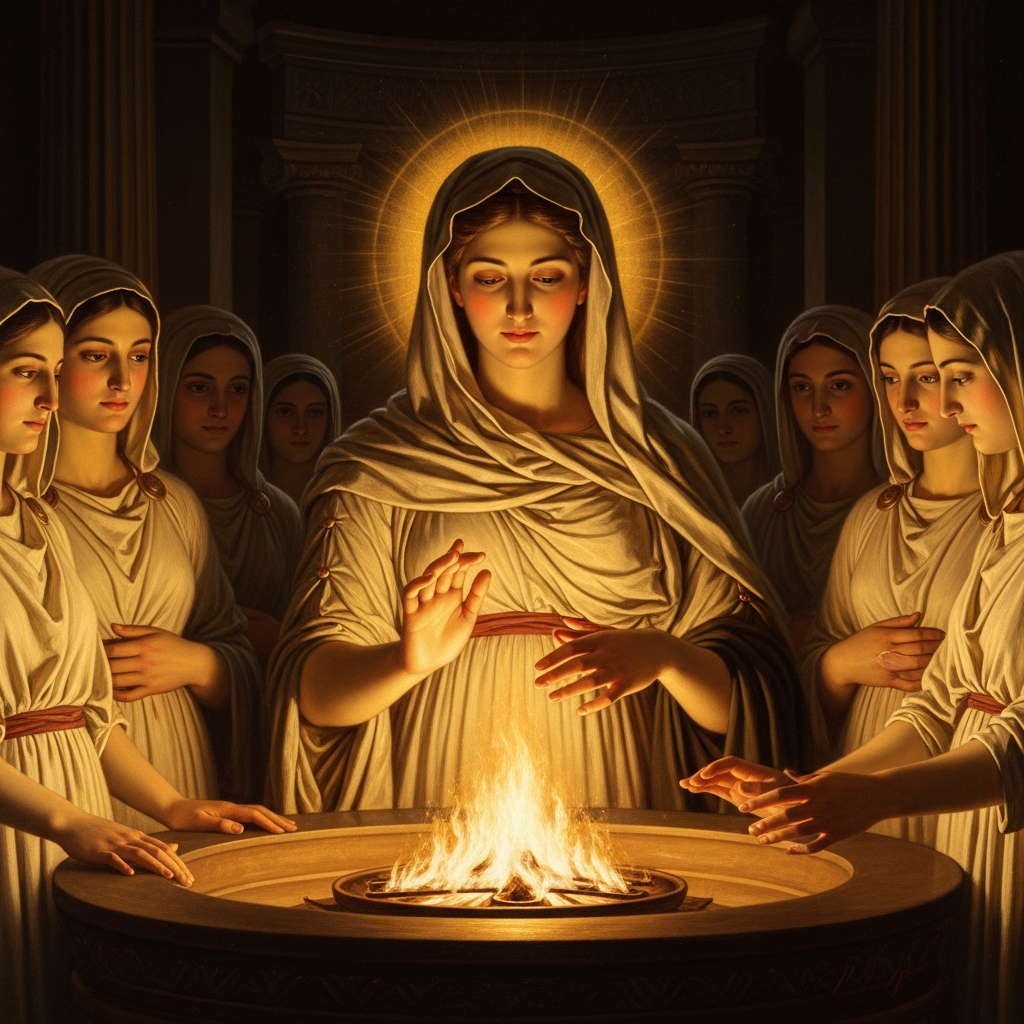
Vesta is the goddess of the hearth-fire — both the household hearth and the great public hearth of the Roman state. Her sacred fire burned perpetually in the Temple of Vesta in the Roman Forum, tended by the Vestal Virgins, six women selected as girls and serving for thirty years of strict celibacy. If the fire went out, it was a catastrophic omen requiring elaborate purification; if a Vestal broke her vow of chastity, she was buried alive (the gods’ fire could not be polluted by human bloodshed, so she had to be killed without any blood).
Vesta has no statue in her temple — only the fire itself. She is the rare anthropomorphic deity who is not anthropomorphized. Her presence is the flame. She represents the continuity of Rome itself: as long as her fire burns, Rome lives; if it goes out, Rome falls. The fire was extinguished and rekindled annually on the first of March (the original Roman New Year), but otherwise it had to burn unbroken for over a thousand years.
Biblical Parallels: Vesta parallels the perpetual fire on the altar of the Israelite tabernacle and Temple, which the priests were commanded never to let go out (Leviticus 6:12-13, “the fire on the altar must be kept burning; it must not go out”). The Vestal Virgins parallel the female priestesses of the broader ancient Mediterranean (though the Hebrew Bible firmly excludes female cultic personnel). The “fire of God” as a sign of divine presence is biblically central (Exodus 3:2, the burning bush; Acts 2:3, Pentecostal fire).
Cross-Tradition: Direct cousin of Vedic Agni (the household and sacrificial fire that must never be extinguished) and Iranian Atar (the sacred fire still tended in Zoroastrian fire-temples today). Parallels Greek Hestia (her direct counterpart, also the hearth-goddess), Slavic Ognik, and the perpetual fires of various indigenous religions worldwide. The “perpetual sacred fire tended by virgins” is a Proto-Indo-European institution, attested across Vedic, Iranian, Greek, Roman, Celtic (the perpetual fire of Brigid at Kildare), and Baltic religion.
2 min read