Combat Profile
Queen's Warning
Juno Moneta sounds an alarm whenever her city or household is threatened by hidden danger; the warning is unmistakable and gives time to prepare a defense
Lady of Marriages
Juno's blessing protects every legitimate marriage in her domain; marriages contracted under her aegis cannot be dissolved by external malice, and infidelity is supernaturally exposed
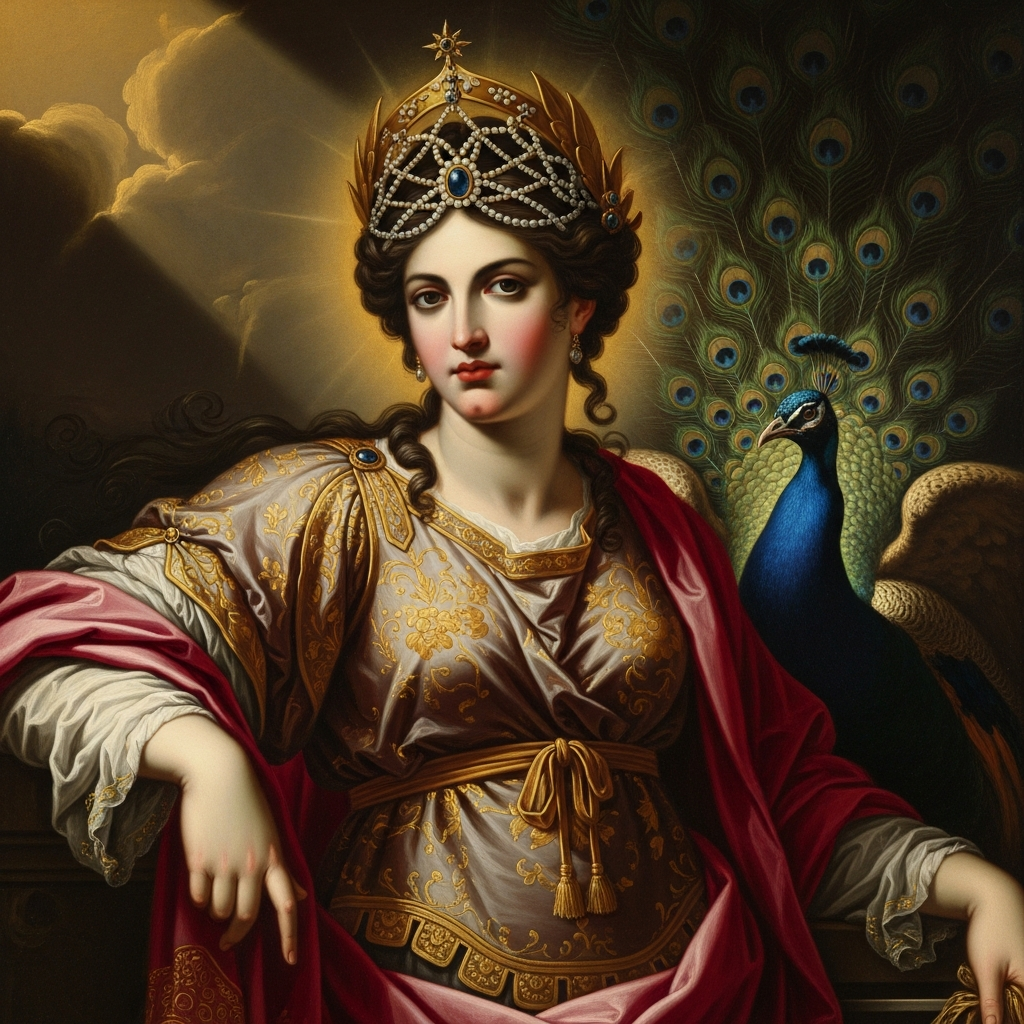
Juno is the queen of the gods and protector of women, marriage, and childbirth — but the Roman Juno is not the Greek Hera with the serial numbers filed off, despite the canonical equivalence. Roman Juno is more dignified, less driven by jealous rage, and far more central to civic religion than the Greek Hera ever was. She forms the Capitoline Triad with Jupiter and Minerva, and her temple shared the most sacred hill of Rome with theirs. She had multiple cult-aspects: Juno Regina (Queen), Juno Lucina (of childbirth, “the bringer to light”), Juno Moneta (the warner — her temple held the Roman mint, which is why we still call coined money “money”), Juno Sospita (the savior, depicted in goat-skin armor).
Juno was the divine patron of every Roman woman in the same way Mars was the patron of every Roman man. Each woman was believed to have a personal juno — a guardian spirit that mirrored her in heaven — just as each man had a personal genius. She presided over weddings, pregnancies, births, and the protection of married women. The Roman calendar had numerous festivals dedicated to her: the Matronalia (March 1, celebrating mothers), the Nonae Caprotinae (July 7, celebrating Juno Caprotina), and the goose-festival commemorating the geese of Juno’s temple that allegedly woke the defenders of the Capitoline when the Gauls attempted a night-attack in 390 BCE.
Biblical Parallels: Juno parallels the protective-mother aspect of the divine — the Yahweh of Isaiah 66:13 who comforts “as a mother comforts her child” — but the Hebrew tradition firmly excludes a divine queen alongside the divine king. The “Queen of Heaven” condemned in Jeremiah 7:18, 44:17 is precisely the type of Juno-figure that prophetic monotheism rejected. Christianity later partially restored the maternal-divine in the figure of Mary, Queen of Heaven, whose iconography sometimes draws on older Juno imagery.
Cross-Tradition: Direct counterpart to Greek Hera, but with significant differences in temperament. Parallels Vedic Aditi (mother of the gods) and the later Hindu Parvati and Lakshmi (royal consorts of the supreme male deity). The “queen-of-heaven sister-wife of the supreme god” is a recurring Indo-European pattern.
2 min read