Combat Profile
Boundless Release
Severs any bond, chain, curse, or constraint placed on a target; remits sin and frees the bound regardless of the binding agent's power
Cosmic Womb
As the mother of all Adityas, Aditi cannot be permanently destroyed; she is the space from which divinity itself arises and persists as long as any of her sons exist
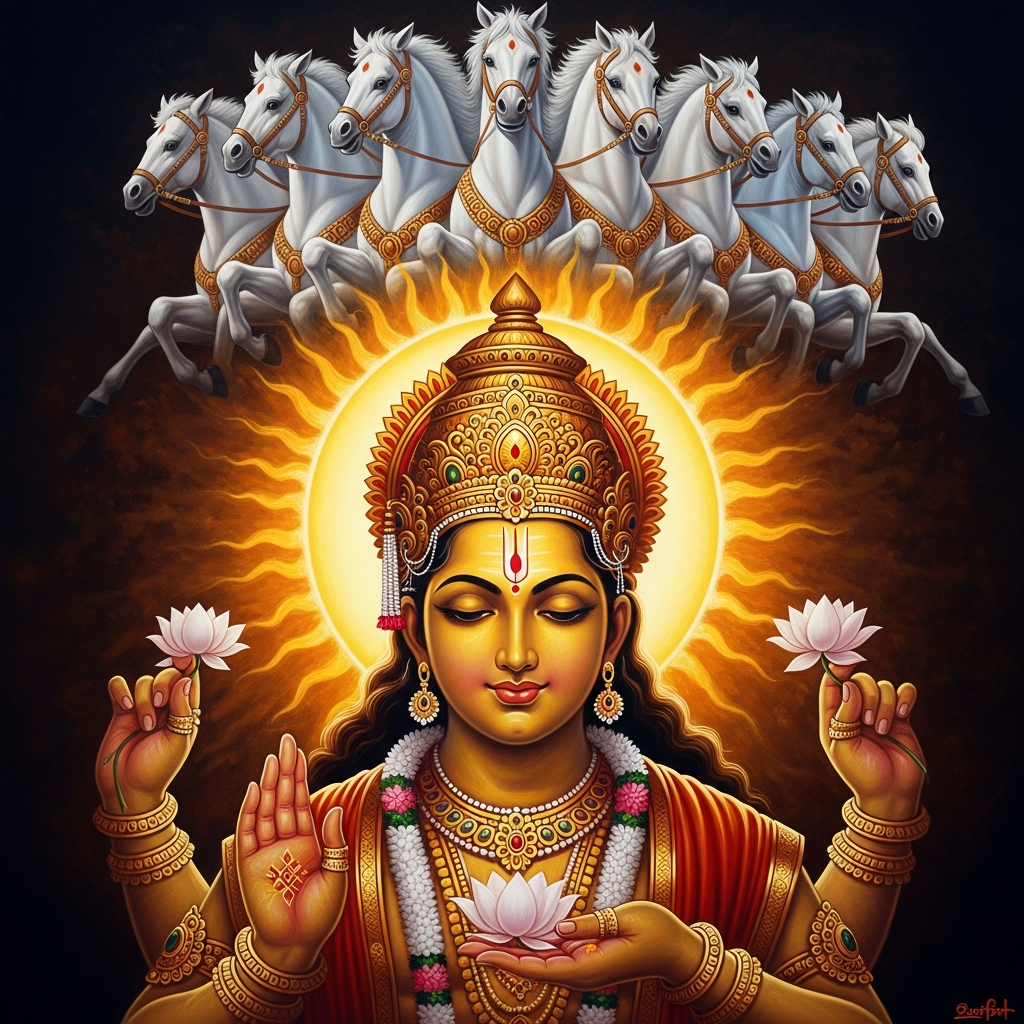
Aditi is “the boundless” — the cosmic mother whose name means literally “without bonds, without limits.” She is the mother of the Adityas (the solar sovereigns), and through them the grandmother of cosmic order itself. In some hymns she is identified with the visible sky; in others with the cosmic cow whose milk is the rain; in still others with an abstract principle of unbinding, freedom, release from sin and constraint.
She is invoked when prisoners need to be freed, when the bound need to be loosed, when sin needs to be remitted. She represents the primordial generative space — older than the gods, the womb from which sovereignty itself emerges. By the Brahmana period she is largely identified with the earth or with Speech, but in the Rigveda she remains a strange, half-abstract maternal principle of cosmic spaciousness — what later Hindu theology will reach toward when it speaks of prakriti (primordial matter) or the Mahadevi (Great Goddess).
Biblical Parallels: Aditi has no direct biblical parallel — Hebrew religion firmly excludes a divine mother — but the abstract principle of cosmic boundlessness echoes the Hebrew ein sof (the limitless) of later Kabbalah, and the maternal divine evoked in Isaiah 66:13 (“as one whom his mother comforts, so will I comfort you”). The remission-of-sin function carries straight into Christian sacramental theology, though attached to a male deity.
Cross-Tradition: Parallels Greek Gaia (cosmic earth-mother), Egyptian Nut (sky-mother arching over the earth), Norse Ginnungagap (the boundless primordial void), and the Chinese Dao (the unnameable boundless source). Aditi’s name shares an Indo-European root with words for “binding” — a-diti literally “un-binding” — and the un-binding principle is a recurring feature of mother-goddesses in shamanic traditions worldwide.
1 min read