Combat Profile
Monsoon Burst
Calls down a torrential downpour that revives withered crops, refills empty wells, and fertilizes the surrounding land; doubles agricultural yield for one season
Bull of the Sky
Parjanya's roar (thunder) carries his blessing across vast distances; lands within hearing of his thunder receive enhanced fertility for one full year
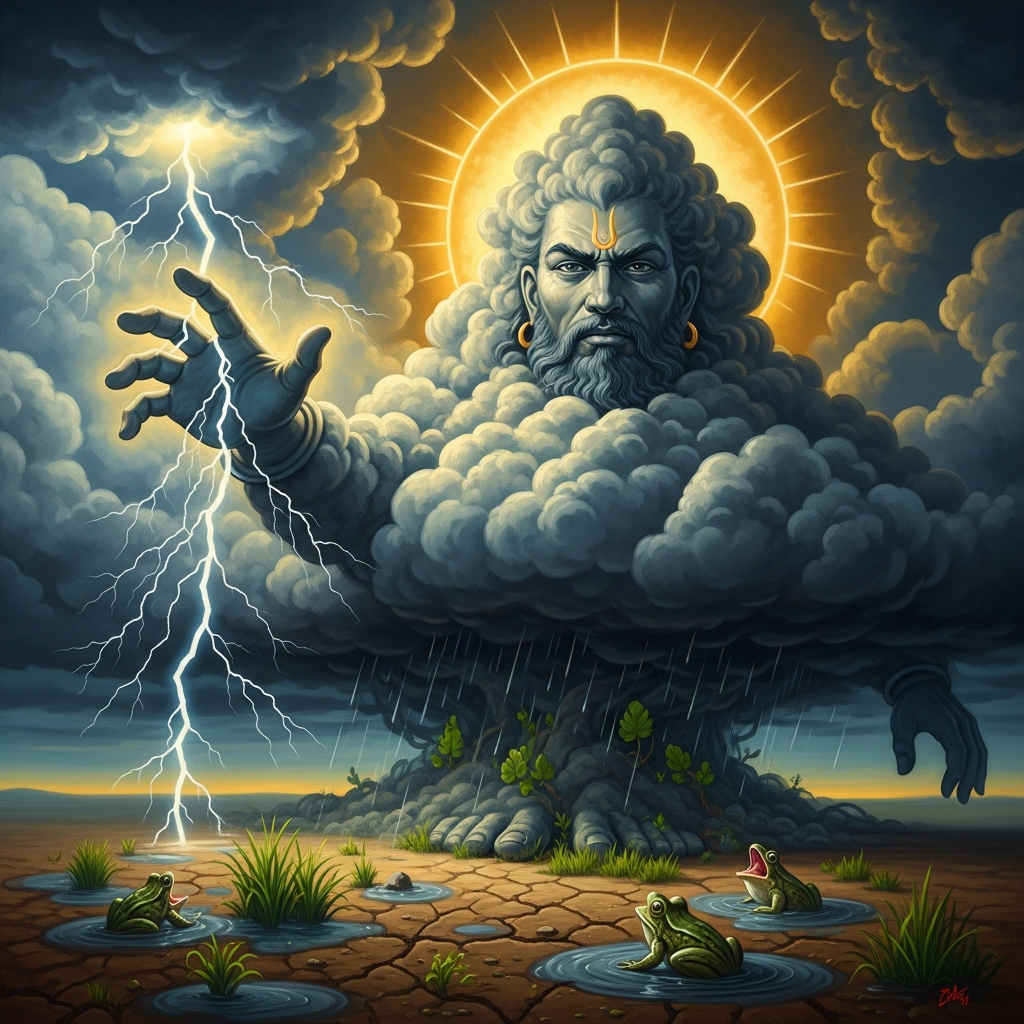
Parjanya is the rain-cloud personified — the thundering, fertile cloud that breaks open in the monsoon and lets fall the waters that the dry earth desperately drinks. In one of the Rigveda’s most beautiful hymns (5.83), Parjanya is described as “the bull who roars, who plants the seed” — a cosmic male who fertilizes the female earth with his pouring rain. He is sometimes identified with Indra, sometimes distinguished as a separate deity; the boundary between storm-god and rain-cloud is porous.
Parjanya is fundamentally agricultural. He is the deity of the village and the field rather than the warrior’s chariot. When he is satisfied, the cattle drink, the women laugh, the rivers swell, the seeds sprout. When he is angry or absent, drought withers everything. His worship preserves the older shamanic pattern of bringing the rain — a function he shares with rain-priests on every continent.
Biblical Parallels: Parjanya parallels the rain-giving aspect of Yahweh in Deuteronomy 11:14 (“the rain of your land in its season”) and the rebuke of Baal-worship in 1 Kings 17-18, where Elijah challenges the rain-prophets of Baal — explicitly arguing that Yahweh, not Baal, controls the rain. Christ’s parable of the sower (Matthew 13) and the imagery of the Spirit “falling like rain” (Hosea 6:3) carry the same agricultural-divine logic.
Cross-Tradition: Direct cognate with Lithuanian Perkūnas, Slavic Perun, and possibly the Norse Fjǫrgynn — all rain-and-thunder deities deriving from a Proto-Indo-European *Perkʷunos. Parallels Canaanite Baal-Hadad (the storm-god whose worship the Hebrew prophets attacked), Mesopotamian Adad, and Hittite Tarhunna.
1 min read