Combat Profile
Solar Chariot
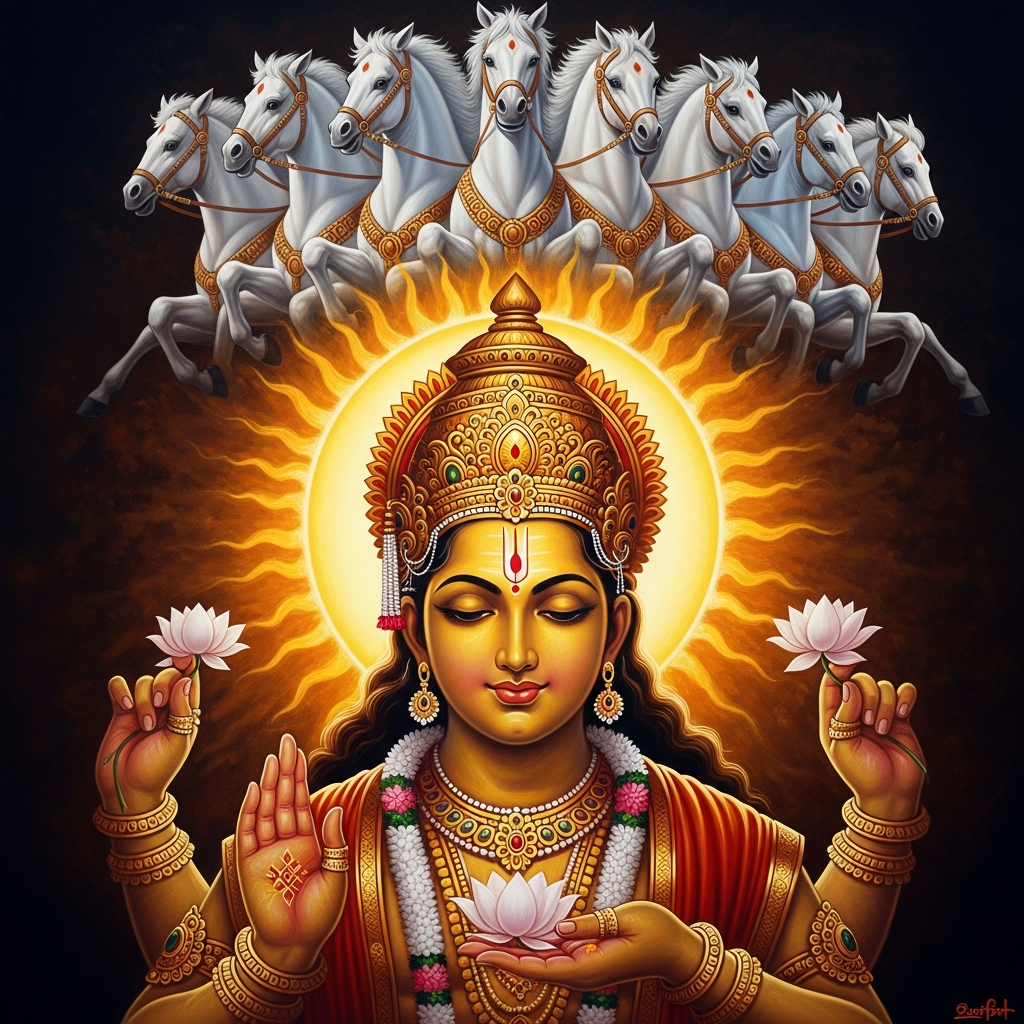
Surya's seven-horse chariot can traverse any distance instantaneously while the sun is above the horizon; passengers gain immunity to darkness and despair
Eye of the Gods
All deeds done in daylight are witnessed by Surya; no concealment is possible from sunrise to sunset, and lies told in his presence weaken the speaker
Surya is the visible sun — not an abstraction or a metaphor, but the brilliant disk that crosses the sky each day in his chariot drawn by seven horses (or by one horse with seven heads, depending on the hymn). He is the eye of the gods, the witness who sees all daylight deeds. His charioteer is Aruna (“Reddish”), the dawn personified. His daughter is Surya (the female form), who marries Soma in a great mythological wedding that establishes the prototype for all subsequent Vedic marriages.
Surya is one of the Adityas, the sons of Aditi, and is invoked daily in the Gayatri mantra (RV 3.62.10) — perhaps the most-recited line in human religious history, still repeated by hundreds of millions of Hindus every dawn: Tat savitur varenyam bhargo devasya dhimahi, dhiyo yo nah pracodayat — “May we contemplate the desirable radiance of the god Savitri, that he may inspire our thoughts.” The Vedic sun is not yet the demoted figure of later Hindu mythology; he is a primary deity worshipped at sunrise as the very face of the divine.
Biblical Parallels: The Hebrew Bible polemicizes against sun-worship (Deuteronomy 4:19, 2 Kings 23:11 — Josiah destroys the chariots dedicated to the sun) precisely because the surrounding cultures (Egyptian Ra, Canaanite Shapash, Vedic Surya) had elevated the sun to divine status. Yet Yahweh is described in solar terms — “the Lord God is a sun and shield” (Psalm 84:11) — and Christ becomes “the sun of righteousness” (Malachi 4:2). The Christian dawn-prayer tradition echoes the Vedic Gayatri mantra in form if not theology.
Cross-Tradition: Cognate with Greek Helios, Roman Sol Invictus, Egyptian Ra, Norse Sol, Slavic Dazhbog, and Japanese Amaterasu. The seven-horse chariot is shared with Helios. The Iranian Mithra is the closest functional parallel — both are solar covenant-witnesses.
1 min read