Contents
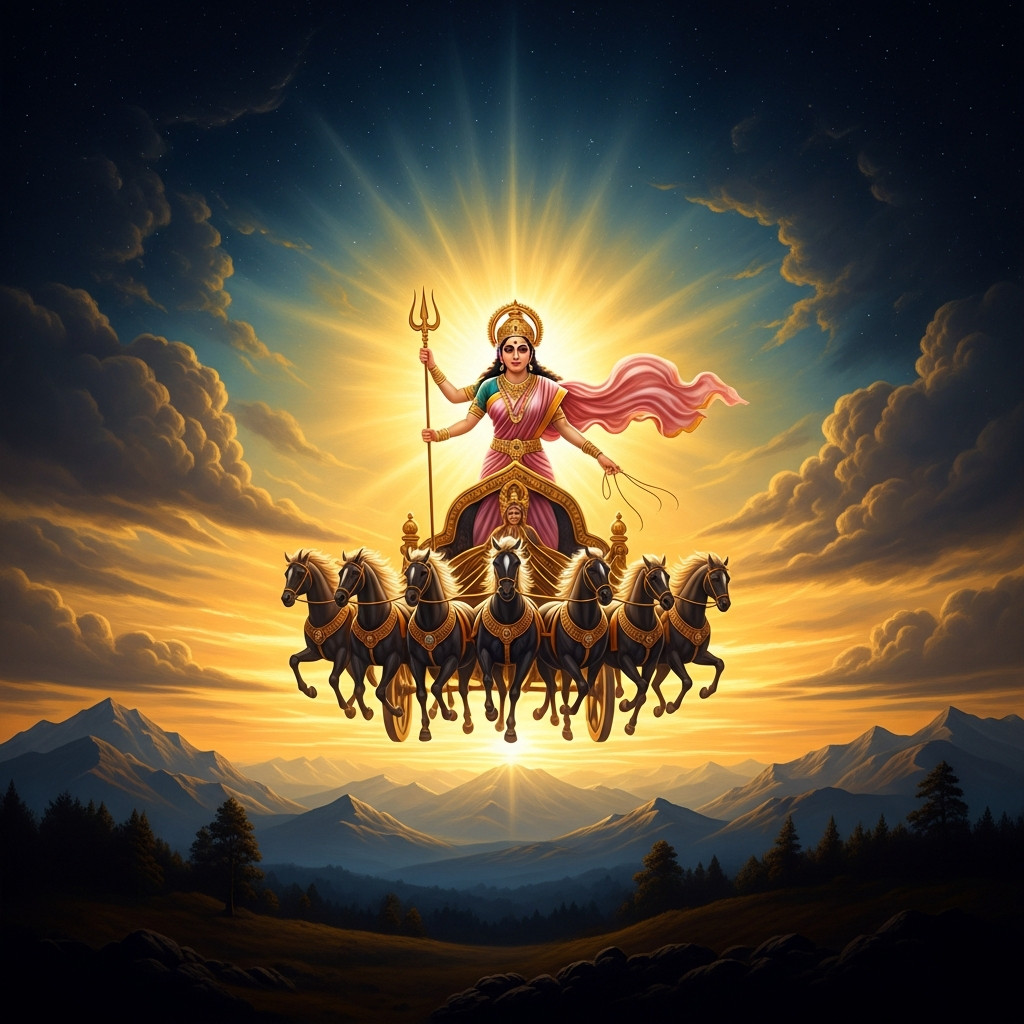
Ushas, the dawn goddess, is praised more often in the Rig Veda than any deity except Indra. She is described as a young woman undressing — radiant, modest, ageless — driving away the darkness with her chariot of red horses. She has come ten thousand mornings; she will come ten thousand more; and yet each morning she comes as if for the first time.
- When
- Late Bronze Age, c. 1500–1200 BCE
- Where
- The eastern horizon at the edge of night
She comes from the east. The hymns watch her come. She is ageless and yet ancient — they call her the Old Maiden, the One Who Was Always — and she is also the Young Bride, made new every morning. She is the daughter of heaven. She is the sister of the night, Ratri, who has just passed her on the road. They embrace as they pass; the hymns are sweet about that meeting and parting.
Ushas drives a chariot. The horses are red, sometimes ruddy cows, sometimes called both at once because the early Vedic mind did not separate herd-wealth from light. The chariot is bright, the wheels are new, and as it climbs the eastern sky the darkness scatters and the birds begin to call. She wears a brightly dyed garment. She is described, in some of the most candid lines in religious literature, as a young woman dressing herself for her lover — adjusting her ornaments, lifting her veil, smiling with the consciousness of being seen.
She wakes everyone. The bird in the nest, the cow in the byre, the priest by the unlit altar, the king on his couch, the thief in the shadow of the wall. Some she wakes to praise; some she wakes to work; some she wakes to flee. Ushas does not choose. She is impartial. She brings light to good and bad alike, and the hymn-poets noticed this and were a little afraid of her — she is the one who makes the day come, and with the day comes everything that the day will hold, including death.
For Ushas marks time. Each of her arrivals subtracts a day from a man’s life. The hymns are clear about this: she has dawned for our forefathers, who are now bones; she dawns for us; she will dawn for our descendants when we too are bones. “She wears away mortal life,” one verse says — the same red light that wakes the singing birds is also the soft hand that pulls the singer toward the grave. Ushas is the goddess of beauty and the goddess of mortality at the same time, and the early seers understood that these were not two different things.
And yet what the hymns mostly express is gratitude. Rig Veda 1.92 is one of the most ravishing texts in the Veda. “These dawns have raised their banner,” it begins. “In the eastern half of the dusky firmament, they paint themselves with light, like heroes brandishing their weapons; the ruddy cows return to their pastures.” The poet watches the sky redden and thinks: warriors raising banners. He watches the cattle stir and thinks: the universe is working. He watches Ushas come and forgets, for a moment, that he is going to die.
What is hardest to translate is the line in Rig Veda 1.113 — “the dawn that was, the dawn that will be” — where the poet realizes that this dawn is one of an infinite series, and that the same goddess has visited every morning since the world began, and will visit every morning until it ends, and that she does not weary. Mortals weary. Repetition wears mortals out. But Ushas, the hymn says, is unwearying — agnata, the unfading — and her unfading is what makes her divine.
The Vedic poets composed perhaps twenty hymns to her, and they are the only hymns that read like love poetry. There is no battle in them. There is no soma drunk. There are no enemies struck down. There is only a man standing in the cold half-light, watching the sky lighten, and trying to find the words for what he sees.
He finds them. “Lighting all things, the radiant one has come; she has set the dark away. She wakes the sleeper, urges the bird to flight, makes the offering possible, lays out the road to the gods.” She is, in the end, the path itself — the way that opens between earth and heaven each morning, the moment when sacrifice becomes possible again because there is light to see by.
She has done this ten thousand times. She will do it ten thousand more. And tomorrow she will come over the eastern hills, and the birds will sing, and a Vedic poet, somewhere in the long human past, will have known exactly what we are still trying to say.
Echoes Across Traditions
Entities


Sources
- Rig Veda 1.48, 1.92, 1.113, 1.123, 3.61, 6.64, 7.75, 7.77 (the great Ushas hymns)
- Atharva Veda 7.22