Contents
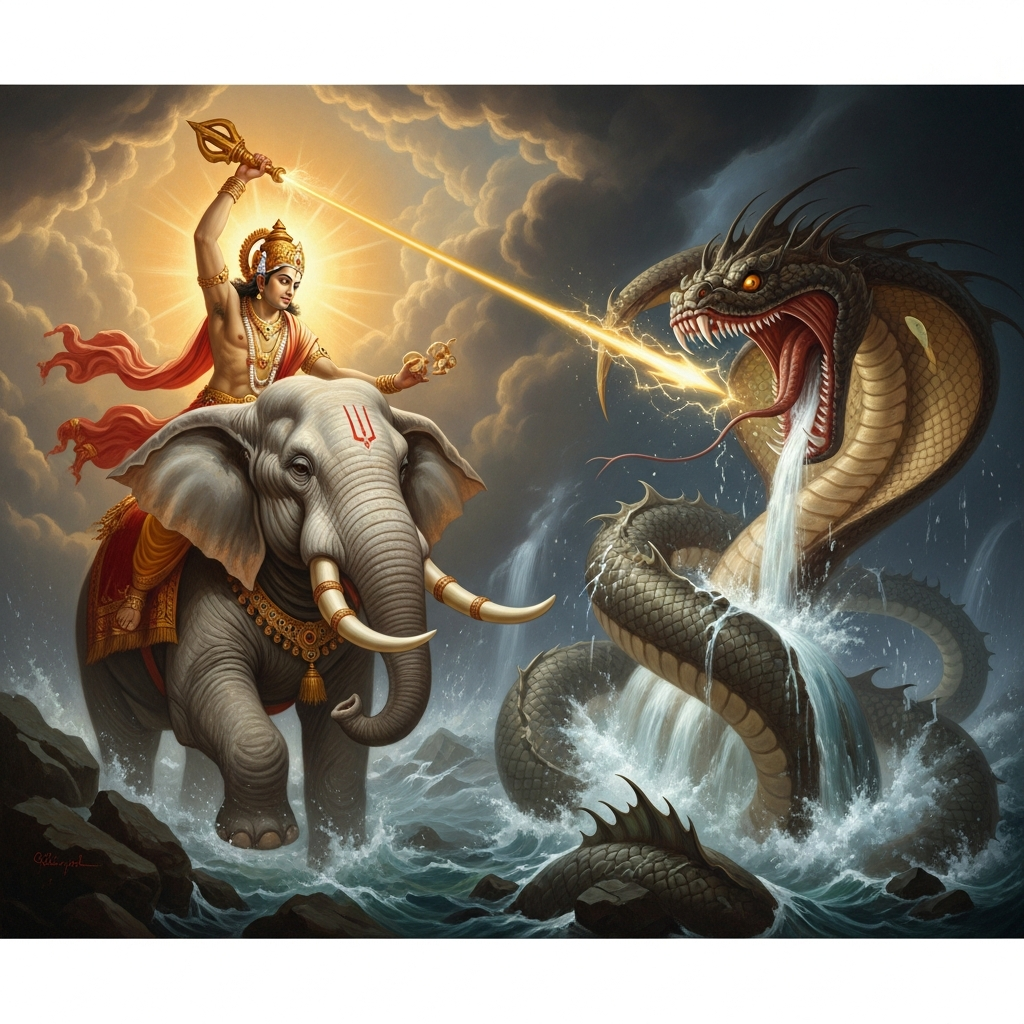
The cosmic serpent-dragon Vritra has swallowed every river and coiled around the mountains, leaving the world parched. Indra drinks the soma until his strength swells beyond measure, lifts the thunderbolt Vajra forged by Tvashtri, and splits the dragon open — and the seven rivers, freed at last, race down to the sea.
- When
- Late Bronze Age, c. 1500–1200 BCE
- Where
- The mountains at the edge of the inhabited world
Before the rivers ran, Vritra was coiled around the mountains. His name meant the Encloser, the Withholder. He had swallowed the seven sisters — the rivers — and was holding them in his belly. The earth cracked. The cattle stood with their tongues out. The fire-altars went unwatered. And the gods, in their high places, were thirsty too.
It was Tvashtri who forged the thunderbolt. He was the divine craftsman, the artisan who shapes wombs and hammers cosmic tools, and he beat the Vajra into the shape of a club whose blow could crack mountains. Tvashtri did not love Indra — Indra had killed his son in some earlier quarrel — but the world needed Vritra dead, and only Indra could swing the weapon.
Indra drank the soma. He drank three lakes of it, the hymns say, until his belly swelled and his arms grew heavy with power. The drink was pressed by the priests with stones, filtered through wool, mixed with milk; it was a god in liquid form and it filled him with the strength to do what no other god dared. Then he took up the Vajra, and the Maruts — the storm-troops, his retinue of howling young warriors — rode at his side, and they went up the mountain.
Vritra rose to meet him. The dragon had no feet and no hands, the hymn says — only coil and hunger. He hissed and lunged. He struck Indra and made him stagger. For a moment the gods watching from the upper air thought their champion would fall. But Indra braced his feet, lifted the bolt, and brought it down once.
Once was enough. The thunderbolt clove the dragon along his length. Vritra split open like a rotten log, and the waters that had been pent inside him came roaring out — not as a trickle but as seven rivers at once, racing down the mountain in white foam, finding their courses, finding the sea. The lowing cattle lifted their heads. The dry priests laughed. The earth drank.
Indra stood over the corpse of the dragon, his Vajra still humming, the soma still bright in his veins. The hymn of Rig Veda 1.32 was composed to remember this moment — and it is the most-recited passage in the entire Veda, the first thing a young brahmin would learn to chant. “I will declare the manly deeds of Indra,” the hymn begins, “the first that he performed, the wielder of the thunder. He slew the serpent, then released the waters, and split the bellies of the mountains.”
Some hymns add a darker note. After the killing, Indra fled. He fled because Vritra was a brahmin too — the son of Tvashtri, born of priestly blood — and to kill a brahmin is the worst sin in the Vedic moral order. So even Indra, even after his greatest victory, had to be ritually cleansed; the guilt of the dragon-slaying clung to him. The Brahmanas would later argue about how this stain was washed away, divided among the trees and the women and the earth. The hero is never wholly clean.
But the rivers ran. The cosmos worked. The drought was broken. And every monsoon afterwards, when the first thunder cracked over the parched plains and the rains came, the priests would say: it is happening again. Indra is killing Vritra, the way he killed him at the beginning of the world.
Echoes Across Traditions
Entities


Sources
- Rig Veda 1.32 (the canonical Vritra-slaying hymn)
- Rig Veda 2.12, 4.18, 6.17
- Shatapatha Brahmana 1.6.3