Contents
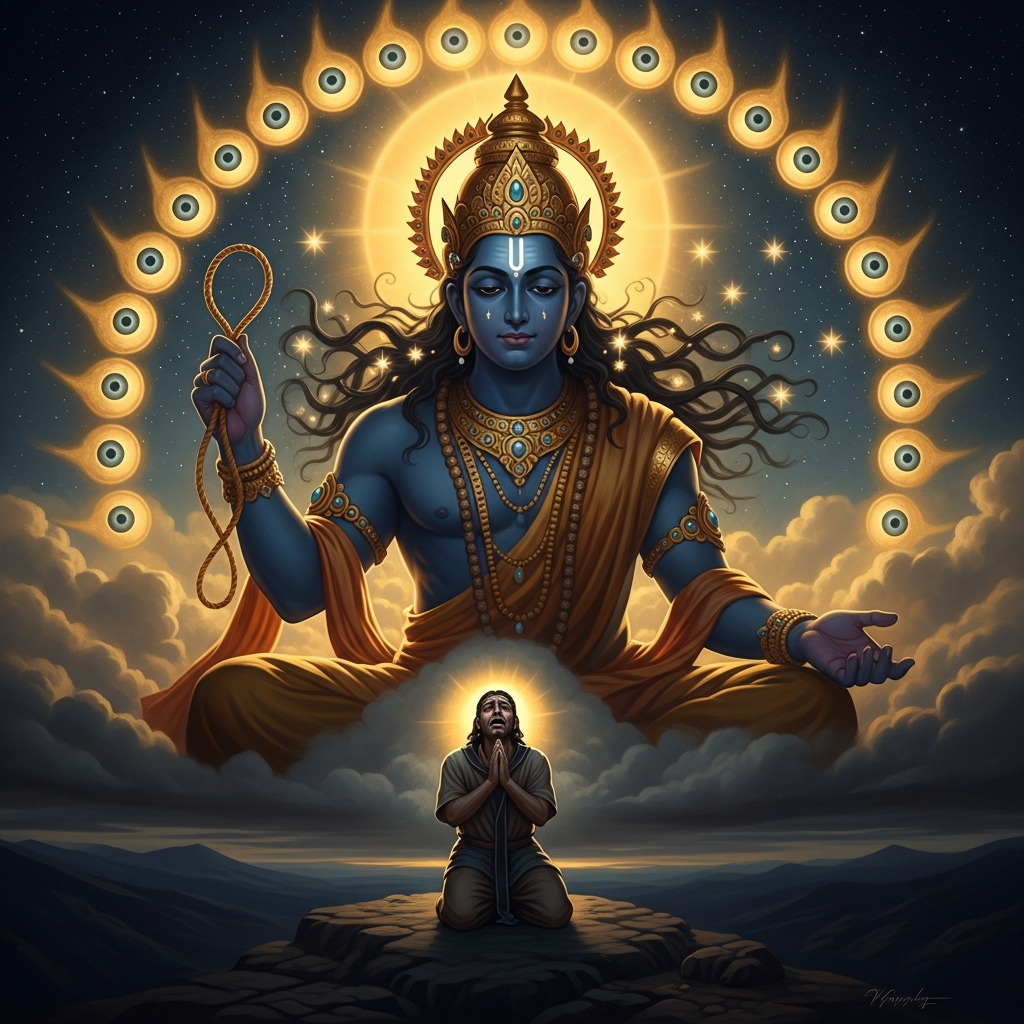
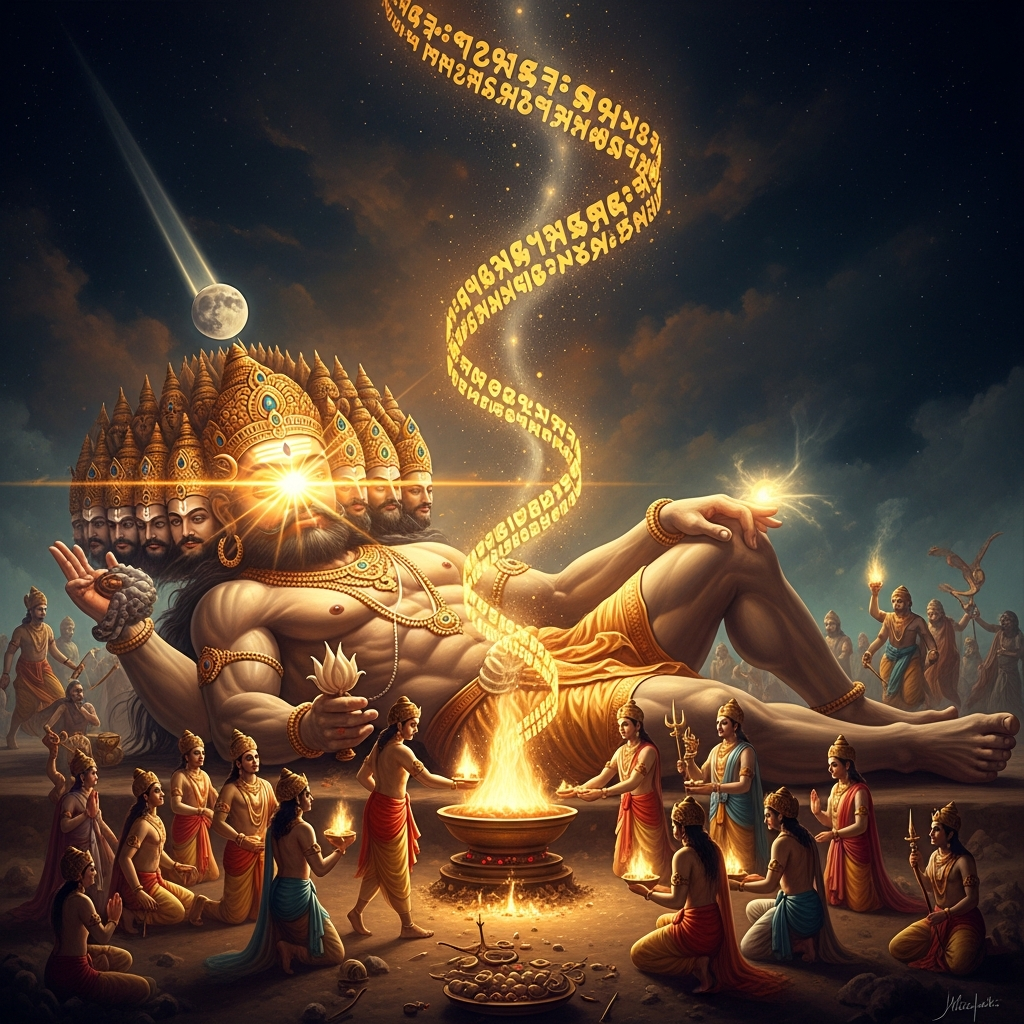
Purusha, the cosmic person, was a being with a thousand heads, a thousand eyes, a thousand feet — three-quarters of him in heaven, one quarter on earth. The gods bound him at the beginning of time and offered him as a sacrifice. From his mouth came the priests, from his arms the warriors, from his thighs the merchants, from his feet the laborers — and from his body the sun, the moon, the sky, the seasons, the Vedas themselves.
- When
- Late Bronze Age, c. 1500–1200 BCE
- Where
- Before the world had measure
A thousand heads has Purusha, a thousand eyes, a thousand feet. He covered the earth on every side and extended ten fingers’ breadth beyond it.
This is how the Purusha Sukta begins, and the image is the largest image in the Rig Veda. Purusha — the Person, the Man — is so vast that the world is only a corner of him. Three-quarters of him are in heaven, immortal, beyond reach. One quarter is here, in time, where the things we know happen.
The hymn says that all this — all that has been and all that will be — is Purusha. He is the lord of immortality. He is what grows by food. The world is, in some sense, his body, dispersed.
And then, at the beginning of time, the gods spread him out as a sacrifice. The hymn does not say who Purusha is sacrificed to; the gods are the priests, but they are not the recipients. He is sacrificed, perhaps, to himself, by himself, through himself — the primordial offering before any other offering was possible. The seasons were the clarified butter, spring was the offering, summer the fuel, autumn the oblation. The young grass was strewn in the wind. The world was the altar, and there was no second altar yet.
What came out of that sacrifice was everything.
The verses are stark. From his mind came the moon. From his eye came the sun. From his mouth came Indra and Agni. From his breath came the wind. From his navel came the middle air. From his head came the sky. From his feet came the earth. From his ear came the directions. So they shaped the worlds. The hymn proceeds with terrible economy — each line a body part, each line a feature of the cosmos.
And then, in the verses that would shape Indian society for the next three thousand years, came the four classes:
The Brahmin was his mouth. From his arms the Rajanya — the warrior, the king — was made. His thighs became the Vaishya, the merchant and farmer. From his feet, the Shudra was born — the laborer, the servant.
This is the verse that would be cited by every later defender of the caste order, and the verse that every later reformer would have to grapple with. The hymn does not condemn the Shudra; it does not exalt the Brahmin; it simply says that society, as it was, came from the body of the cosmic person, and so society, as it was, was sacred. The mouth speaks; the arms fight; the thighs bear; the feet stand. The body needs all four. But the body is also a hierarchy: the mouth is at the top.
What scholars have come to think — not all of them, but many — is that Rig Veda 10.90 is one of the latest hymns in the Veda, composed when the social structure of the early Aryans had crystallized and needed cosmological justification. The verse projects an existing order back to the beginning of the world. The mythology and the politics arrive together.
But to read it only as politics is to miss its strange beauty. Purusha is the first sacrifice and the model of every later sacrifice. The seers will repeat it, in miniature, on every fire-altar — every offering of butter and grain re-enacts the cutting of the cosmic body, the giving of part to make whole. Sacrifice in the Vedic mind is not a payment to the gods; it is participation in the original act by which the world was made. The priest at the altar is doing again what the gods did to Purusha at the beginning, and so he is, in a small way, holding the world together.
There is also this: Purusha is willingly given. The hymn does not describe a struggle. He is bound, he is offered, he becomes the world. The Upanishads will pick this up later and turn it inward — the cosmic Purusha will become the atman, the self in the heart, and the sacrifice will become the gift of the small self to the large. Christian readers will find here, with surprise, something close to the kenosis of Philippians: the self-emptying of the divine into the world.
A thousand heads. A thousand eyes. A thousand feet. And every grain of rice, every blade of grass, every sun rising in the east, is a fragment of him, scattered in time.
Echoes Across Traditions
Entities


Sources
- Rig Veda 10.90 (the Purusha Sukta)
- Atharva Veda 19.6
- Shatapatha Brahmana 13