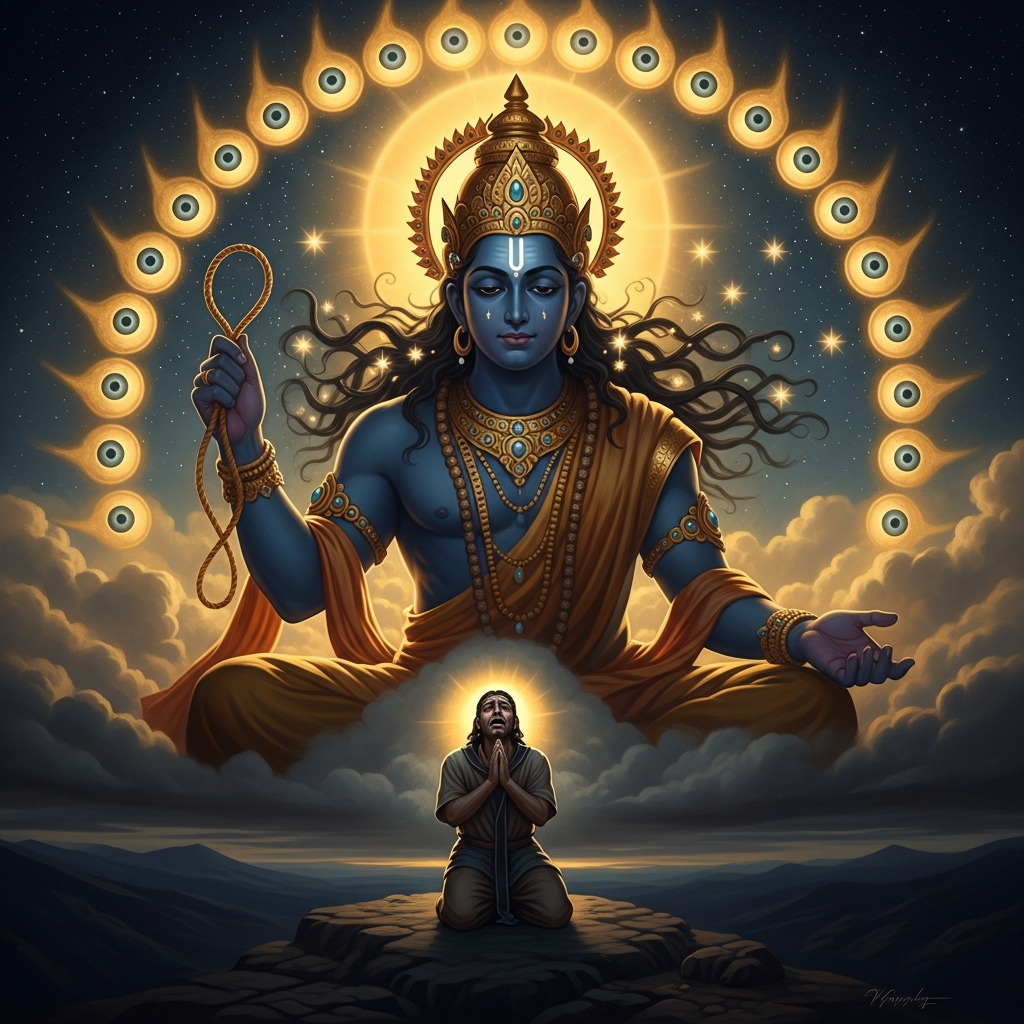
Varuna's Noose: The God Who Sees Every Sin
Late Bronze Age, c. 1500–1200 BCE · The night sky above the rivers of the Punjab
Contents
Varuna is the god of cosmic order, the upholder of Rta — the deep law that makes rivers flow and stars wheel. He sees every action with a thousand spies; nothing is hidden from him. The hymns to Varuna in the Rig Veda are among the most intimate confessions in all of ancient literature: a man trembling, naming his sins, and begging the great god to loosen the noose.
- When
- Late Bronze Age, c. 1500–1200 BCE
- Where
- The night sky above the rivers of the Punjab
Varuna is the oldest of the great gods. Before Indra rose to the head of the pantheon, before Vishnu and Shiva were anything more than minor figures, Varuna ruled the night sky and the moral law. The Iranians called him Ahura. The Greeks may have called him Ouranos. He was the high god of the Indo-Europeans before they split, and in the Vedic hymns his power is still vast — though already, even in the Rig Veda, you can feel him beginning to recede.
He is the keeper of Rta — the cosmic order, the truth-pattern, the deep grain of the world that makes the rivers run downhill and the stars return to their stations and a man’s word match his deed. To violate Rta is to lie, to break a vow, to cheat at sacrifice, to kill without cause. And Varuna sees every violation.
The hymns describe his eyes as a thousand. He has spies — the spases — who walk through the world unseen and report to him. Nothing is hidden. The man who whispers in his bed at night, the man who plots in the closed chamber, the man who curses his brother in his heart — Varuna hears it. The blink of the eye is counted. The drop of water in the falling rain is counted. The man waking in the dark already in his noose.
For Varuna binds. That is his particular dread. The noose — pasha — is his weapon, and it is not a noose around the neck only; it is a noose around the soul. To be bound by Varuna is to suffer dropsy, the slow swelling sickness; to lie sleepless; to lose one’s herds; to feel the cold weight of a guilt one cannot name.
And so the great hymns of the seventh book of the Rig Veda are unlike anything else in the corpus. They are not heroic. They do not boast. They are the prayer of a man who knows he has done wrong and does not entirely know what wrong he has done, and who is terrified.
“What was the great sin, Varuna,” the seer Vasishtha cries in 7.86, “for which you wish to slay your friend who praises you? Tell me, unfailing, self-dependent god — and freed from sin I will fall before you in adoration. Let me not yet enter the house of clay, O King — be gracious, mighty Lord, and spare me. Whenever we men, O Varuna, commit an offense before the heavenly host, whenever we break your law through thoughtlessness — punish us not, O God, for that offense.”
The voice is broken and direct. Vasishtha is not arguing theology. He is begging. He says: it was not my own will, perhaps it was wine, or anger, or dice, or thoughtlessness — and not even the older brother is free from sin; the youngest goes wrong; even in dreams a man may sin. Loosen the noose. Forgive. Let me live a little longer.
What is most striking is the friendship in the prayer. Varuna is not a distant tyrant. The hymn calls him sakha — friend. The seer remembers that he and Varuna used to ride together in a boat on the cosmic ocean; he asks where that closeness has gone. “When shall I and Varuna meet again?” he says. “When will I delight in his ambrosial presence?” The terror is not just of punishment — it is of estrangement.
Varuna in the later tradition would shrink. He would become a sea-god, a regional power, the lord of waters in the western direction. Indra would take his throne. The fierce, all-seeing conscience-god of the Bronze Age would soften into a figure of waters and serpents and ritual oaths. But the hymns survive. And anyone who reads them in the original — the trembling vocative, the half-named sin, the noose loosening at last — will recognize the voice. It is the voice of every later confessional prayer in every later religion. It started here, three thousand years ago, in a hymn to a god who could see in the dark.
Echoes Across Traditions
Entities


Sources
- Rig Veda 7.86, 7.87, 7.88, 7.89 (the Varuna confessional hymns)
- Rig Veda 1.25, 5.85
- Atharva Veda 4.16