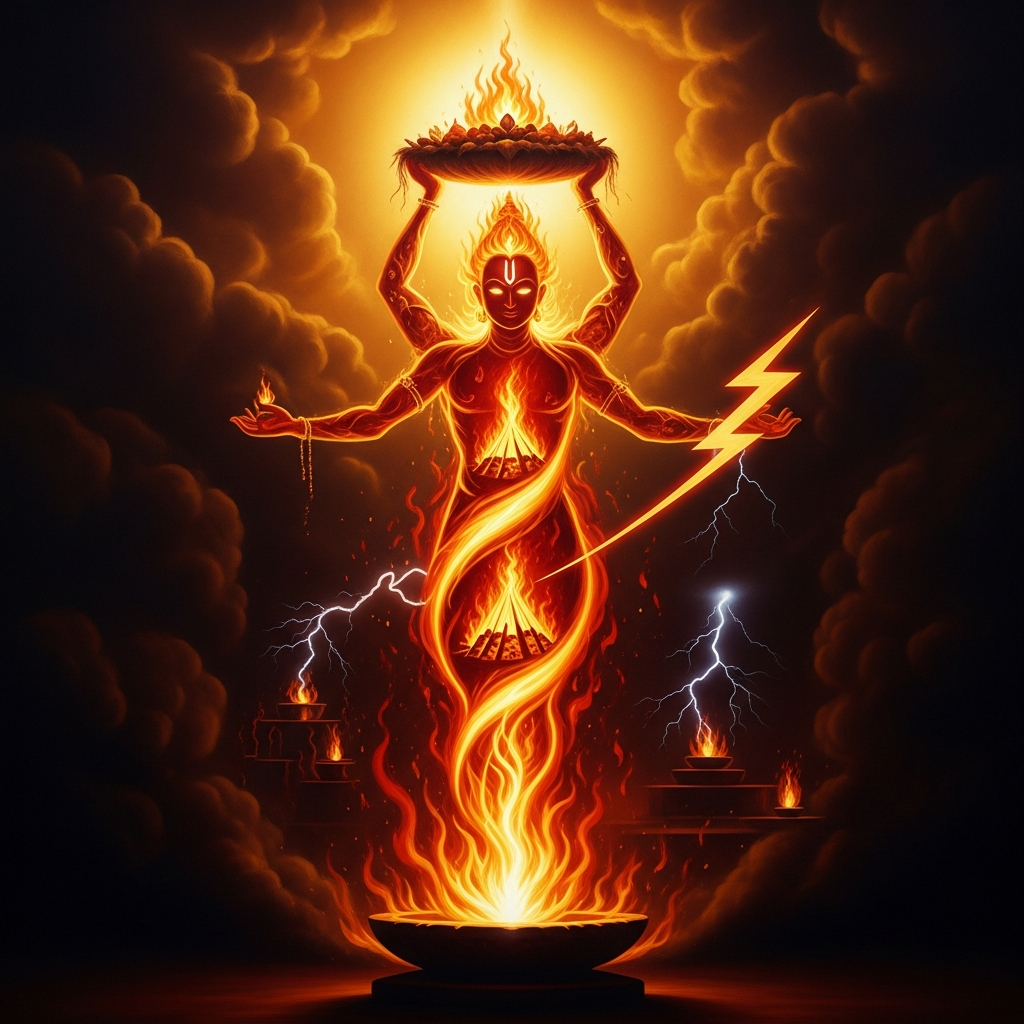
Agni: The Fire That Carries the Offerings
Late Bronze Age, c. 1500–1200 BCE · The household altar and the high sacrificial ground
Contents
Agni is the first word of the Rig Veda. He is the fire on the altar, the fire in the digestive belly, the fire of lightning, and the fire of the funeral pyre. He is the priest of the gods and the god of priests — the messenger who carries every offering up to heaven and brings every god down to earth. Without him, no sacrifice is possible. Without sacrifice, the world stops working.
- When
- Late Bronze Age, c. 1500–1200 BCE
- Where
- The household altar and the high sacrificial ground
Agni I praise — the household priest, the divine minister of the sacrifice, the offerer-of-oblations who lavishes wealth.
This is the first verse of the Rig Veda. The first word of the entire scripture is Agni’s name. Whoever arranged the canon decided that fire would speak first, and three thousand years of Hindu liturgy have honored that arrangement.
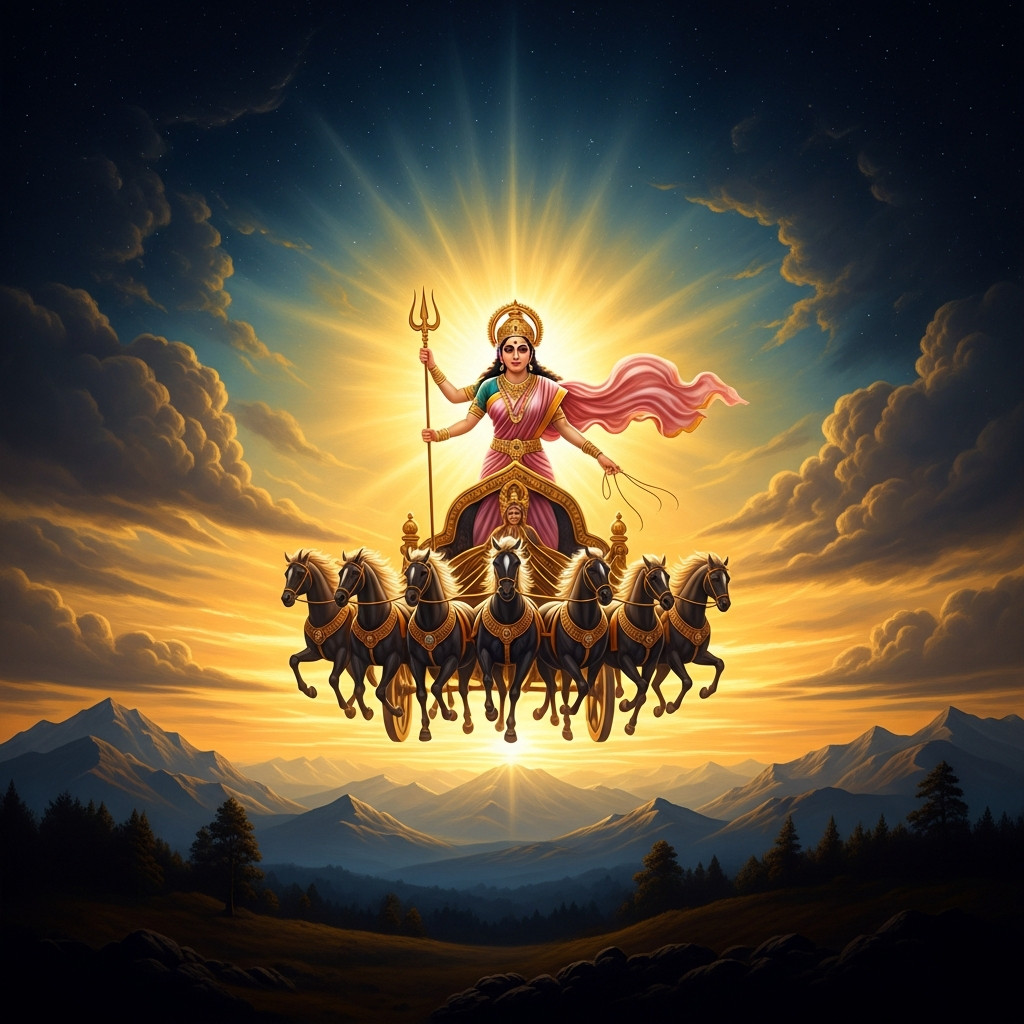
He has many forms. The Vedic theologians counted three: the fire on the earth (the altar, the hearth), the fire in the middle air (lightning), and the fire in the heavens (the sun). They all shared a single nature. When you lit the household fire in the morning, you were lighting a small fragment of the sun. When the lightning split the monsoon sky, that was the same flame on a larger scale. The seer who poured ghee into the morning altar was, in some sense, feeding the cosmos.
But Agni was not only outside. He was also inside. The fire in the belly that digests food — vaishvanara, the all-men’s fire — was Agni. The hymns are very specific about this. The same divinity who carries the sacrifice to heaven sits in the human gut and turns rice into life. The body is an altar. The metabolism is a sacrifice. Every meal is a small soma-pressing.
And he is the messenger. The Vedic gods, with their thousand names and thousand domains, were far away. Indra was in the storm-clouds. Varuna was in the night sky. Surya was the high sun. Soma was the moon, or in the soma-stalk, or in the priest’s bowl. To reach them required a courier, and the courier was Agni. The hymn pours the butter into the flame, the flame consumes it, the smoke rises, and at the top of the smoke the offering arrives at its destination. No fire, no delivery. The Vedic ritual system depended on this single mechanism.
Hence Agni’s other title: the priest of the gods, the god of priests. He sat on both sides of the altar at once. From the human side, he was the senior brahmin presiding over the ceremony. From the divine side, he was the immortal counterpart who received what the brahmin offered. He doubled himself across the line that separated heaven and earth, and so he could carry messages across.
The hymns to Agni are some of the most numerous in the Rig Veda — perhaps two hundred of them, distributed across all ten books. They tend to share a particular quality: gratitude. Agni is the god of dependable presence. He answers when called. You strike the fire-sticks together — the lower stick the female araṇi, the upper stick the male — and from the friction Agni is born, again, every morning, in your own household. The hymns call him the most-recently-born and the eldest at the same time, because he was born this morning and he is older than the sun.
There is a story buried in one of the hymns. Agni hid. The seers say he was tired or afraid; he fled and concealed himself in the waters, and the gods could not find him. Without him sacrifice was impossible. The gods searched. A fish — or in some versions a frog — gave him away. He emerged, reluctantly, and resumed his duties. The story is brief and odd, and the priests took from it a doctrine: Agni is also in the waters. The fire is hidden in everything. Even what looks cold has him inside.
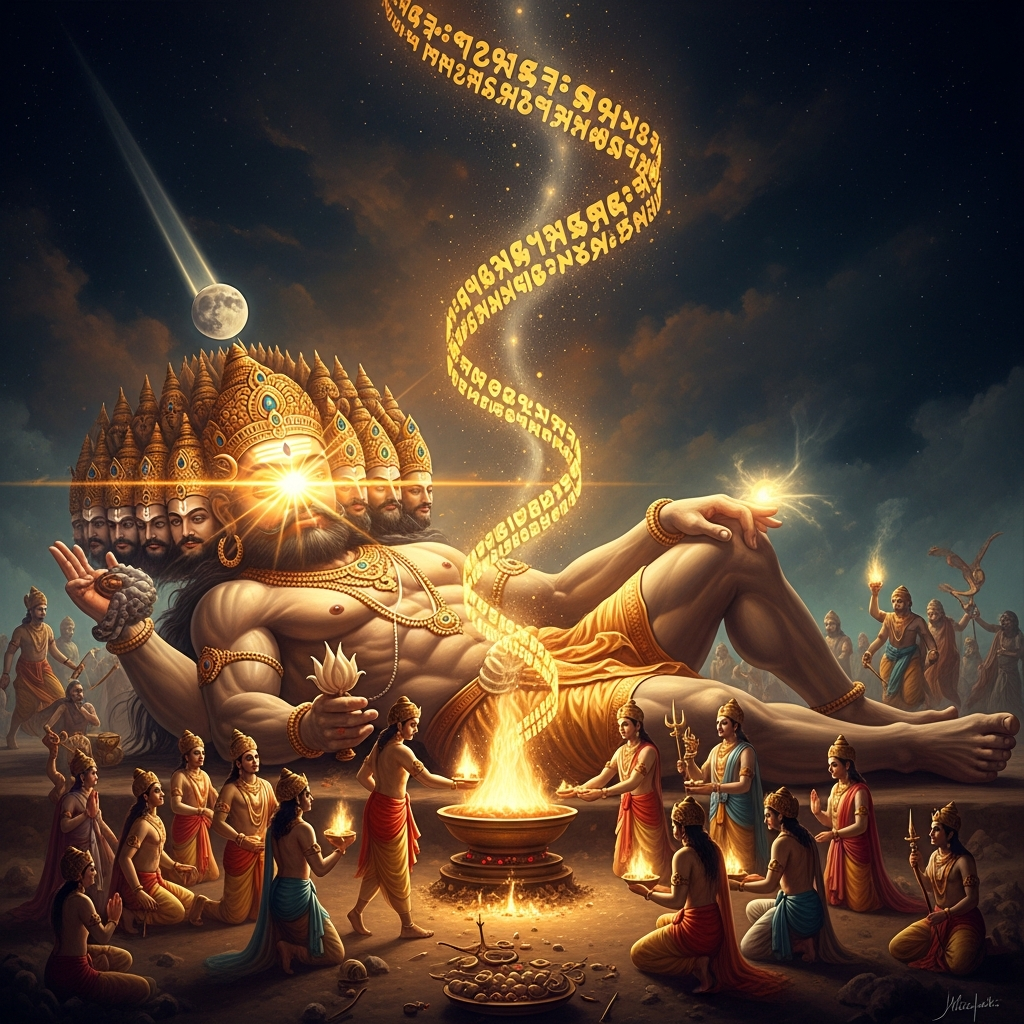
He is the funeral fire too. This is harder to write about, but it is the same god. When a Vedic man died, his body was carried to the cremation ground and given to Agni one last time. The hymn that accompanied this rite — the great Rig Veda 10.16 — addresses Agni with a tenderness that is almost shocking after the rest of the Veda’s pomp. Burn him not entirely, the verse says. Do not split his skin. Do not crack his bones. Cook him kindly, and send him to the fathers. Agni had been the family’s friend his whole life — sitting in the hearth, accepting the morning offering, digesting his food — and now he was conducting him out.
This is why Agni was beloved. The other gods were powers; Agni was an intimate. He was in the kitchen. He was in the body. He was the warmth of the home in the cold months and the only god you could touch, with proper care, every day. The other gods you imagined; Agni you saw. The flame was their visible representative, and he never failed to come when called.
Agni I praise. The household priest. The divine minister of the sacrifice. The offerer-of-oblations. So begins the Veda, and so, every morning for three thousand years, it has been begun again — at altars in the high country, at hearths in village houses, at temple lamps in the long nights — by people striking two sticks together and waiting, with the patient certainty of all those who have done this before, for the small flame to lift, take the butter, and start its long climb toward heaven.
Echoes Across Traditions
Entities


Sources
- Rig Veda 1.1 (the opening hymn of the Veda)
- Rig Veda 3.17, 3.27, 4.4, 6.16
- Shatapatha Brahmana 2.2.4 (the kindling rite)