The Judgment of Paris: One Apple, One City, One War
The mythological events placed before the Trojan War, which ancient Greeks dated c. 1250-1180 BCE; the Judgment of Paris appears in archaic sources and vase painting from c. 600 BCE onward · The wedding feast of Peleus and Thetis on Mount Pelion; the slopes of Mount Ida near Troy, where Paris was a shepherd; the court of Menelaus in Sparta
Contents
Eris throws a golden apple 'for the fairest' at a wedding feast. Three goddesses compete. Paris of Troy judges. He chooses Helen. Troy burns.
- When
- The mythological events placed before the Trojan War, which ancient Greeks dated c. 1250-1180 BCE; the Judgment of Paris appears in archaic sources and vase painting from c. 600 BCE onward
- Where
- The wedding feast of Peleus and Thetis on Mount Pelion; the slopes of Mount Ida near Troy, where Paris was a shepherd; the court of Menelaus in Sparta
She was not invited.
Eris, goddess of discord, was left off the guest list for the wedding of Peleus and Thetis. This is understandable — who invites the goddess of discord to a wedding? — and it is also, in mythological logic, fatal. Excluding the disruptive force from the proceedings does not neutralize the disruptive force. It determines when and how it will express itself.
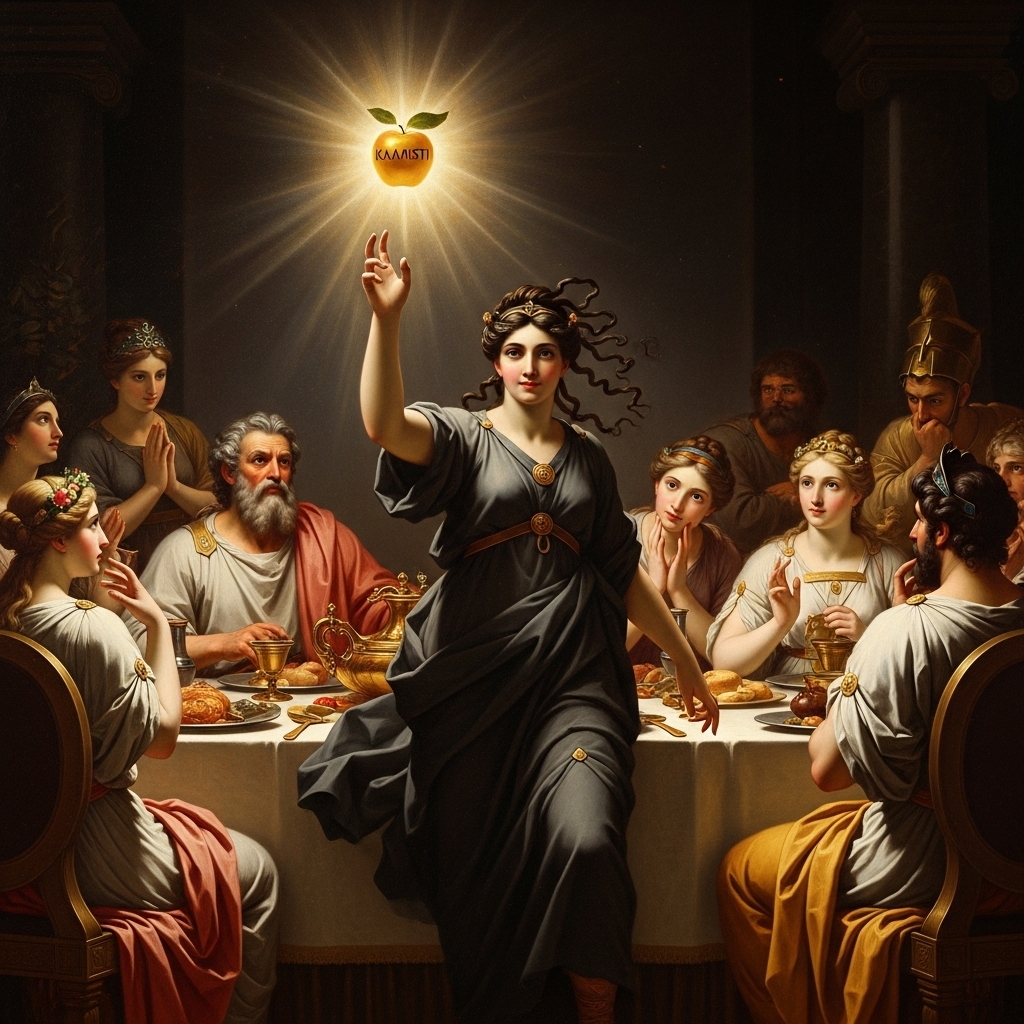
Eris arrives anyway.
She walks to the door of the wedding hall. She does not come inside. She rolls a golden apple through the door, across the floor, to where the divine guests are sitting.
The apple is inscribed: For the fairest.
Three goddesses reach for it simultaneously.
Hera is queen of the gods, wife of Zeus, sovereign of marriage and family. Her claim to fairest is institutional: she is the first among divine women by rank.
Athena is goddess of wisdom and strategic war, born from Zeus’s head fully armored. Her claim is intellectual: wisdom is the highest beauty.
Aphrodite is the goddess of love and sexual desire, born from the sea foam at the place where Ouranos’s severed genitals fell into the water. Her claim is literal: she is the source of beauty, the force that makes things appear beautiful or not.
All three are technically correct.
None of them will give up the apple.
Zeus refuses to judge.
This is the detail that matters most and gets the least attention. The most powerful being in the cosmos, the one who ends disputes among the gods, the husband of one of the contestants and the father (by different means) of the other two — Zeus will not touch this. He delegates it to Hermes, who travels with the three goddesses to Mount Ida, near Troy, where a young shepherd is tending his flock.
The shepherd is Paris.
He is a prince of Troy living as a shepherd because at his birth the augurs declared he would destroy the city, and his father Priam had him exposed on the mountain, and the shepherd who was supposed to leave him there couldn’t quite do it, and Paris grew up in the hills.
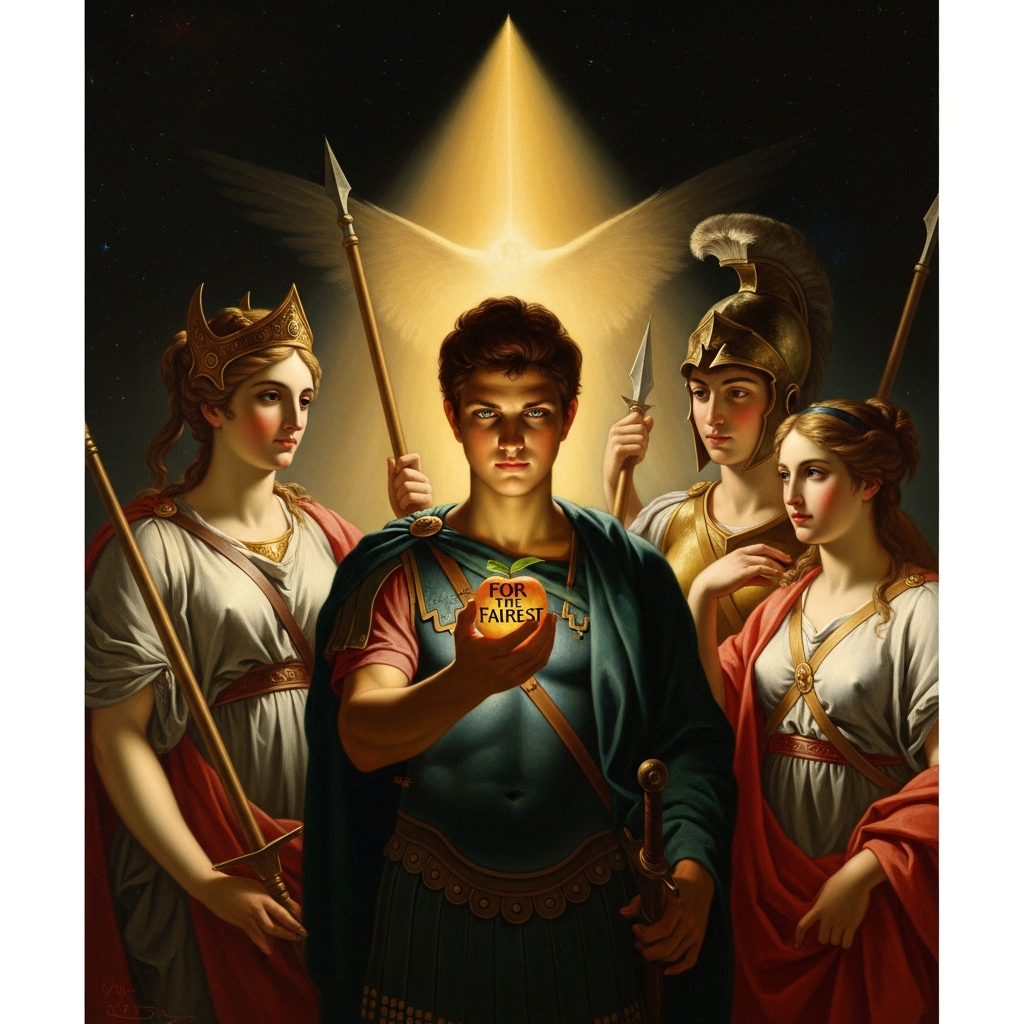
Hermes delivers the three goddesses to the shepherd and gives him the golden apple and tells him to judge.
Each goddess makes her case. Each offers a bribe.
Hera offers power: sovereignty over the kingdoms of men, dominion over nations. If Paris chooses her, he will rule.
Athena offers wisdom and military skill: he will be the greatest strategist alive, undefeatable in war, the wisest man of his generation. If Paris chooses her, he will be invincible.
Aphrodite offers love: the most beautiful woman in the world, Helen, wife of the Spartan king Menelaus, will love him. If Paris chooses her, he will have that.
Paris gives the apple to Aphrodite.
He goes to Sparta.
Menelaus receives him with full hospitality — the Greek xenia, the sacred guest-friendship that makes the host responsible for the guest’s wellbeing and the guest responsible for the host’s honor. Menelaus is away at a funeral in Crete. His wife Helen and their guest Paris are alone together.
Whether Helen was taken by force or left willingly is the question the Iliad never fully answers and every subsequent retelling has to decide. Helen in the Iliad blames herself. Helen in Euripides’s Trojan Women blames Aphrodite. Helen in Euripides’s Helen was never in Troy at all — a phantom of her was sent there and the real Helen waited in Egypt. The myth cannot decide what she chose because the myth is about the impossibility of that question when divine compulsion is involved.
They go to Troy. They take the Spartan treasury.
Menelaus sends messengers to every king in Greece.
The kings in Greece had all previously courted Helen. Her father Tyndareus, facing the problem of choosing among them without triggering a war, had required each suitor to swear an oath: they would accept the chosen man’s marriage to Helen, and they would defend that marriage if it were ever threatened.
The suitors who swore include Odysseus, who didn’t want to swear but had to; Achilles’s father Peleus — who is now dead, but whose son is available; Agamemnon, king of Mycenae and the most powerful king in Greece; Ajax; Diomedes; Menestheus.
Menelaus calls in the oath.
The fleet gathers at Aulis.
The fleet is a thousand ships.
The number is Marlowe’s — Was this the face that launched a thousand ships / And burnt the topless towers of Ilium? — but it captures something the myth always understood: the scale of destruction that a single choice at a single moment can produce. Paris chose the apple for love. He chose Helen for love. He went to Sparta for love. He took her for love. And a thousand ships cross the Aegean, and the best men of two generations will die on the beach at Troy, and the city will burn.
Hector dies. Achilles dies. Ajax goes mad and kills himself. Agamemnon comes home and is murdered by his wife. Odysseus wanders for ten years. Troy burns.
Helen goes home to Sparta. Menelaus takes her back. Their marriage continues. The sources generally agree that they are reconciled, that she is beautiful, that she returns to her former life.
The civilization that destroyed itself to retrieve her is gone.
The myth is about causation, not about blame.
Eris is the goddess of discord. She produces discord. That is what she does; excluding her from the proceedings did not change what she does. The three goddesses each made a legitimate claim. The bribe each offered was genuinely hers to give. Paris chose genuinely — not unwisely, from the perspective of a young man who has been told that the most beautiful woman in the world will love him.
Every step is locally rational.
The aggregate is catastrophe.
This is the insight that makes the Judgment of Paris more than a pretty story about goddesses competing. It is a theory of how systems fail: not through single acts of villainy but through the collision of individual rationalities within a system that has no mechanism for handling a dispute about value.
Hera’s bribe: power. Athena’s bribe: wisdom. Aphrodite’s bribe: love. Paris chooses love.
The myth does not say he was wrong.
It shows what the choice costs.
It shows what love costs, when love requires taking what belongs to someone else, in a world held together by the oath of kings.
The apple is still rolling across the floor.
Echoes Across Traditions
Entities
- Paris
- Eris
- Hera
- Athena
- Aphrodite
- Helen
- Peleus
- Thetis
- Achilles
Sources
- Hyginus, *Fabulae* 91-92 (c. 1st-2nd century CE)
- Euripides, *Iphigenia at Aulis* (c. 408 BCE)
- Euripides, *Trojan Women* 924-932 (415 BCE)
- Pseudo-Apollodorus, *Epitome* 3.2 (c. 2nd century CE)
- Colluthus, *The Rape of Helen* (c. 5th-6th century CE)
- M.I. Finley, *The World of Odysseus* (1954)
- Sarah B. Pomeroy, *Goddesses, Whores, Wives, and Slaves* (1975)