Prometheus Bound: The Price of Stolen Fire
Hesiod's canonical account c. 700 BCE; dramatic treatment by Aeschylus c. 430 BCE; the myth in oral tradition certainly centuries earlier · The forge of the gods on Olympus; the road from heaven to earth; a crag in the Caucasus mountains; the hall of the gods where Loki is bound
Contents
Prometheus steals fire from the gods and gives it to humanity. Zeus chains him to a rock. Each day an eagle eats his liver. Each night it grows back. The torment is eternal — until it isn't.
- When
- Hesiod's canonical account c. 700 BCE; dramatic treatment by Aeschylus c. 430 BCE; the myth in oral tradition certainly centuries earlier
- Where
- The forge of the gods on Olympus; the road from heaven to earth; a crag in the Caucasus mountains; the hall of the gods where Loki is bound
He is a Titan, which means he is old enough to remember when things were different.
Before Zeus, there were the Titans. Prometheus is one of them — a son of the Titan Iapetus, a being of the second divine generation, which puts him in a complicated position when the third generation (the Olympians under Zeus) wins the war and takes over the world. Prometheus backed the winning side. He is clever enough to have seen it coming.
His name means forethought. His brother is Epimetheus: afterthought. The myth contains its own epistemology in the family tree.
The trouble begins with a negotiation at Mecone.
The gods and men are dividing up the sacrificial offerings. Prometheus is the advocate for the human side, and he rigs the deal. He slaughters an ox and divides it into two portions: in one, the meat and organs, wrapped in the ox’s stomach to look unappealing; in the other, the bones, wrapped in rich white fat to look magnificent.
He offers Zeus the choice.
Zeus knows it is a trick — the texts are careful about this; Zeus is not fooled. He chooses the fat-wrapped bones anyway. He is choosing to be angry. He is choosing the grievance that will justify what comes next.
What comes next is that Zeus removes fire from the world of men.
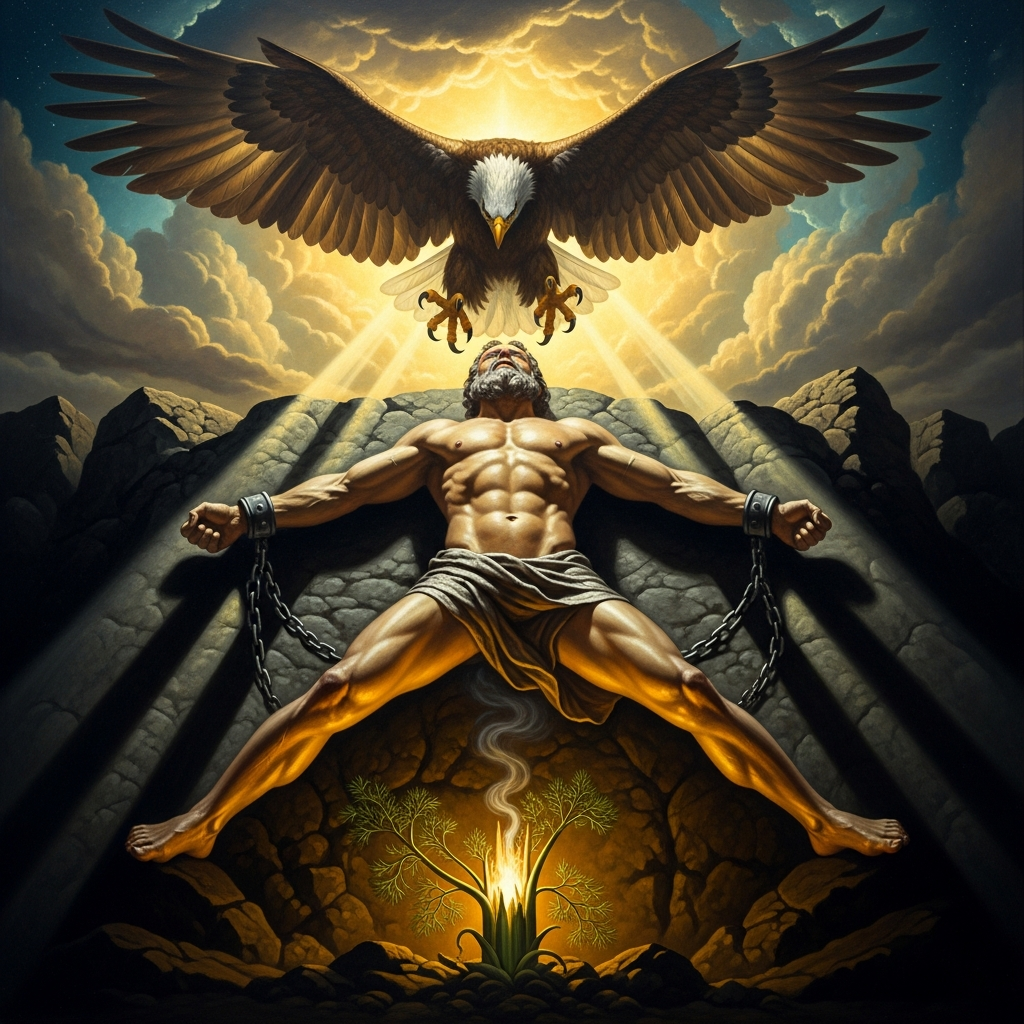
Prometheus steals it back. He takes a hollow reed and carries fire from the forge of Hephaestus, a live coal in the fennel stalk, and walks it down to earth.
Zeus’s punishment is comprehensive.
First comes Pandora — the first woman, fashioned from clay by Hephaestus at Zeus’s order, given a jar containing all the evils that humanity will now have to endure. This is the punishment aimed at men. Every disease, every grief, every hardship that empties from the jar: this is what fire costs the human race in the Hesiodic account.
Then comes the punishment for Prometheus himself.
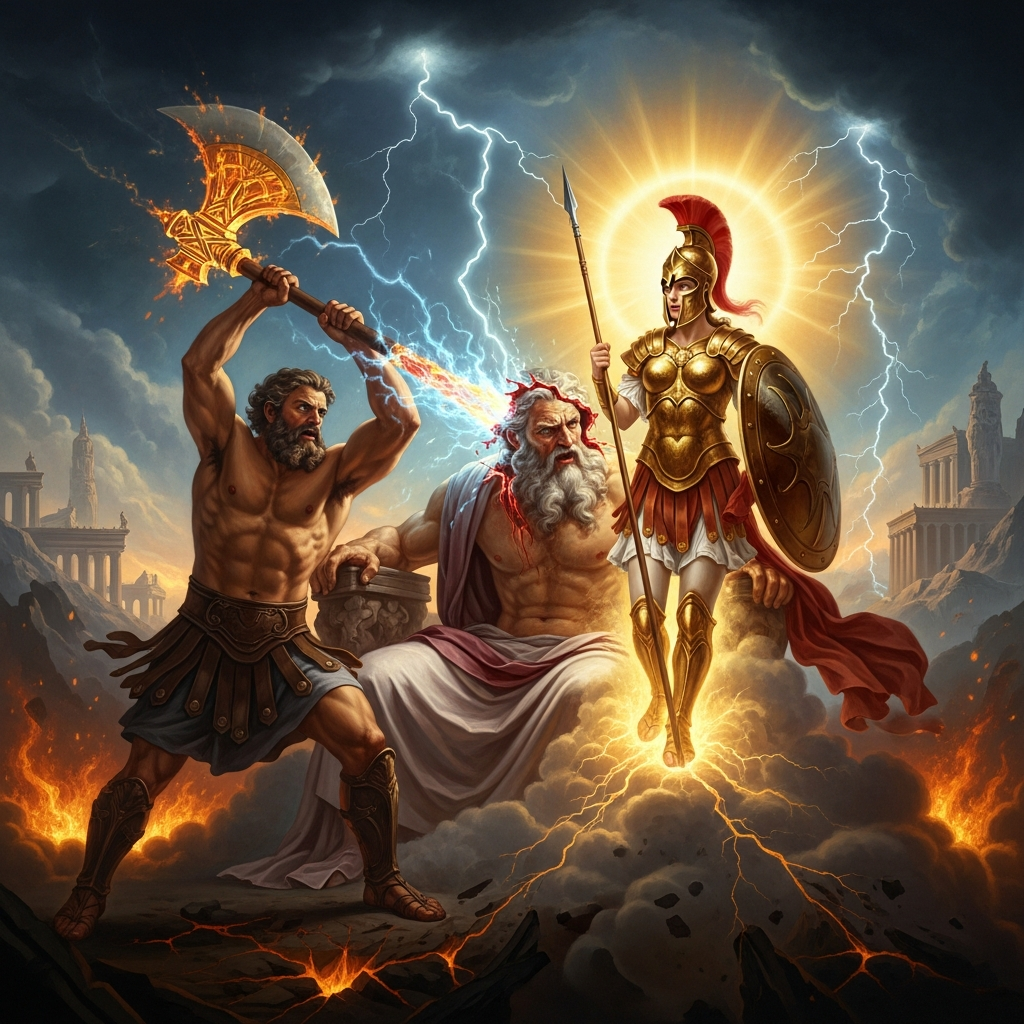
Hephaestus binds him to a crag in the Caucasus. The binding is with unbreakable chains, adamantine — the same material the gods use for anything they don’t want broken. The crag is remote. The sun reaches it. The wind reaches it. The cold at night reaches it.
An eagle comes each morning.
It lands on his chest. It tears open his side. It eats his liver through the day while he cannot move and cannot die, because he is a Titan and death is not available to him. At night, when the cold comes, the liver grows back. The next morning the eagle returns.
This happens every day.
Aeschylus wrote a trilogy about it. Only one play survives: Prometheus Bound, in which Prometheus is chained on stage throughout, visited by a series of gods who offer him variations on the same message — confess, apologize, tell Zeus the secret you are keeping, and the torment will end.
Prometheus refuses.
The secret is this: he knows who will bear the son that overthrows Zeus. He knows the prophecy. He is keeping it because it is the only leverage he has, and he has decided to suffer for as long as it takes rather than give it up.
Io passes through — a woman Zeus transformed into a cow, wandering the earth stung by a gadfly, a different kind of torment for a different kind of divine attention. Prometheus prophesies her descendants. Somewhere in them, generations hence, will be the one who frees him.
Hermes arrives in the final scene and offers the deal one more time. Prometheus tells him to leave. The play ends with the mountain falling on Prometheus — Zeus’s final move, burying him alive. The suffering continues underground.
The second and third plays of the trilogy, in which Heracles eventually comes and frees him, are lost. We know the outcome from other sources: the demigod finds the rock, shoots the eagle, breaks the chains. Prometheus is freed after what the various sources compute as somewhere between thirty thousand and thirty thousand years of the eagle.
He is freed. Zeus is not overthrown. The prophecy is eventually disclosed and averted. The cosmos continues.
A thousand years and a different tradition to the north: Loki.
The Norse Loki is not Prometheus, but the pattern is too close to ignore. Loki is the trickster god, part of the Aesir by adoption, clever in ways the other gods are not, responsible for gifts they enjoy — Odin’s spear, Thor’s hammer, Freya’s necklace — and responsible also for the worst catastrophe in Norse mythology: the death of Baldr.
After Baldr’s death, the gods find Loki. He has turned himself into a salmon to hide in a waterfall. They net him. They drag him to a cave.
They bind him across three sharp-edged stones with the entrails of his own son Narfi, which have been turned to iron fetters. A serpent is fastened above him. The venom drips onto his face.
His wife Sigyn holds a bowl under the serpent’s fangs to catch the venom. When the bowl is full she must empty it, and in those moments the venom reaches his face, and the pain is such that Loki writhes, and the earth shakes. That is the Eddic explanation for earthquakes: Loki writhing in his cave.
He will be bound until Ragnarok, when the fetters break and the world ends.
The two myths together form a category. Call it the bound benefactor.
The benefactor is always a trickster or a liminal figure — Prometheus as Titan in an Olympian world, Loki as a fire-giant in an Aesir world. They are outsiders who are also insiders, which gives them access to things full insiders do not have. They use that access to obtain something impossible and give it away.
The gods punish not the giving but the taking. What was stolen was theirs. The disruption to the divine order is the crime, not the humans who benefit.
And the humans, in both myths, are nowhere to be seen during the punishment. They have their fire. They have their winter. They are warm, or cold as fate allows, and the Titan who walked the fennel stalk to their hearths is hanging on a mountain being eaten by an eagle that he cannot kill.
The myth knows what it is saying.
When a civilization builds itself on stolen fire — on knowledge or technology or freedom that power would not have given willingly — someone usually paid for the theft. It is rarely the people who are warmed by the flame. It is the one who carried the coal.
The liver grows back each night so the eagle can eat it again in the morning.
That is the structure of the transaction.
That is the price.
Echoes Across Traditions
Entities
- Prometheus
- Zeus
- Heracles
- Hephaestus
- Io
- Hermes
- Loki

Sources
- Aeschylus, *Prometheus Bound* (c. 430 BCE)
- Hesiod, *Theogony* 507-616 (c. 700 BCE)
- Hesiod, *Works and Days* 42-105 (c. 700 BCE)
- Apollodorus, *Library* I.7.1 (c. 2nd century CE)
- Snorri Sturluson, *Prose Edda*, Gylfaginning and Skáldskaparmál (c. 1220 CE)
- Carol Dougherty, *Prometheus* (2006)
- Norman O. Brown, *Hesiod's Theogony* (1953)