The Wedding of Peleus and Thetis: The Party That Started a War
Placed in mythological time before the Trojan War, which ancient tradition dated c. 1250-1180 BCE; the apple of Eris episode as a narrative unit is attested in archaic sources and the Epic Cycle (c. 7th-6th century BCE) · Mount Pelion in Thessaly, where the centaur Chiron has his cave; the wedding hall of Peleus; the slopes where the Olympians gather
Contents
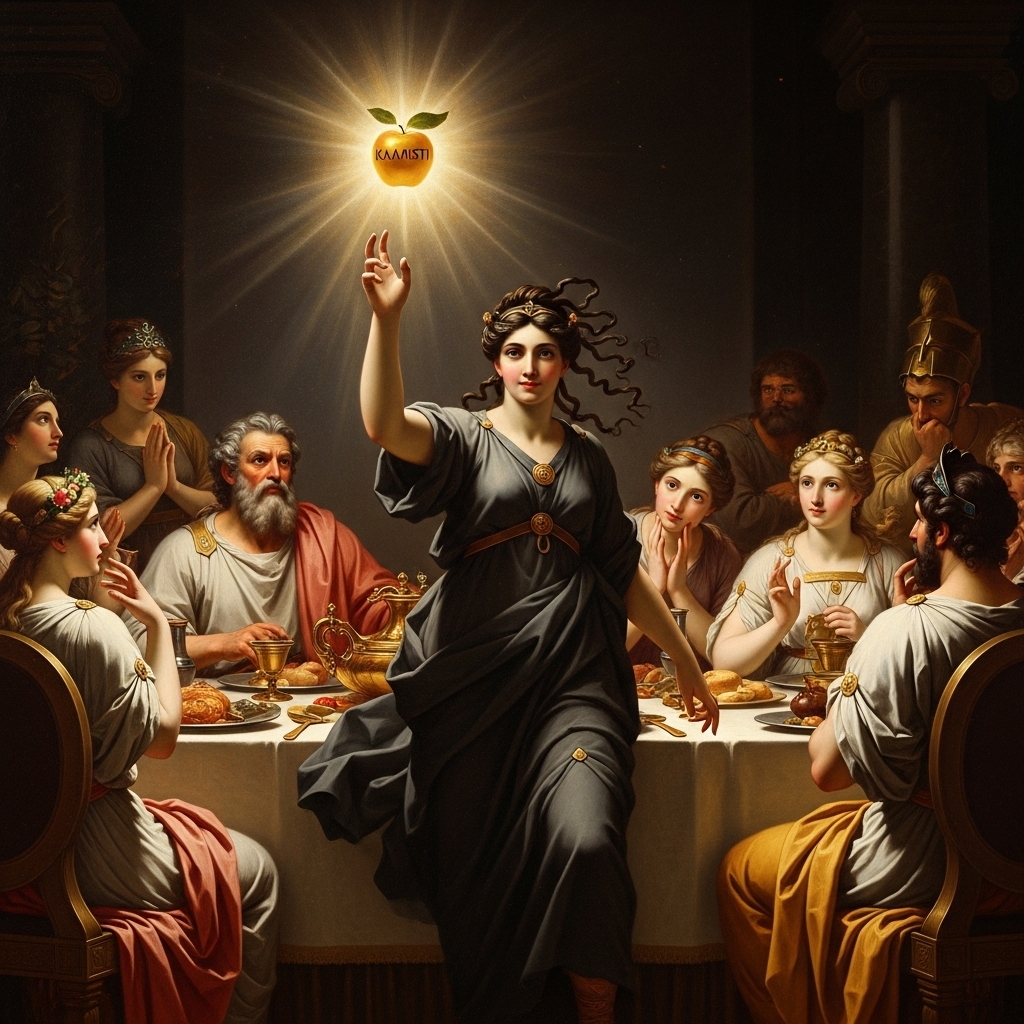
Every god is invited to the wedding of Peleus and Thetis — except Eris, goddess of discord. She arrives anyway and throws the golden apple 'for the fairest.' The apple will not stop rolling until Troy is ash.
- When
- Placed in mythological time before the Trojan War, which ancient tradition dated c. 1250-1180 BCE; the apple of Eris episode as a narrative unit is attested in archaic sources and the Epic Cycle (c. 7th-6th century BCE)
- Where
- Mount Pelion in Thessaly, where the centaur Chiron has his cave; the wedding hall of Peleus; the slopes where the Olympians gather
Begin with the problem.
The sea-nymph Thetis is too beautiful.
Zeus wants her. Poseidon wants her. The Olympian court has its desires, as it always does, and Thetis is among the most beautiful beings in the divine world — a sea-nymph who can change shape, who is physically extraordinary, who is the daughter of the old sea-god Nereus.
But there is a prophecy.
The son of Thetis will be greater than his father.
This is, in the Greek cosmological arrangement, disqualifying. Zeus is the third divine generation — he overthrew Cronus, who overthrew Ouranos. The pattern of son-surpassing-father is the operative principle of divine succession. If Zeus fathers a son on Thetis, that son will surpass Zeus. If Poseidon fathers a son on Thetis, that son will surpass Poseidon.
Neither Zeus nor Poseidon will take that risk.
They arrange for Thetis to marry a mortal.
The mortal chosen is Peleus, king of Phthia in Thessaly.
Peleus has his own heroic credits: he sailed with the Argonauts, he hunted the Calydonian Boar, he is counted among the worthwhile heroes of his generation. But he is mortal, and a sea-nymph’s marriage to a mortal is a diminution — a divine being stepping down from what she could have been.
Thetis does not want this marriage.
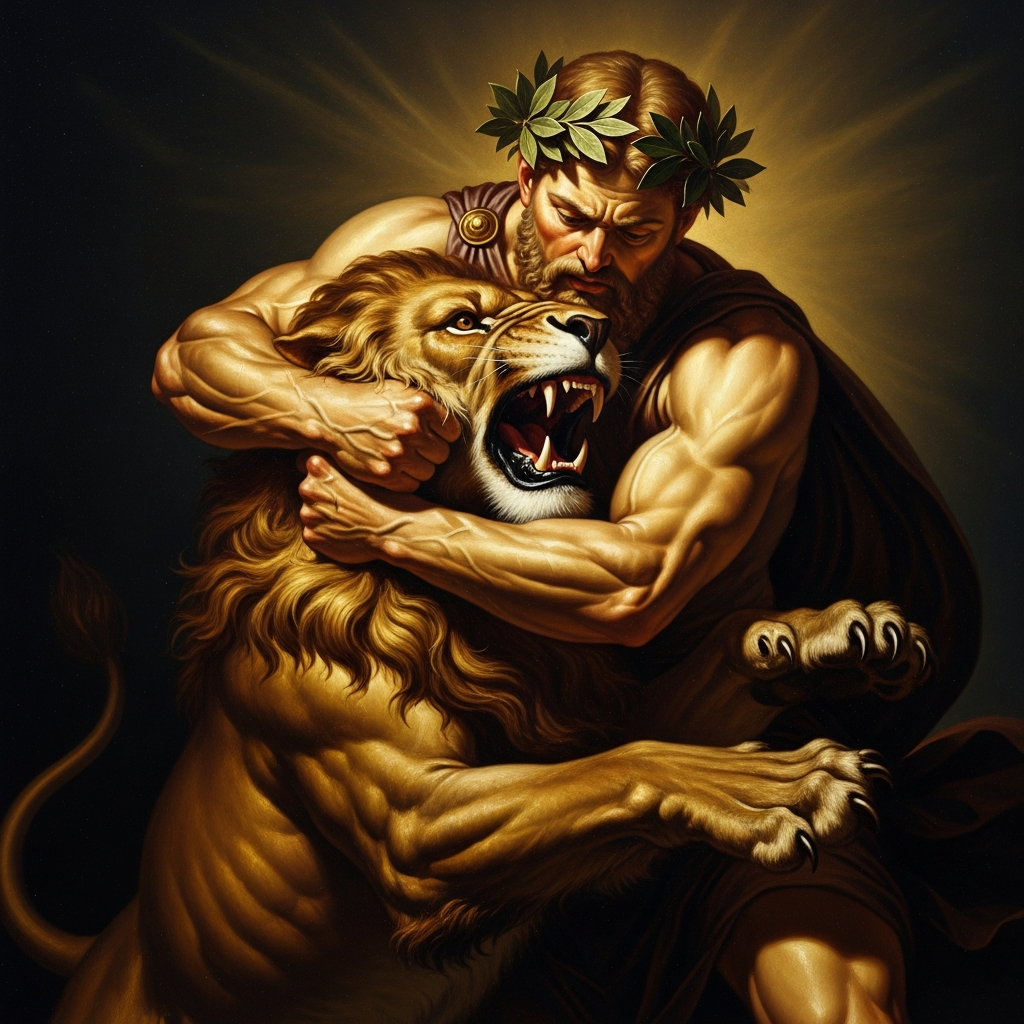
She shape-shifts to resist him — she becomes fire, then water, then a lion, then a serpent. Peleus has been told (by Chiron the centaur, who knows everything useful) to hold on. He holds on through all the shapes. She becomes herself again. The marriage proceeds.
The wedding is on Mount Pelion.
All the gods are invited. The Muses come and sing. Chiron provides the hall. The Nereids dance. The food is divine, the wine is divine, the whole occasion is the kind of event that the Olympian world assembles for only occasionally — a divine-mortal marriage that the divine world has chosen to bless.
Every god is there.
Except Eris.
Eris is the goddess of discord. Her name means strife. Her genealogy in Hesiod is striking: she is the daughter of Night, the sister of Death and Sleep and the Fates. She is the power that makes armies fight, that makes neighbors hate each other, that turns a misunderstanding into a blood feud. She is present, in the Iliad, at every battle.
She was not invited to the wedding because who invites discord to a celebration?
She arrives anyway.
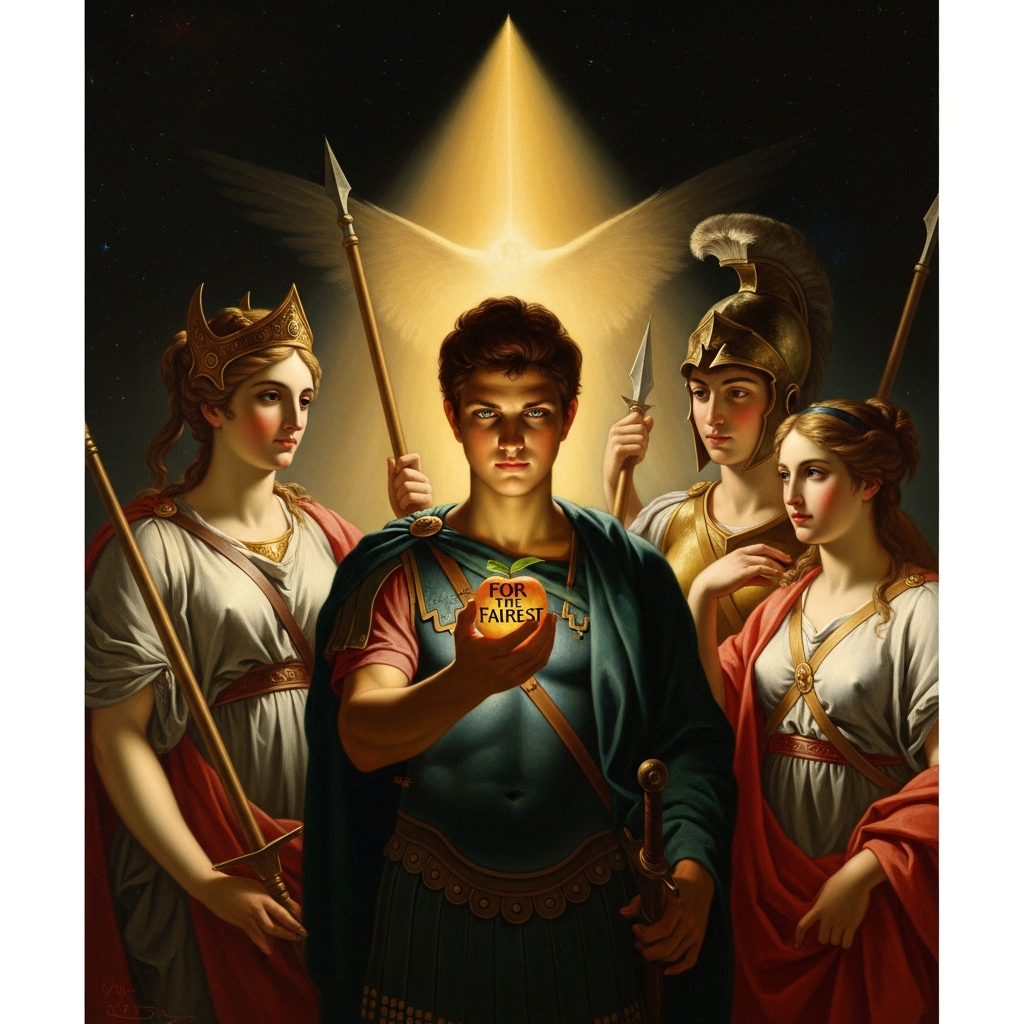
She stands at the door — she may not come inside without invitation, or she chooses not to come inside, the sources don’t quite agree — and she rolls a golden apple through the door. The apple lands among the divine guests. It is inscribed for the fairest.
She turns and leaves.
What follows is described elsewhere on this site in the Judgment of Paris.
The three goddesses — Hera, Athena, Aphrodite — compete for the apple. Zeus refuses to judge. The apple goes to Mount Ida. Paris decides. Helen goes to Troy.
The point of tracing it back to the wedding is the proportionality.
One uninvited guest. One apple. The length of the causal chain that follows: Paris’s judgment leads to Menelaus’s outrage leads to the oath of the suitors leads to the fleet at Aulis leads to Iphigenia’s sacrifice leads to ten years of siege leads to the death of Hector leads to the death of Achilles leads to the wooden horse leads to the death of Priam and the burning of Troy leads to Agamemnon’s murder leads to Orestes’s trial.
Two decades of catastrophe, ending with nearly everyone involved dead and a civilization ended.
From one apple.
Thetis knows what is coming.
She has married Peleus. They have a child. He is extraordinary from birth — she recognizes this, the gods recognize this, Chiron recognizes this and educates him in the cave on Mount Pelion: medicine, music, hunting, the art of war.
She tries to prevent the inevitable.
In some accounts she dips him in the Styx — the river of the underworld — to make him invulnerable. She holds him by the heel and the heel doesn’t enter the water. This is the most famous version. In older accounts, she holds him in fire at night to burn away his mortality and Peleus interrupts her, and the attempt fails.
She tries various things. The baby survives them all. He is extraordinary. He is also mortal. The heel — or the fire — or the mortality that she cannot quite extract — ensures it.
She hides him eventually on the island of Scyros, dressed as a girl among the daughters of the king Lycomedes. The prophecy is coming: the Trojan War will require Achilles, and Achilles will not return from it. She is hiding the thing she cannot save.
Odysseus finds him.
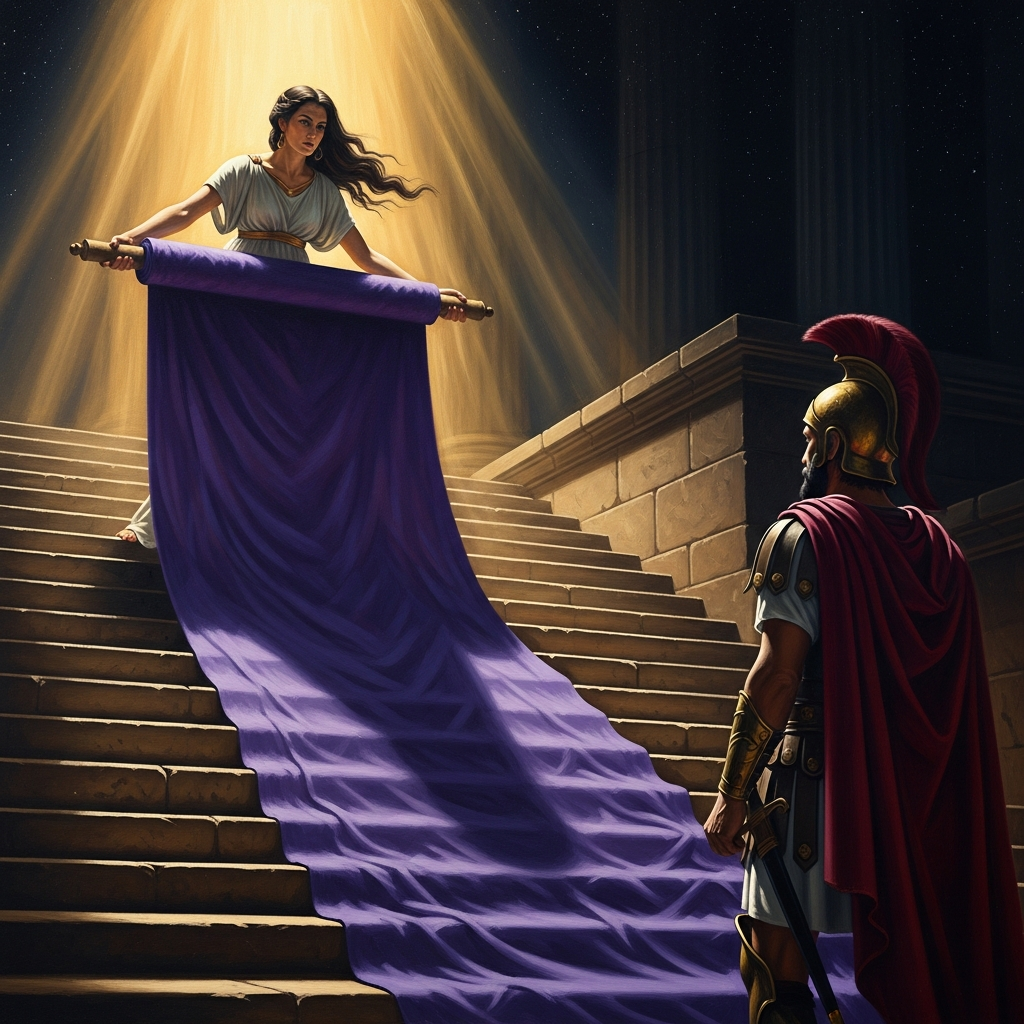
Odysseus arrives on Scyros disguised as a merchant, carrying women’s gifts — cloth, perfume, jewelry — and also a sword and a shield. He watches the girls who gather around the goods. One of them picks up the sword.
That is Achilles.
The wedding happened. The apple was thrown. The judgment was made. The war happened. Achilles died at Troy, shot in the heel by Paris guided by Apollo, having killed more Trojans than any other Greek warrior and having been the instrument of Hector’s death, which was the moment the war became inevitable.
The causal chain ran exactly as far as it needed to run.
Thetis grieves him as she always knew she would. She is a goddess; her grief does not kill her. She is still there at the end of the Iliad when Achilles asks for honor and she brings it to him from Olympus. She is still there at the sea’s edge.
Peleus grows old and mortal in the way mortals do. She is not there.
The wedding was a mistake they both entered into because the prophecy required it — neither of them chose the other freely; it was the gods’ solution to the problem of the prophecy. The prophecy was the problem, and the solution produced a dead son and a grieving goddess and a burned city.
Catullus, the Roman poet, wrote the longest surviving literary treatment of the wedding of Peleus and Thetis — Poem 64, composed around 60 BCE. It is ekphrastic: it describes a tapestry on the wedding bed that shows the story of Ariadne abandoned by Theseus, which is a story of betrayal and divine consolation. The tapestry on the wedding bed shows the costs of the divine world’s interactions with the mortal one.
Catullus ends the poem by saying the gods used to walk among humans and attend their weddings, but now they no longer do, because humanity has become too corrupt for divine presence.
He has it backwards.
The gods stopped attending human weddings because of what happened the last time they did.
The apple is still rolling.
Echoes Across Traditions
Entities
- Peleus
- Thetis
- Achilles
- Eris
- Zeus
- Hera
- Athena
- Aphrodite
- Chiron
Sources
- Pindar, *Nemean Odes* 4 and 5 (c. 480-473 BCE)
- Hyginus, *Fabulae* 92 (c. 1st-2nd century CE)
- Pseudo-Apollodorus, *Epitome* 3.1 (c. 2nd century CE)
- Catullus, *Poem 64* (c. 60 BCE) — the most extended surviving literary treatment
- Homer, *Iliad* (c. 750-700 BCE) — presupposes the wedding without narrating it
- M.L. West, *The Epic Cycle* (2013)
- Malcolm Davies, *The Epic Cycle* (1989)