The Labors of Heracles: Twelve Impossible Tasks
The labors as a canonical list of twelve appear in Apollodorus c. 2nd century CE; the cycle's components reach back to Mycenaean Greece, c. 1500-1100 BCE · Greece, the Peloponnese, Crete, Thrace, the land of the Amazons, Erytheia at the edge of the western ocean, the garden of the Hesperides, the underworld itself
Contents
Heracles, in a fit of divinely induced madness, kills his own children. His penance is twelve labors set by King Eurystheus — each one designed to be fatal, each one a cosmological act of monster-cleansing.
- When
- The labors as a canonical list of twelve appear in Apollodorus c. 2nd century CE; the cycle's components reach back to Mycenaean Greece, c. 1500-1100 BCE
- Where
- Greece, the Peloponnese, Crete, Thrace, the land of the Amazons, Erytheia at the edge of the western ocean, the garden of the Hesperides, the underworld itself
The labors begin with a murder.
Hera has hated Heracles since before his birth — since the night Zeus disguised himself as Alcmene’s husband and fathered the child that was coming, since she delayed his birth so that the lesser child Eurystheus would be born first and inherit the kingship of Tiryns that Zeus had promised to the next-born son of his bloodline.
She waits until Heracles has a wife and children and a life. Then she sends madness.
The madness comes without warning. Heracles is in his home. He looks at his children and does not see his children. He sees enemies. He lifts his bow. When the madness passes, the house is full of dead bodies — his own sons, his wife’s father Iphicles, an archer who tried to stop him. Heracles is standing in the middle of it holding his bow.
He has to go somewhere with what he has done.
The oracle at Delphi sends him to Eurystheus.
Eurystheus is the king who should never have been born — the child whose birth was artificially accelerated by Hera’s manipulation so he could claim the destiny Zeus intended for Heracles. He is small, frightened, and petty. He hides in a bronze jar when Heracles arrives. He issues his commands from behind closed gates, through a herald.
His instructions are designed to be fatal. Every labor is a death trap. The number twelve is not original to the myth — the canonical list solidified late, in the Hellenistic period — but the principle is consistent: go somewhere nobody survives and bring something back.
Heracles goes.
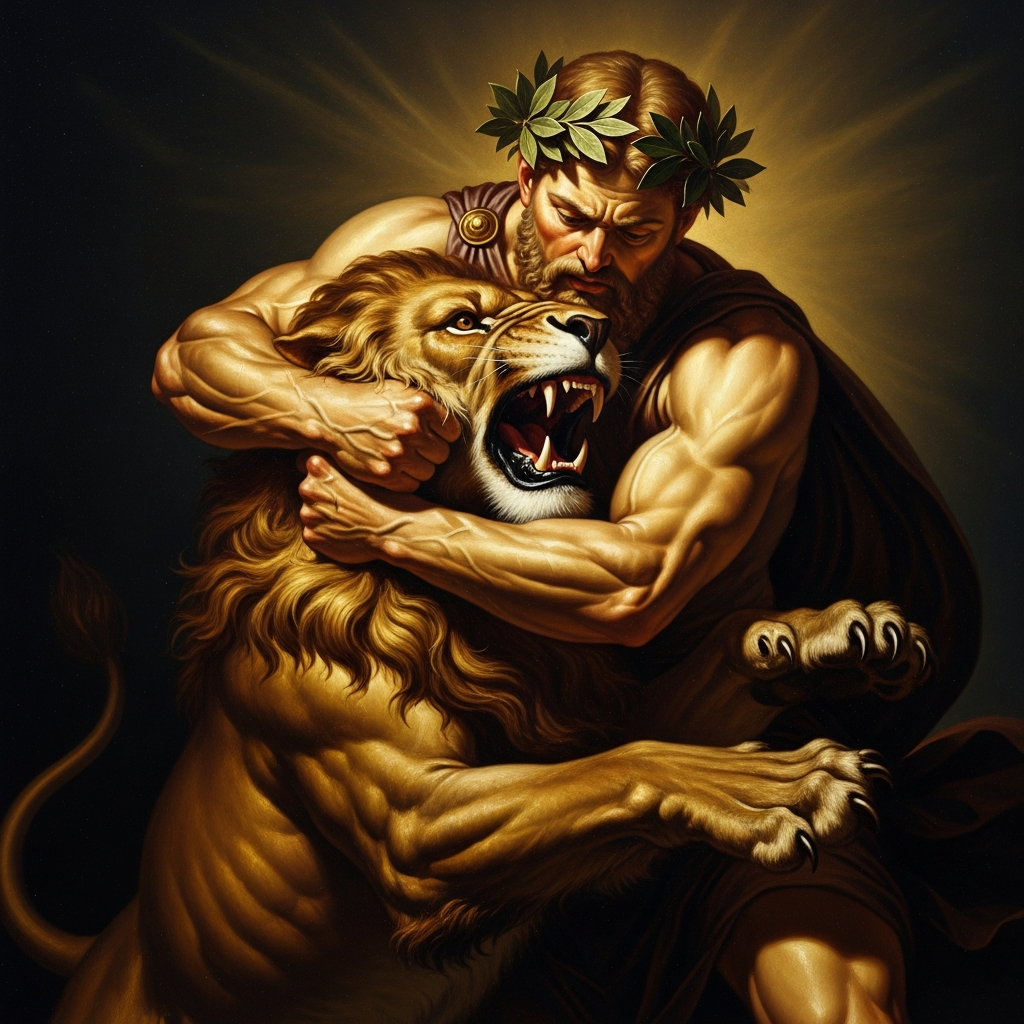
The Nemean Lion cannot be killed by weapons. Its skin deflects arrows and spears. Heracles finds this out empirically — he shoots it, the arrow bounces — and then closes with the lion bare-handed, strangling it. He cannot cut the skin with any blade, so he uses the lion’s own claws to flay it. He wears the skin as armor for all the labors that follow. He carries the club.
The Lernaean Hydra grows two heads for every one cut off. This is the labor where Heracles establishes the pattern that will define his heroism: when straightforward force doesn’t work, adjust. His nephew Iolaus holds a torch and cauterizes each neck stump before the heads regenerate. There is one immortal head; Heracles cuts it off and buries it under a rock. He dips his arrows in the Hydra’s blood, which will matter later.
The Ceryneian Hind is sacred to Artemis and cannot be harmed. Heracles pursues it for a year before catching it without wounding it — patience, not strength, is the tool this time.
The Erymanthian Boar has to be driven into deep snow so it slows down enough to be caught.
The fifth labor is the Augean Stables.
Augeas, king of Elis, has three thousand immortal cattle. The stables have not been cleaned in thirty years. The dung is so thick it has raised the level of the ground around the stables and begun to infect the surrounding farmland. Eurystheus’s choice of this task is a deliberate humiliation: it is not a monster fight, it is sanitation work.
Heracles agrees to clean the stables in a single day in exchange for a tenth of the cattle — without telling Augeas that Eurystheus ordered it. He reroutes the rivers Alpheus and Peneus through the stables. The water clears three decades of dung in a day.
This labor is cosmological hygiene: the hero restores the land’s fertility by performing a task that everyone else found too disgusting to attempt. The symbolism is explicit in the mythological tradition. The world accumulates filth that threatens to overwhelm it, and the hero’s function is not only to fight monsters but to clean up after them — sometimes literally.
The first six labors are in Greece. The last six take Heracles to the edges of the world.
The Stymphalian Birds, which have bronze beaks and poisonous dung and whose flock has grown large enough to blot out the sun over Stymphalus — Athena gives Heracles a bronze rattle (made by Hephaestus) to startle them into the air, then he shoots them.
The Cretan Bull is rampaging and fire-breathing. Heracles wrestles it, ships it back to Eurystheus.
The Mares of Diomedes eat human flesh. Their master Diomedes feeds them his own people. Heracles feeds Diomedes to his own mares, then leads them home.
The Girdle of Hippolyta, queen of the Amazons — Heracles sails to the land of women warriors at the edge of the world. Hippolyta is willing to give up the girdle peacefully; Hera disguises herself as an Amazon and starts a riot. Heracles kills Hippolyta and takes it.
The tenth labor is the Cattle of Geryon.
Geryon lives on the island of Erytheia, at the edge of the western ocean, beyond the Pillars of Hercules — the rocks at the mouth of the Mediterranean that Heracles erected during this journey as markers of the world’s limit. Geryon has three bodies, three sets of heads and legs joined at the waist. He guards cattle with a two-headed dog named Orthus, who is the sibling of Cerberus.
Heracles shoots the sun with an arrow while crossing the scorching western desert because the heat is intolerable. Helios, the sun-god, is so delighted by the audacity that he lends Heracles his golden cup-boat to cross the ocean.
He kills Orthus. He kills Geryon with a single arrow that passes through all three bodies. He herds the cattle back to Greece, fighting his way through Italy and Spain on the return journey, a labor that becomes another labor on its own terms.
The eleventh labor is the Apples of the Hesperides.
The Hesperides are nymphs who guard a garden at the western edge of the world where golden apple trees grow. The garden is also guarded by Ladon, a dragon that never sleeps. The apples are divine fruit.
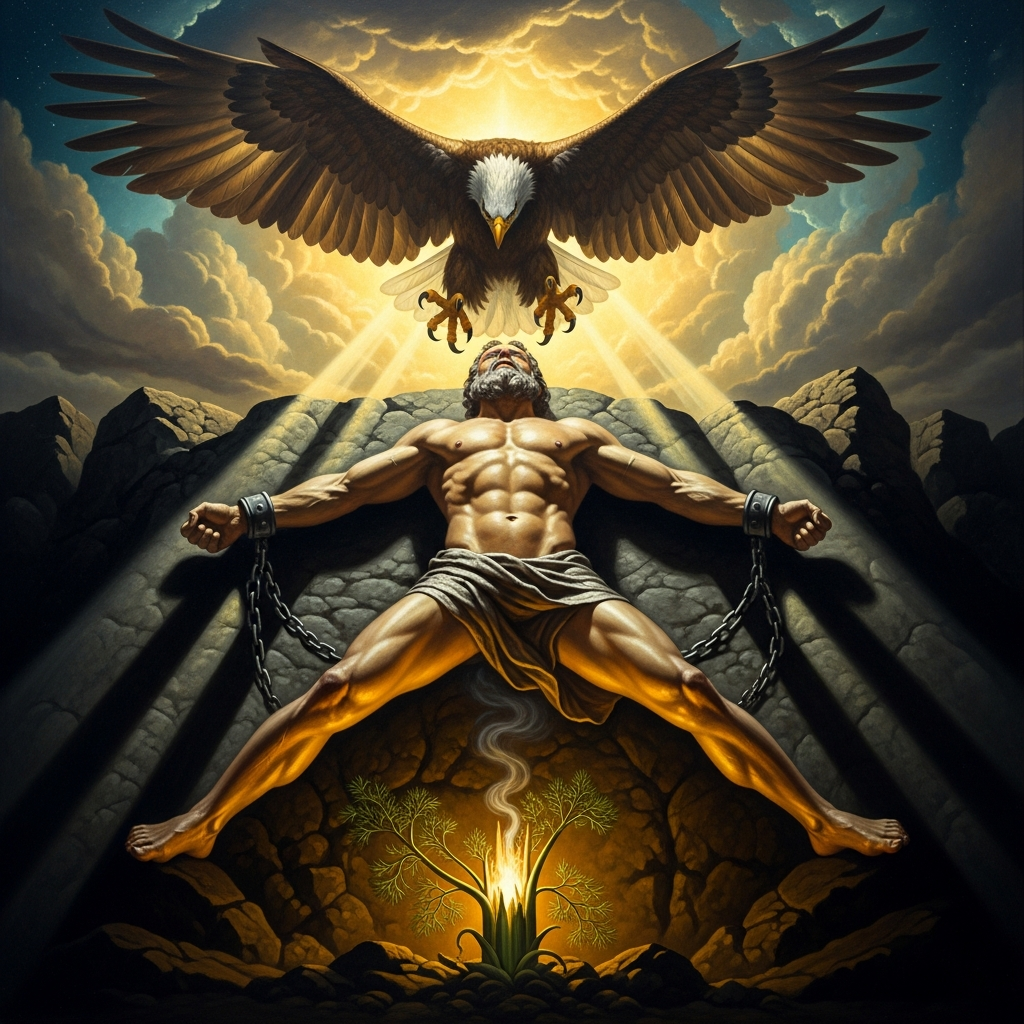
Heracles gets directions from Nereus by catching him and holding on through his shape-shifting. He frees Prometheus from his rock on the way. He holds up the sky so Atlas — who guards the garden’s direction — can fetch the apples. Atlas takes the apples and tries to leave Heracles holding the sky permanently. Heracles agrees to continue holding it if Atlas just takes it back for a moment so Heracles can put a pad on his shoulders. Atlas takes the sky. Heracles picks up the apples and leaves.
The twelfth labor is the underworld.
He goes to Hades alive and asks Hades for permission to borrow Cerberus. Hades, impressed, gives permission — on the condition that Heracles subdue the dog without weapons. He wrestles the three-headed guardian of the dead into submission with his bare hands, carries it to the surface, shows it to Eurystheus (who hides in his jar), and returns it.
The penance is complete.
The labors as a sequence describe a movement: from the immediate vicinity of Heracles’s crime (the Peloponnese, his home territory) outward to the edges of the world and finally down into the world below it. The twelve tasks are a map of the cosmos measured by a man performing penance, and the man winds up having mapped it completely.
He has been to the west where the sun sets and the ocean runs off the edge. He has been to the east where the Amazons live. He has been to the garden of immortal fruit. He has been to the underworld and returned.
He knows the world because his penance required him to traverse it. The crime that should have destroyed him becomes the instrument of his transformation. Every monster he kills was a thing the world needed killing. Every impossible task was a world that needed its impossible problem solved.
The Greeks understood this as justice in the deepest sense: the man who shattered the world by killing his own children repairs the world by spending his life repairing the damage that isn’t even his.
His own damage, the unkillable grief of the thing he did in madness, he carries with him the whole time.
The labors do not heal it.
They make it useful.
Echoes Across Traditions
Entities
- Heracles
- Eurystheus
- Hera
- Iolaus
- Athena
- Hermes
- Admetus
Sources
- Apollodorus, *Library* II.4.12-II.7.7 (c. 2nd century CE) — the fullest surviving systematic account
- Diodorus Siculus, *Library of History* IV.9-39 (c. 60-30 BCE)
- Pindar, *Nemean Odes* 1.33-72 (c. 473 BCE)
- Euripides, *Heracles* (c. 416 BCE)
- G.K. Galinsky, *The Herakles Theme* (1972)
- Walter Burkert, *Structure and History in Greek Mythology and Ritual* (1979)
- Timothy Gantz, *Early Greek Myth* (1993)