Fire Stolen and Fire Born: Prometheus, Agni, Pele, Hephaestus, and Kagutsuchi
Mythic time — across traditions spanning from Vedic Bronze Age to Hawaiian oral tradition · Mount Caucasus, the Vedic altar, Kilauea, the forge beneath Olympus, the birth-moment of Japan
Contents
Fire is the one technology that changed everything, and every culture built a myth around it. Whether fire was stolen, given, born, or discovered reveals what each tradition believed about the relationship between humanity and divine power.
- When
- Mythic time — across traditions spanning from Vedic Bronze Age to Hawaiian oral tradition
- Where
- Mount Caucasus, the Vedic altar, Kilauea, the forge beneath Olympus, the birth-moment of Japan
Fire is the technology that changed everything.
The control of fire — for warmth, for cooking, for light, for metallurgy — marks a threshold in human evolution that no other species has crossed. Every anthropologist who has tried to identify what makes humans categorically different from other animals eventually arrives at fire. Cooked food changed our digestion and our brains. Light in darkness changed the structure of community life. Metal changed what we could build. Everything that followed — agriculture, cities, writing, all the rest — is downstream of fire.
Every culture has known this. And every culture has built a myth around how fire came to exist in the world, which means every culture has been asking the same question: why do we have this, and what does it mean that we have it?
The answers diverge completely, and the divergence is revealing.
Prometheus: The Theft That Cannot Be Forgiven
The Greek fire myth is a crime story.
Prometheus — whose name means “forethought” — is a Titan, one of the older divine generation. He is also humanity’s great friend, their advocate before the gods, and ultimately the being who decides that humans should have what the gods have been withholding: fire.
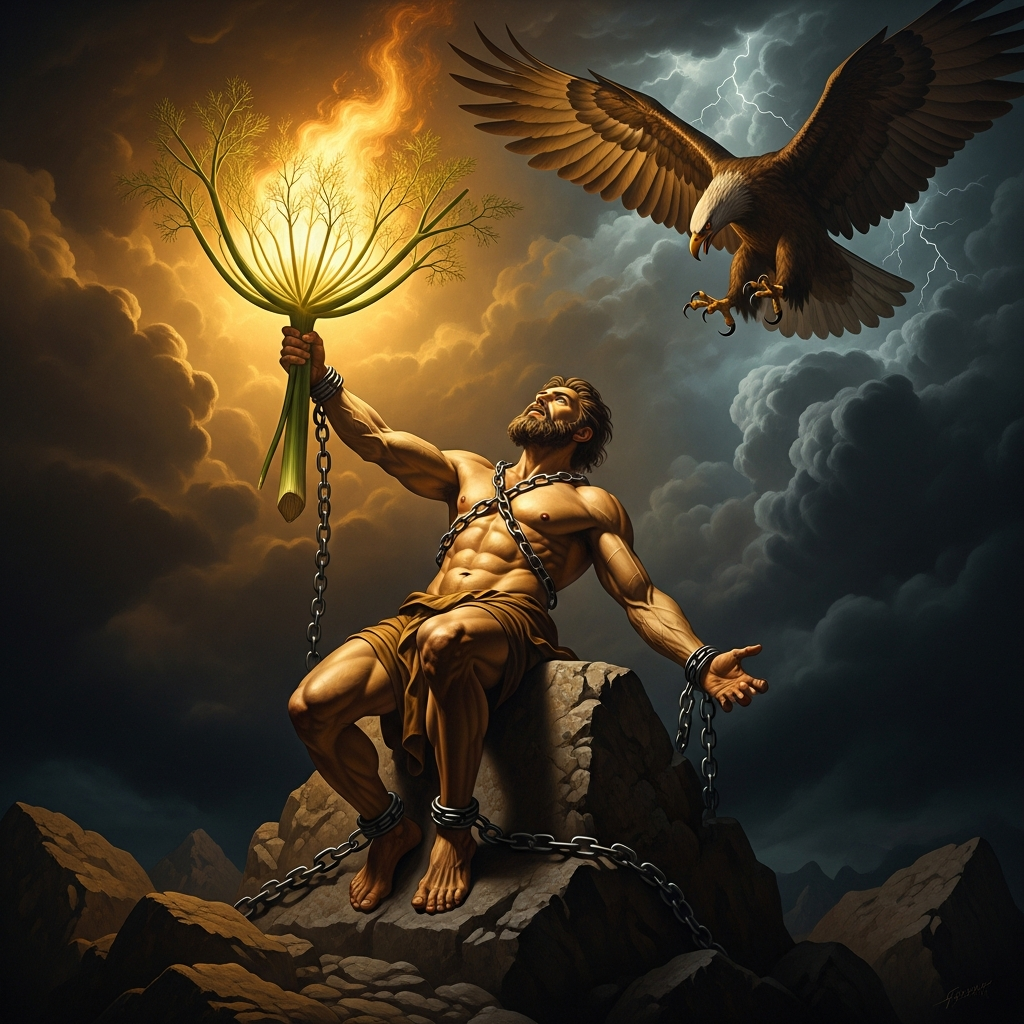
He steals it. The standard account in Hesiod has him hollow out a fennel stalk, carry fire inside it from the sun or from the forge of Hephaestus, and bring it to humanity. Zeus had deliberately withheld fire from human beings as punishment for an earlier trick of Prometheus’s, in which Prometheus arranged the division of a sacrificial ox so that humans kept the meat while the gods received the bones and fat. Zeus was already angry. The fire theft was the second offense.
Zeus’s response is total. He chains Prometheus to a rock at the edge of the world — some accounts say a mountain in the Caucasus — and sends an eagle to eat his liver each day. Because Prometheus is immortal, the liver regenerates overnight. The punishment is eternal.
Then Zeus sends Pandora — the first woman, the “gift” to humanity — with her jar of evils, which she opens. Disease, suffering, and death enter the world. The fire myth and the fall of humanity are the same story.
What the Greek myth insists on is that human technological capacity was obtained illegitimately. We did not develop fire through divine grace or natural evolution. We have fire because someone took it without permission, and the consequences of that taking are still running. Prometheus is still on his rock (or was, until Heracles eventually freed him). The conditions of his punishment outlast his crime.
The myth is the most honest account of technological ambivalence in ancient literature. Fire is good — it makes human life possible — and it was obtained through transgression, and the world is different because of that transgression, and the gods have never fully forgiven it.
Agni: The Fire That Talks to God
In the Vedic world, fire is not stolen or earned or even born in the usual sense. Fire is a god, and it lives everywhere at once.
Agni — whose name is the Sanskrit root from which the English word “ignite” descends — is simultaneously the fire in the ritual altar, the fire in the sun, the fire of lightning, the fire in the body’s digestive heat, and the fire in the earth’s geological heat. He is not a deity who governs fire; he is fire as a divine presence that can be present in multiple forms simultaneously without contradiction.
His central function in Vedic religion is as the intermediary between humans and the divine. When a sacrifice is placed in the altar fire, Agni carries it to the gods. He is the divine messenger in the most literal sense: he is the medium through which communication travels. The Rig Veda opens with a hymn to Agni — he is the first invocation, the prerequisite for contact with any other deity.
This gives fire in Vedic theology a status it does not have elsewhere in this survey: it is not just useful, not just powerful, not even just sacred. It is relational. Fire is how humans and gods talk to each other. To maintain a fire is to maintain a channel of divine communication. To let a fire die is to go silent.
Pele: The Fire That Builds the World
The Hawaiian Pele is the volcano, and the volcano is not a metaphor.
Pele does not govern volcanoes or represent them or use them as symbols. She is the volcanic fire, the force that pushed the Hawaiian islands up from the ocean floor through basaltic eruption, and the force that can, when she chooses or when provoked, reclaim them. The islands exist because of her fire. The ground Hawaiians stand on is her cooled breath.
Her mythology involves a long journey from a distant homeland to Hawaii, pursued by her older sister Na-maka-o-Kaha’i (a sea deity), and the establishment of her home in Kilauea on the Big Island after Na-maka destroys each of her previous homes. She is volatile, jealous of her domain, and capable of transforming into different forms — old woman, beautiful young woman, flame, lava flow.
Pele’s fire is not given to humanity as a gift or taken as a theft. It simply is. She does not owe anyone the islands she built, the warmth she provides, or the destruction she sometimes sends. The relationship between humans and Pele is not a transactional relationship between a benefactor and recipients but a relationship between people and the geological force that made their world. You do not thank Pele for fire. You respect Pele because she is fire, and she will continue being fire whether you respect her or not.
Hephaestus: The Cost of Mastery
The Greek smith god is the fire-tamer, and his mythology is insistent about what taming fire costs.
Hephaestus — Vulcan in Roman theology — is lame. The texts disagree about the origin of his disability: in one account, Hera threw him from Olympus in disgust because he was born ugly; in another, Zeus threw him when Hephaestus tried to defend Hera from Zeus’s anger. Either way, he fell, and the fall broke him, and the great craftsman of the gods works at his forge from a body that cannot move gracefully.
His portfolio is fire as craft: the making of things. He forged the palaces on Olympus. He made Achilles’ armor from divine metals. He built the automata — mechanical servants of gold — that assisted him in his workshop. He built the net that caught Ares and Aphrodite in flagrante and called the gods to witness the humiliation. He is the most productive deity in the Greek pantheon, and the most mocked — cuckolded by Ares, thrown from heaven by his own parents, working underground away from the beautiful gods who live above.
The smith god mythology across cultures (Hephaestus, the Norse Volundr, the West African Ogun) tends to present the master of fire as someone excluded from the normal world in some way — lame, underground, ugly, isolated. The control of fire requires a specialization so total that it separates you from ordinary social life. The artisan’s power is real, but it comes at the cost of belonging to the community that benefits from it.
Kagutsuchi: The Fire That Killed Its Mother
The Japanese fire deity Kagutsuchi’s birth myth is the most brutal in this survey.
His mother, Izanami, was burned to death giving birth to him. The fire deity passes through the divine birth canal, and the heat kills her. Izanagi’s grief at Izanami’s death drives him to kill Kagutsuchi — he draws his sword and cuts the fire god into pieces, each piece generating additional deities (gods of mountains, thunderstorms, and water). Izanagi then descends into the underworld to retrieve Izanami, and what follows is the Japanese version of the Orpheus descent.
The theological content of Kagutsuchi’s birth myth is dark: fire enters the world by killing the divine mother. It is not stolen and not given. It is born, and its birth is a death. The fire deity is also a parricide who did not choose to be one.
The myth connects fire to death at the foundational level of Japanese cosmology — fire and death enter the world simultaneously, inseparably. And the solution is not redemption but fragmentation: Kagutsuchi is killed and dispersed, and the fragments become the natural forces (thunder, mountain, water) that shape the Japanese landscape. Fire that is too concentrated is destructive. Distributed, it becomes the world.
The Question Behind the Fire
Each fire myth asks, in its own way: what is the relationship between human capability and divine order? Did we earn our power, steal it, receive it as a gift, or are we simply lucky enough to live on a planet where fire exists and can be used?
The Greek answer — we stole it, we are still paying — is the mythological origin of one of Western civilization’s defining anxieties: the fear that human technological advancement is transgressive, that we are always at risk of going too far. The Vedic answer — fire is the medium of relationship with the divine — is entirely different: our technology is also our liturgy. Pele’s answer refuses the question: the fire was never ours to obtain. It was already here, and it makes the ground we stand on.
None of them are wrong about fire. All of them are right about something.
Echoes Across Traditions
Entities


Sources
- Hesiod, *Works and Days* and *Theogony* (c. 700 BCE)
- Wendy Doniger, *The Rig Veda: An Anthology* (1981)
- Martha Beckwith, *Hawaiian Mythology* (1940)
- Donald Philippi, trans., *Kojiki* (1968)
- Walter Burkert, *Greek Religion* (1985)