The Great Mother: Gaia, Isis, Durga, Pachamama, Nut, and Cybele
Ancient, across all periods — Neolithic through classical antiquity · Greek earth, Egyptian sky, Hindu battleground, Andean mountains, Phrygia
Contents
The mother goddess is the oldest divine archetype. She is the earth beneath your feet, the sky above your head, and — when her children are threatened — the most terrifying force in any pantheon.
- When
- Ancient, across all periods — Neolithic through classical antiquity
- Where
- Greek earth, Egyptian sky, Hindu battleground, Andean mountains, Phrygia
The first divine figure in human art is probably a woman.
The Neolithic figurines — round, abundant, emphasizing fertility — predate writing by thousands of years. They predate organized theology. They predate most of the specific myths we can recover. Whatever they represented, it was recognized as sacred long before any of the pantheons described in ancient texts were assembled. The mother goddess is the oldest category in the history of religion, and she is still there, everywhere you look, if you know what you are looking at.
The question is not whether the mother goddess is universal. She effectively is. The question is what qualities each culture emphasized — earth mother versus sky mother, nurturer versus warrior, source of life versus agent of terrible grief — and what that tells us about the civilization doing the emphasizing.
Gaia: The Earth That Generates Everything
The Greek Gaia is not metaphorical. She is the earth as a divine being — the ground you walk on, the soil that feeds you, the geological reality of the planet made sacred and sentient.
Her cosmogonic role in Hesiod’s Theogony is primary: she is among the first things to emerge from Chaos, along with Tartarus and Eros. She then generates Ouranos (the starry sky) from herself without a partner, and with Ouranos produces the Titans, the Cyclopes, and the hundred-handed giants (the Hecatonchires). Ouranos, fearing his own children, pushes them back into Gaia’s body as they are born — a theological metaphor for the earth containing what the sky will not acknowledge.
Gaia’s response is the founding act of Greek mythological violence: she creates an adamantine sickle and asks her Titan children to castrate their father. Only Kronos agrees. He performs the act; Ouranos is unmanned; the children are freed.
This is the mother goddess as the first avenger. She does not appeal for help or submit to her children’s imprisonment. She engineers the overthrow of the force that is harming them. The earth’s long patience — cycles of seasons, slow geological time — has a limit, and the limit is the suffering of what grew from her.
Gaia reappears throughout Greek myth as an advisory figure: she warns Kronos that his son will overthrow him, she guides Zeus to the Titans’ location, she produces the monster Typhon to challenge Zeus after the Titans’ defeat. She is always the oldest, deepest authority — the one whose counsel is worth having precisely because she predates every political arrangement and will outlast it.
Nut: The Mother Who Gives Birth to the Sun Every Dawn
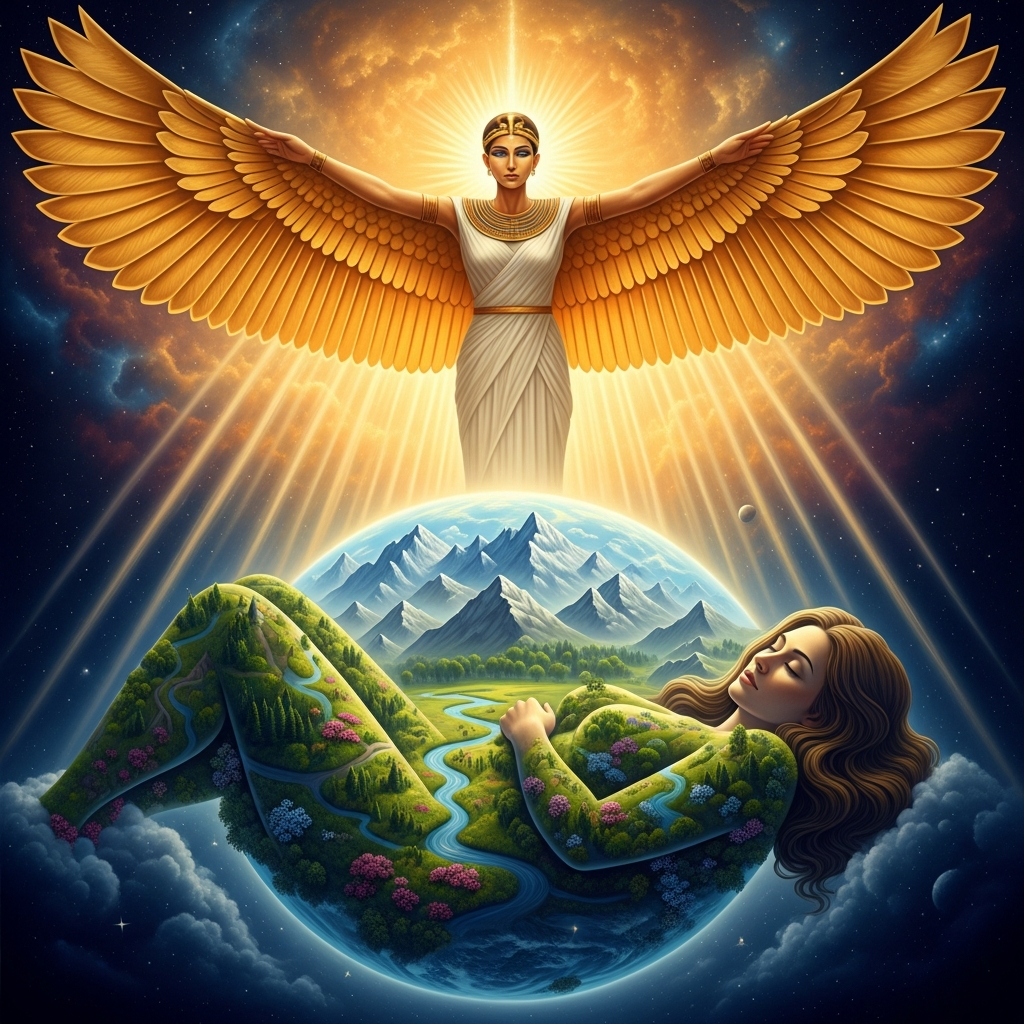
The Egyptian sky goddess Nut is perhaps the most visually remarkable mother goddess in world mythology.
Her body arches over the earth — she is depicted in tomb paintings as a woman whose fingers touch the western horizon and whose toes touch the eastern, her star-covered belly spanning the sky above the recumbent earth god Geb. Each evening, she swallows the sun. Each dawn, she gives birth to it. The solar cycle is, in Egyptian theology, a continuous act of maternal generation: the sun dies each evening by entering the mother’s body and is reborn each morning by leaving it.
This is the most thoroughgoing identification of motherhood with cosmic process in any mythology: not a metaphor but a description. The mechanism of the sky is the mechanism of a mother repeatedly giving birth. Day is not a political event or a divine battle (as in the Ra theology) but a biological one — an event in the body of the divine mother.
Nut is also the mother of the Ennead: she bears Osiris, Horus the Elder, Set, Isis, and Nephthys in five days stolen from the year by Thoth. Ra had decreed that Nut could not give birth on any day of the calendar year; Thoth gambled with the moon for extra days and won, creating the five epagomenal days outside the official 360-day year. The mother goddess’s fertility exceeds what the existing calendar can contain, and requires the expansion of time itself to accommodate it.
Durga: The Assembled Warrior
The Hindu mother goddess tradition is the most militarized of those in this survey, and the circumstances of Durga’s creation explain why.
The gods faced a crisis they could not solve: the buffalo-demon Mahishasura had received a boon from Brahma making him invincible against any male — god, demon, or mortal. He conquered the heavens and drove the gods from their own realm. The gods went to Vishnu and Shiva and described their humiliation, and from their collective anger — from the concentrated fire of their shame and fury — a great light emerged and took the form of a woman.
Each god contributed his power to her. Shiva gave her his trident. Vishnu gave her his discus. Yama gave her his staff of death. The ocean gave her a garland of lotuses and a gleaming garment. She received weapons from every deity in the pantheon and rode into battle on a lion.
The theological structure here is stunning: the mother goddess is created because the male order has failed. She is assembled from their combined power, which means she is stronger than any of them individually. She is the form that divine force takes when it needs to be more than any single deity can be. And she succeeds where they could not, killing Mahishasura and restoring order to heaven.
Durga’s Navratri festival — nine nights of the goddess — is one of the largest religious festivals in the world. The mother goddess as warrior, as the power that protects the world against what the gods cannot handle alone, is not a marginal figure in Hindu theology. She may be the most actively worshipped deity in the world today.
Pachamama: The Earth You Must Thank
The Andean Pachamama is older than the Inca empire and will outlast the Inca empire’s memory.
She is the earth itself — not the earth’s spirit, not the earth’s representative, but the earth as a living, divine, reciprocal entity. In the Andean understanding, nothing is taken from the earth without return: before planting, you offer her chicha (fermented maize beer) poured into a hole in the ground. Before a meal, you return a bite of food to her. Before building, you ask her permission. The relationship between humans and Pachamama is not one of gift-giving from a benevolent deity to passive recipients but of mutual exchange between beings who need each other.
What distinguishes Pachamama from other earth mothers is her survival into the present. She is not a museum piece or a scholarly reconstruction. She is still propitiated daily across Bolivia, Peru, Ecuador, and Argentina. Her August 1 feast day is among the most widely observed in the Andes. Catholic missionaries overlaid her with Our Lady of the Assumption but never replaced her. The Great Mother is patient. She has time.
When the Mother Becomes the Warrior
The pattern that emerges from Gaia, Isis, Durga, Nut, and Cybele is not the soft maternal figure of sentimental iconography. It is a divine force of enormous creative power that becomes lethal when its children are threatened.
Gaia engineers the castration of a god to free her children. Isis reconstitutes her murdered husband’s dismembered body through sheer magical determination to conceive her son. Durga is assembled from every god’s power because only the feminine can defeat what masculinity cannot touch. Cybele’s grief drives her priest-devotees to ritual self-mutilation.
The mother goddess is the most patient figure in mythology — she is the earth, which operates on geological time, which has already seen everything you are doing and will see you end. But she is also the most dangerous figure in mythology, because the only thing that activates her fully is harm to what she generated.
The Great Mother mythology is not about tenderness. It is about what happens when the source of all life decides to defend it.
Echoes Across Traditions
Entities


Sources
- Erich Neumann, *The Great Mother: An Analysis of the Archetype* (1955)
- Jan Assmann, *The Search for God in Ancient Egypt* (2001)
- Wendy Doniger, *The Hindus: An Alternative History* (2009)
- Gary Urton, *Inca Myths* (1999)
- Philippe Borgeaud, *Mother of the Gods: From Cybele to the Virgin Mary* (2004)