The Ongon: The Ancestor Kept in a Felt Bundle
traditional time — the ongoing practice of ancestor relationship across generations · Mongolia — the felt ger (yurt) on the steppe, the domestic space as sacred space
Contents
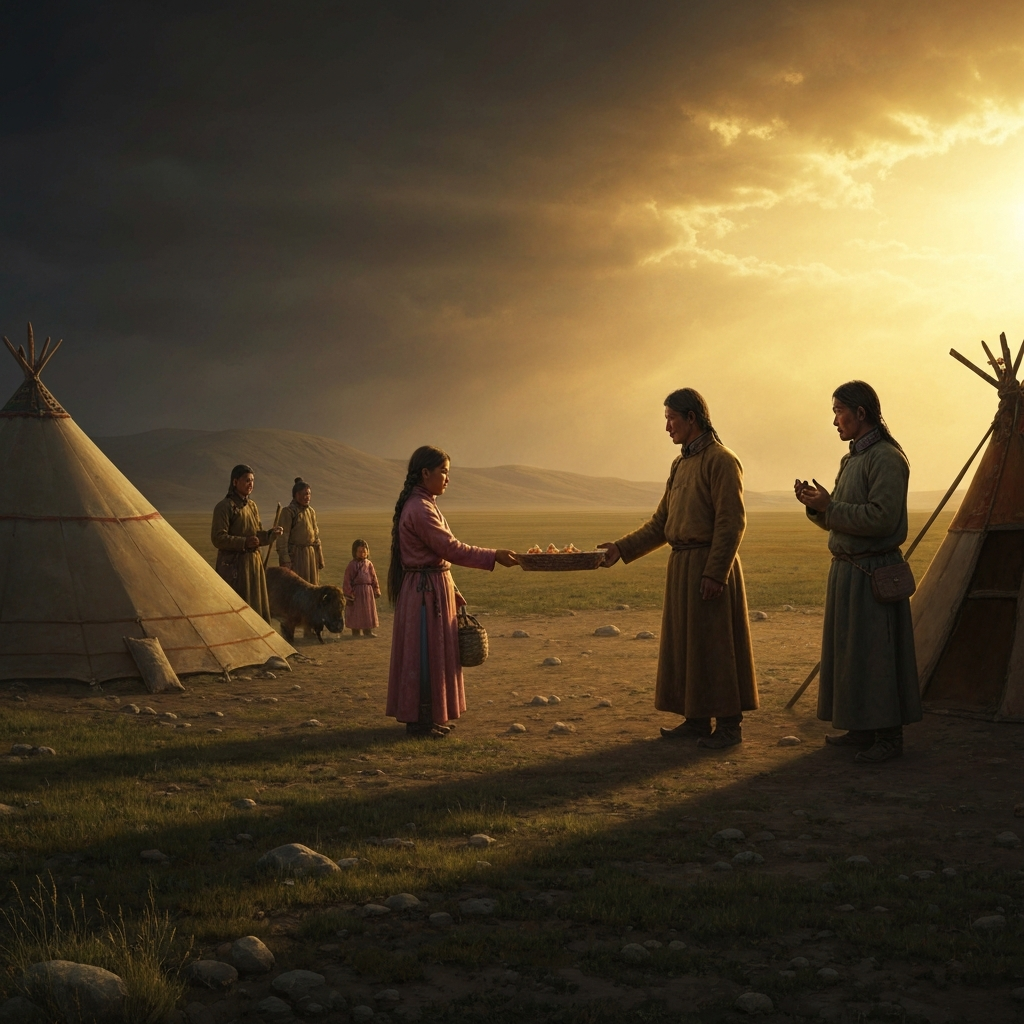
In a Mongolian ger, a cloth bundle on the honored shelf holds an ongon — an ancestor spirit who has been invited to remain among the living, fed and spoken to and consulted, refusing the finality of death as long as the family maintains the relationship.
- When
- traditional time — the ongoing practice of ancestor relationship across generations
- Where
- Mongolia — the felt ger (yurt) on the steppe, the domestic space as sacred space
The bundle on the upper shelf of the ger is wrapped in blue cloth.
It has been wrapped in blue cloth since the grandmother’s time, renewed when the cloth fades, always the same shade — the Tengri-blue, the sky-blue that means sacred in the Mongolian color vocabulary. Inside the cloth is a small carved figure, wrapped again in felt, surrounded by a piece of the deceased man’s clothing, a lock of his hair sealed in birch bark, and a small amulet that belonged to him when he was living.
His name was Davaadorj. He died twenty-three years ago. He is still present.
This is the ongon — not a memorial, not a symbol, but an actual arrangement for the ongoing presence of an ancestor who has been invited to remain. When Davaadorj died, the family consulted their shaman, who performed the ceremony that separates the soul from the body and guides it on its way. But the family also had a second conversation with the shaman: they asked whether Davaadorj might be willing to remain with them in the ongon form, as the family’s protecting spirit, in exchange for regular feeding and attention.
The shaman consulted with Davaadorj’s spirit. Davaadorj agreed.
The ongon requires maintenance.
Every three days, the oldest woman of the family places a small amount of food and tea at the base of the shelf. Not a feast — the spirits do not eat in the way the living eat, and excess is a form of impiety in the steppe tradition where nothing is wasted. A small bowl of tea, a piece of dried meat, the gesture of offering. She speaks to the bundle while she does this: the ordinary news of the household, questions about the children, acknowledgment that the family remembers.
When a significant decision must be made — a marriage, a move to new grazing ground, a question of whether to sell the herd — the family asks the shaman to consult the ongon formally. The shaman comes with drum and smokes the ger with juniper, and the spirit of Davaadorj becomes accessible as something between a presence and a voice: not directly audible in the way ordinary speech is, but clearly communicative, clearly himself, clearly the same person who used to sit at the east side of this ger and drink his tea from that specific bowl which is still in the cupboard.
He gives opinions. Sometimes he disagrees with what the family wants to do. His opinion is weighed alongside the opinions of the living elders, but it carries additional weight because he can see things the living cannot — the spirit-side of the decision, the lines of consequence that run beyond the visible.
The ongon travels with the family.
This is what makes the Mongolian ancestor practice distinctly nomadic. The Chinese ancestor tablet lives in the ancestral hall; you go to the hall to consult it. The Roman Lares protect the house; you cannot take the house with you. The ongon lives in the bundle, and the bundle lives in the ger, and the ger is packed onto the cart three times a year and moved with the herd to new grazing. Davaadorj, who spent his life following the seasonal migration, continues to follow it. The migration is the family’s territory and he stays within it.
Ongons can be decommissioned. If the family line ends, if the ongon becomes troublesome rather than helpful — occasionally a spirit decides to assert too much authority over the living, which the shaman must address — the shaman performs a ceremony to release it and send it on to the underworld where it should have gone originally.
Davaadorj’s ongon will remain until his grandchildren’s children are old enough to have new relationships with more recent ancestors. Eventually the bundle will be opened, the objects returned to the earth or water respectfully, and Davaadorj will complete his journey.
But for now he is here.
The blue cloth on the shelf. The smell of juniper. The tea placed in the small bowl before the morning’s first task.
He approves of the children. He had hoped for more grandchildren, and there are more on the way. He does not say so directly, but the shaman reads it in the quality of his presence when the family gathered last autumn: content, watchful, still recognizably himself.
Still here.
Echoes Across Traditions
Entities
- the ongon (ancestor spirit in object form)
- the deceased ancestor
- the family that maintains the ongon
- the shaman who installed the spirit
- Tengri above and Etugen below
Sources
- Heissig, Walther, *The Religions of Mongolia* (University of California Press, 1980)
- Humphrey, Caroline, *Shamans and Elders: Experience, Knowledge and Power among the Daur Mongols* (Clarendon, 1996)
- Bawden, C.R., *Shamans, Lamas and Evangelicals: The English Missionaries in Siberia* (Routledge, 1985)