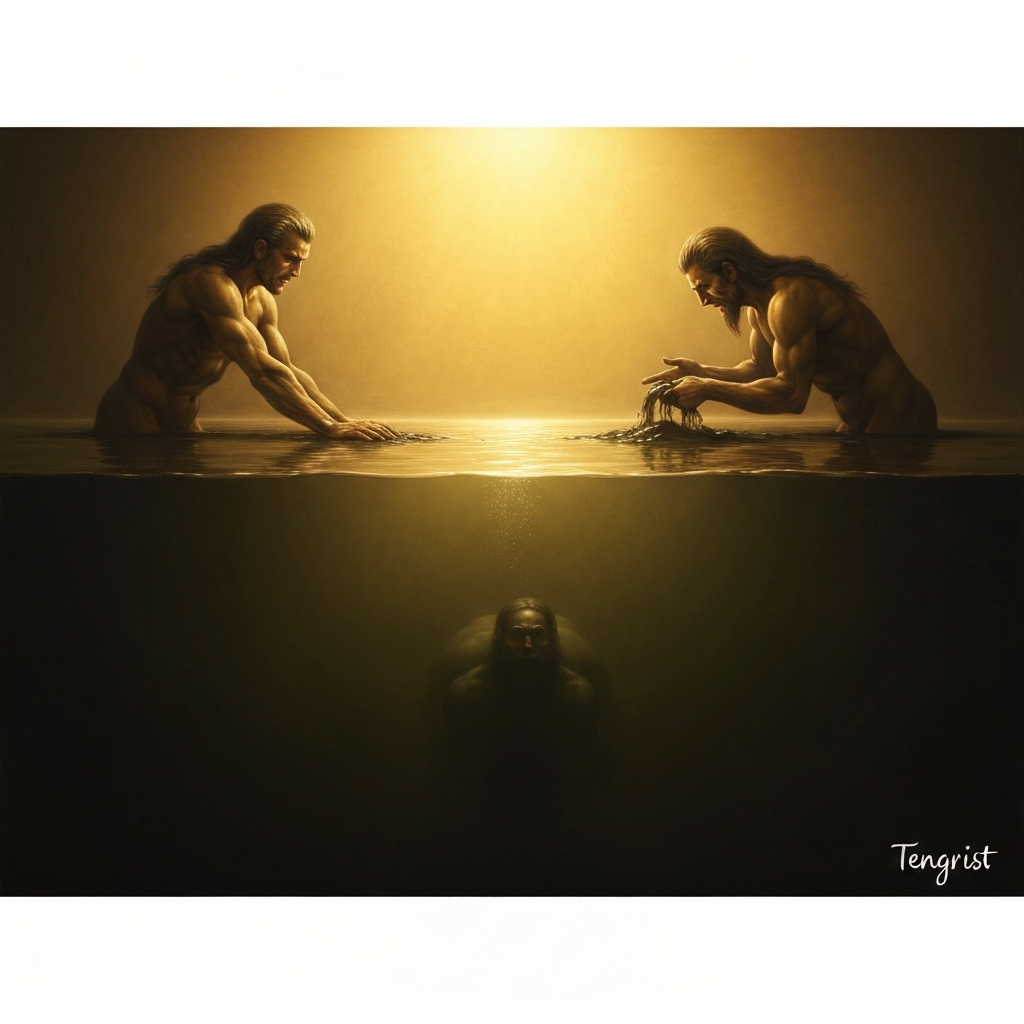
Tengri: The Eternal Blue Sky Above the Steppe
from before human memory — and the endless Mongol present under open sky · The Mongolian steppe — the great grassland that stretches from Manchuria to the Caspian, the largest continuous landscape on Earth
Contents
Köke Möngke Tengri — the Eternal Blue Sky — watches over every living thing on the steppe and speaks only once, at a person's birth, granting their destiny; everything after is the human being's work of living up to it.
- When
- from before human memory — and the endless Mongol present under open sky
- Where
- The Mongolian steppe — the great grassland that stretches from Manchuria to the Caspian, the largest continuous landscape on Earth
Open the sky-door and look up.
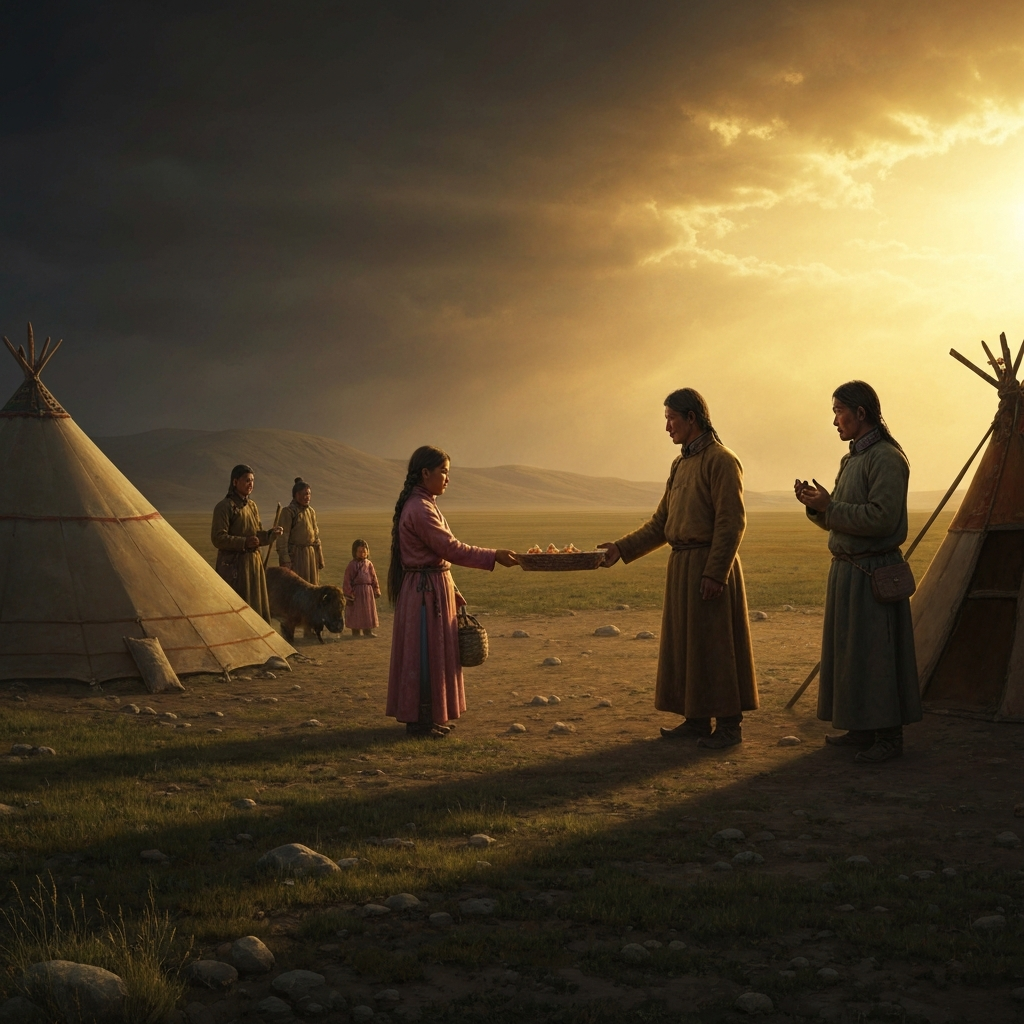
This is the first gesture of Tengrist prayer on the Mongolian steppe, and it requires no building, no priest, no liturgy. You open the smoke-hole of the ger, or you walk out of the ger entirely, and you look straight up into the blue. Not at the horizon, not at clouds, not at the sun — those are particular features. You look at the blue itself, the blue that is behind everything, the blue that was there before the clouds came and will be there after they pass.
That blue is Tengri.
Not a god who lives in the sky. Not a being who resembles a human sitting on a cloud. The sky itself, in its blueness, in its infinite regression upward, in its quality of being the container and witness of everything that happens below — that is what is worshiped. Köke Möngke Tengri: the Eternal Blue Heaven. Blue not as a color but as a quality of openness. Eternal not as immortal but as prior to time.
The steppe people who have carried this tradition for four thousand years say that Tengri speaks only once to each human: at the moment of birth. In that moment the sülde — the personal spirit-force, something between soul and destiny — is breathed into the body and the shape of the life ahead is given. Not its details — Tengri is not interested in details — but its essential quality, its direction, the particular way this life will move through the world.
Everything after that is the human being’s work.
The steppe teaches this directly.
The landscape of Mongolia is too large for illusions. There is almost no feature on the steppe that can hide anything — you can see a rider at twelve kilometers, a herd at twenty. The sky is the only feature that is everywhere, always, inescapable. You cannot look in any direction on the Mongolian steppe without sky occupying more than half your visual field.
Living under that much sky does something to theology. You do not develop the enclosed-sacred-space religion of forest peoples, who have something to hide inside. You develop the religion of the visible, the open, the permanent witness. Tengri sees everything because Tengri is everywhere you look.
This has political consequences.
When Temujin, the young man who becomes Genghis Khan, unifies the Mongolian tribes in 1206 CE, he explicitly invokes Tengri’s mandate. Every tribe has its own clan spirits, its own ancestors, its own shamanic lineages. The claim that Tengri — not any particular tribal deity, but the sky itself — has chosen one man to lead all the Mongol people is a theological claim before it is a political one. The sky chooses. The sky’s choice is above tribal dispute. To resist the Khan is to resist the sky, and the sky cannot be resisted.
The shamans of the various tribes are not entirely comfortable with this arrangement. Some of them have their own relationships with Tengri and their own interpretations of what those relationships imply. Teb Tengri, the shaman who first calls Temujin the Khan of the sky’s choosing, is eventually executed — by order of Genghis Khan himself, because Teb Tengri has accumulated too much personal authority in Tengri’s name.
This too is a theology lesson: the sky chooses, and then the sky is done. What follows is human.
The everyday practice of Tengri worship on the steppe involves the ovoo — the cairns of stone and wood and cloth that accumulate at every high point on the landscape. Riders stop at every ovoo and walk clockwise around it three times, adding a stone. The ovoo is a gift to Tengri, a marker that says: we were here, we noticed this place, we honored the sky’s attention.
The blue cloth that wraps the ovoos is the color of Tengri — sky blue, the specific blue that is the ancient Turkic and Mongolian designation of the divine. Mongol soldiers carried blue banners in battle not as a national symbol but as a statement about whose army this was.
Etugen, the Earth Mother, receives the other half of the prayers. She is below, as Tengri is above, and between them they hold everything: the sky’s attention and the earth’s support, the father’s mandate and the mother’s sustenance. The human being lives in the middle, between sky and earth, and honors both.
The blue is still there.
You can see it any clear day above Ulaanbaatar, or above the taiga, or above the steppe where the grass bends in the west wind. The same blue that the Khan’s banners matched. The same blue that was there when the first herder looked up from the first fire and felt the need to say something to what was watching.
Echoes Across Traditions
Entities
- Tengri (Köke Möngke Tengri — the Eternal Blue Sky)
- Etugen, the Earth Mother
- the human soul (sülde)
- the spirits of wind and weather
- Genghis Khan as Tengri's chosen
Sources
- Paul Ratchnevsky, *Genghis Khan: His Life and Legacy* (Blackwell, 1991)
- Rene Grousset, *The Empire of the Steppes* (Rutgers, 1970)
- Walther Heissig, *The Religions of Mongolia* (University of California, 1980)