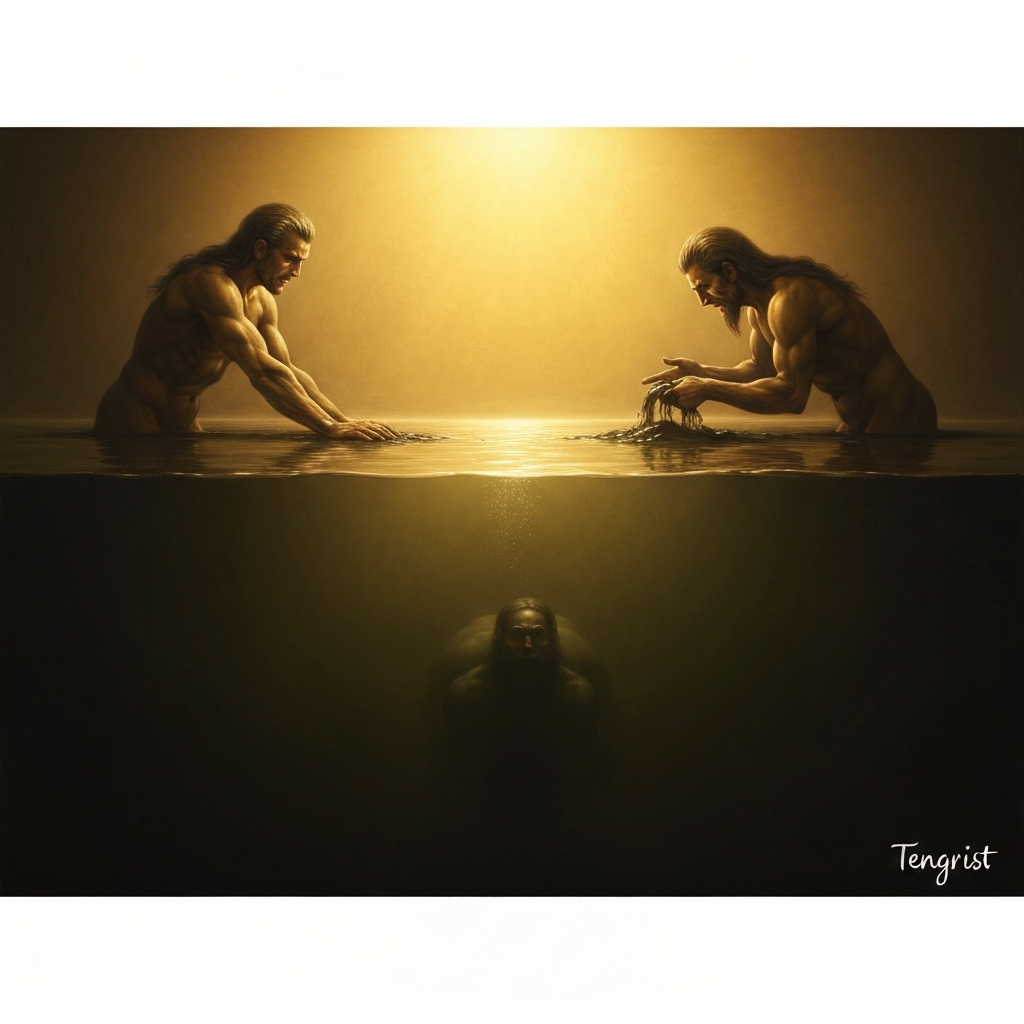
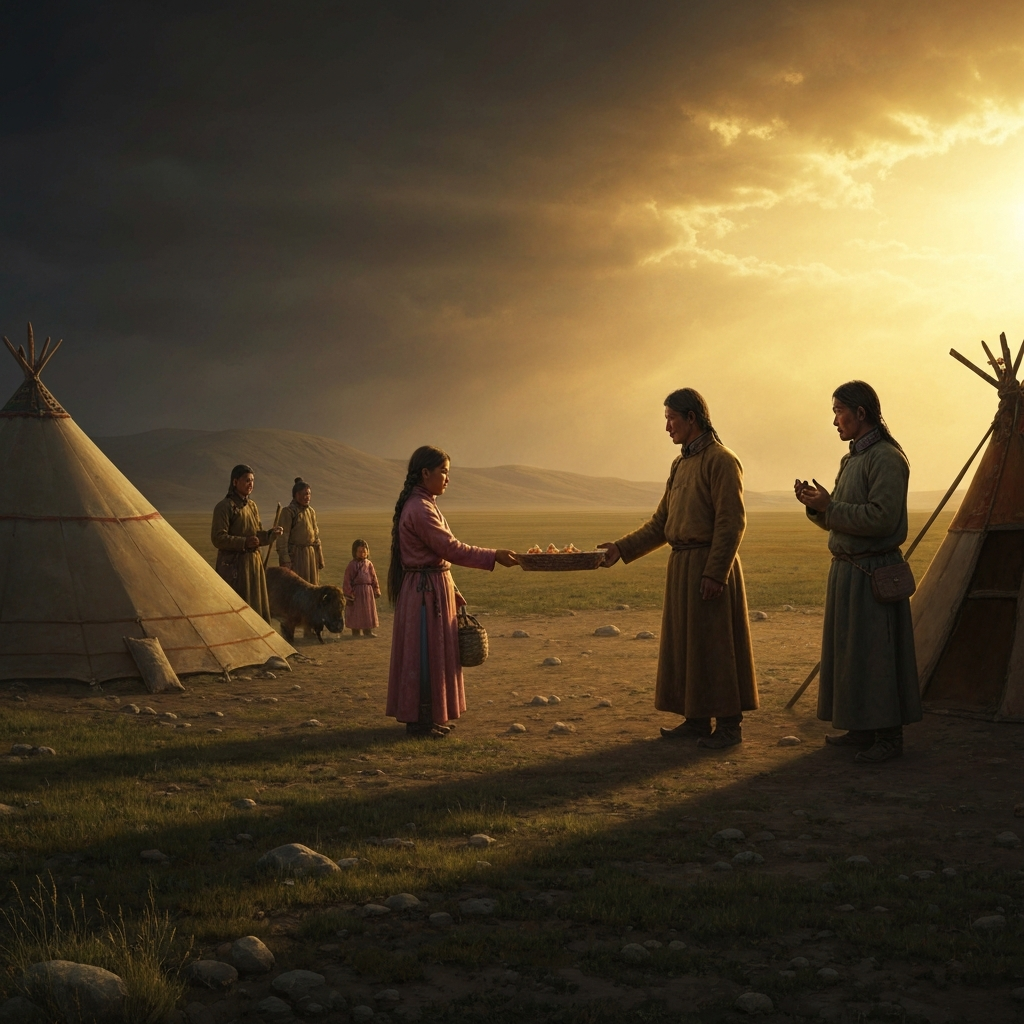
The Heavenly Horse and the Shaman's Spirit Flight
traditional time — the age of the great nomadic steppe empires and their spiritual practices · The Kazakh steppe — the vast grassland from the Ural Mountains to the Aral Sea, the horse's homeland
Contents
On the Kazakh steppe, the sacred horse is not merely a mount but the vehicle of spiritual ascent — and the baqsy shaman beats his drum to summon the heavenly horse that carries him between the worlds in the form of his own flying instrument.
- When
- traditional time — the age of the great nomadic steppe empires and their spiritual practices
- Where
- The Kazakh steppe — the vast grassland from the Ural Mountains to the Aral Sea, the horse's homeland
The horse is the steppe made fast.
This is the philosophical truth beneath the practical one on the Kazakh grassland: the landscape itself moves when the horse runs through it, the distance between any two points collapsing in the rhythm of hooves on dry grass. The people who have lived on this steppe for five thousand years have built every dimension of their culture around the horse — its speed, its intelligence, its willingness to carry a human into conditions that would kill the human alone.
The baqsy knows all of this. His drum is made from a horse’s skin.
The horse was chosen carefully before it was killed for the drum. Not the oldest horse and not the youngest, but a horse at peak maturity, one that had proven its intelligence and speed and willingness. The killing was performed as a sacred act. The hide was prepared with prayers said over it. When the drum was finished and its first ceremony performed — the drum’s awakening, the moment it became a living instrument rather than a stretched skin — the horse’s spirit entered the drum and has been there since.
When the baqsy beats the drum, he is riding.
He mounts the drum the way a rider mounts a horse: firmly, with intent. The drumstick is his whip — not in cruelty but in the same commanding urgency with which a steppe rider signals acceleration. The rhythm is the gallop. Fast at the heart of the ceremony, when he is moving through spirit country at speed, and slower as he approaches the delicate negotiations in the middle and upper worlds where galloping would be rude.
The heavenly horse that appears in trance is the spirit form of his drum’s horse, but also something larger — the archetype of the horse, the divine species from which all earthly horses are partial manifestations. On the steppe the baqsy calls this koblandy, and in the spirit world it is white and enormous, larger than any animal he has seen in the physical world, with a mane that catches light from no visible source.
He mounts it.
The ascent through the sky is mapped by the baqsy’s tradition. Seven heavens correspond to seven stages of the journey, each one hotter and brighter as he moves toward Tengri’s court. The spirit helpers — the qozybash, the ancestor-spirits in animal form — run alongside as escorts. They know the path better than he does. His job is to hold on and maintain the intention of his journey.
This ceremony is for a young man who has been sleepless for forty days.
Not a physical insomnia — the young man sleeps, but when he sleeps he immediately finds himself in the spirit world without preparation or protection, moved by forces he cannot identify toward destinations he did not choose. He wakes from these inadvertent spirit journeys more exhausted than when he lay down. The baqsy has diagnosed this as the beginnings of the shamanic calling: the spirits have identified him as a candidate and are testing his endurance. Left unaddressed, it will either break him or transform him.
In Tengri’s court at the seventh heaven, the baqsy petitions for the young man’s protection. He argues that the young man is not ready — he has not been trained, he has no spirit helpers yet, he cannot navigate the journeys being forced on him. He asks for a guide to be assigned and a temporary shelter built around the young man’s sleeping soul until the training can begin.
Tengri does not appear directly. No one claims to have seen Tengri directly. What the baqsy receives is a response: a quality of light, a feeling of permission, the sense of a vast attention that has heard and agreed. One of the ancestor-shamans present at the court agrees to serve as the young man’s temporary guide.
The baqsy returns on the heavenly horse, landing back in his body with the customary jar that people around him feel as a slight movement in the floor.
He tells the young man he has a guardian for the journeys now. He tells him to begin learning the songs.
The young man’s sleeplessness begins to ease within a week. He will spend the next seven years training. He will become a baqsy. His drum, when it is made, will also carry a horse’s soul.
The line continues.
Echoes Across Traditions
Entities
- the baqsy (Kazakh shaman)
- the heavenly horse (koblandy)
- the spirit helpers (qozybash)
- Tengri above
- the drum that is the horse
Sources
- Radloff, W., *Aus Sibirien* (Leipzig, 1884) — early ethnographic accounts of Kazakh and Altai baqsy practice
- Basilov, Vladimir N., *Chosen by the Spirits: Following Your Shamanic Calling* (Shambhala, 1997)
- Seitkali Seidalin, transcriptions of Kazakh oral traditions (Kazakh Academy of Sciences archives, Almaty)