The Flood That Covered the World: Why Every Culture Has the Same Story
Mythic time · textual versions from c. 2100 BCE (Sumerian flood narrative) through oral traditions of the Pacific · The Euphrates valley, the Tigris river basin, the slopes of Mount Ararat, the Indian subcontinent, the Aegean coast, the Hawaiian islands — the inhabited world under water
Contents
From Mesopotamia to Hawaii, every civilization independently produced a flood myth. One survivor. One boat. One new world. The question is why.
- When
- Mythic time · textual versions from c. 2100 BCE (Sumerian flood narrative) through oral traditions of the Pacific
- Where
- The Euphrates valley, the Tigris river basin, the slopes of Mount Ararat, the Indian subcontinent, the Aegean coast, the Hawaiian islands — the inhabited world under water
In the thirty-first tablet of the Epic of Gilgamesh — or near it, in the section scholars label Tablet XI — the immortal Utnapishtim sits across from the hero and begins to tell a story that Gilgamesh, and most of the Western world for the next three thousand years, will hear again under a different name.
The gods had decided to destroy humanity. The city of Shuruppak stood on the bank of the Euphrates, and the noise of its people had become intolerable to the great gods — specifically to Enlil, the storm god, who found the clamor of human civilization too much to bear. A flood was decided. The council of gods agreed, in secret, to wipe the earth clean.
But Ea — the god of wisdom, of fresh water, of craftsmen — whispered the secret through a reed-wall. He could not break the oath of secrecy by speaking directly. He spoke to the wall, technically, and Utnapishtim heard it through the wall. He was told to tear down his house and build a boat, to renounce his possessions, to take aboard every living thing. He did all of this. The flood came for seven days. The boat grounded on Mount Nisir. A dove and then a swallow and then a raven were sent out. When the raven did not return, the waters had receded.
Utnapishtim sacrificed on the mountaintop. The gods gathered like flies around the sweet smell. The flood was over.
The Oldest Written Version: Utnapishtim and the Noise Problem
The Utnapishtim account, embedded in the Epic of Gilgamesh as a story-within-the-story, is not itself the oldest version. It draws on the Atra-Hasis Epic (c. 1700 BCE), which is the first narrative we have in which the flood is explained as a response to overpopulation and noise rather than to moral failure. This is a striking difference from the later Biblical version.
In Atra-Hasis, humans simply became too numerous and too loud. The gods were trying to sleep. The flood is not a punishment for wickedness but a remedy for overpopulation — an extinction event that the gods engineered out of exhaustion and resentment rather than righteous wrath. The Mesopotamian version of the flood myth is structurally amoral: humanity did not deserve to be destroyed; it was merely inconvenient.
The survivor, Utnapishtim (Atra-Hasis in the earlier version), is chosen not for virtue but for connection — he has the right god in his corner, a god willing to bend the rules of the divine council’s secrecy to warn him. The covenant at the end is not a moral compact but a practical one: the gods, smelling Utnapishtim’s sacrifice after the flood, regret the destruction they caused and agree not to repeat it.
Noah: The Moral Upgrade
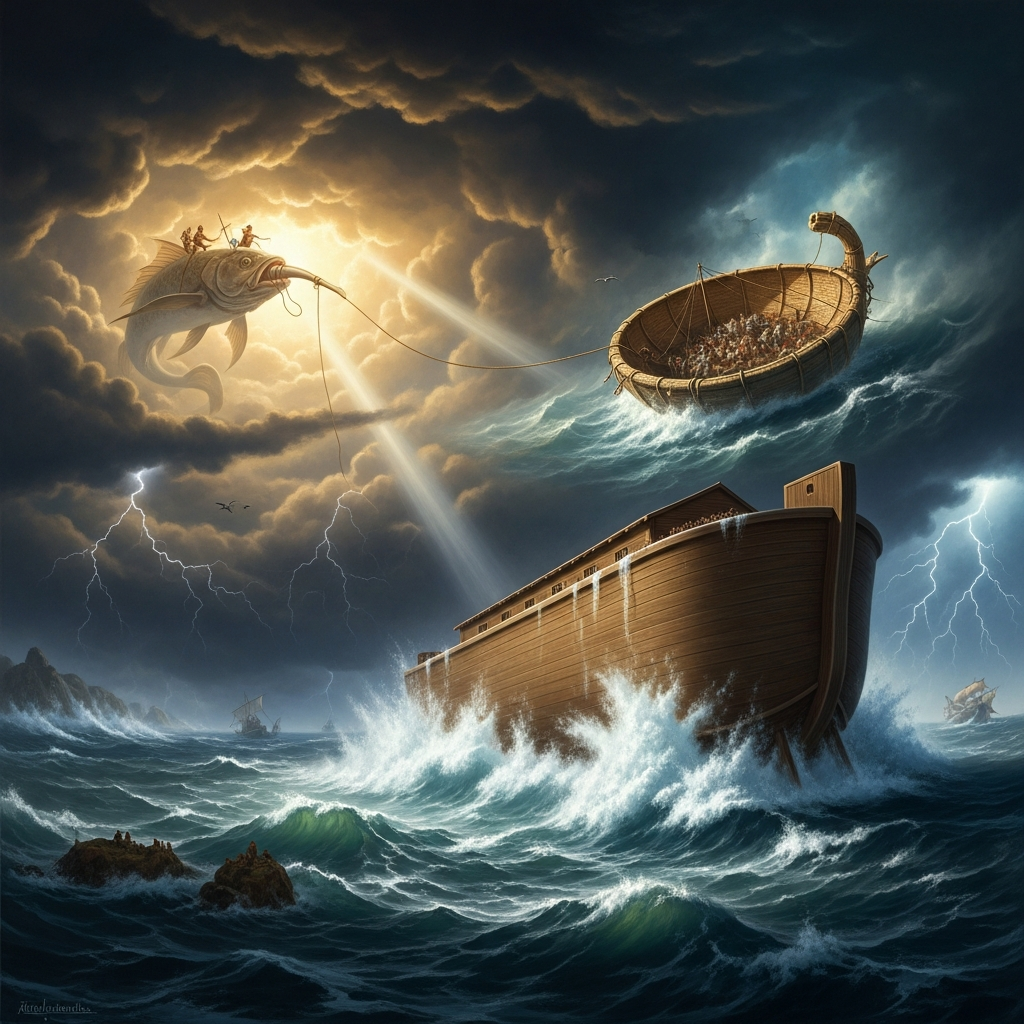
The Biblical flood in Genesis 6-9 inherits the Mesopotamian structure so completely that the verbal parallels extend to specific details: the storm lasting the same number of days, the same three birds sent to find land, the same sacrifice offered on the mountain, the same divine promise not to repeat the flood.
The critical difference is motivation. In Genesis, God looks at humanity and sees that “every inclination of the thoughts of the human heart was only evil all the time” (Genesis 6:5). The flood is a moral judgment. Noah is chosen because he was “a righteous man, blameless among the people of his time” (Genesis 6:9). The covenant signed in the rainbow is not merely practical but ethical: God establishes a binding promise not to destroy all life again, in exchange for a moral order governing human behavior.
The Genesis compiler transformed a Mesopotamian story about divine management into a Hebraic story about moral accountability. The flood becomes the mechanism by which a monotheistic God resets a failed moral experiment and begins again with the one human who passed the test. The same narrative structure carries an entirely different theological weight.
Manu: The Fish and the First Man
The Hindu flood narrative appears in multiple texts across several centuries, most elaborately in the Shatapatha Brahmana and in the Puranas’ account of Vishnu’s Matsya avatar.
The core account: Manu, the first man, is washing his hands in a river when a small fish asks him for protection. He shelters it in a pot; it grows; he moves it to a lake, then to the ocean. The fish — now enormous — warns him that a great flood is coming and tells him to build a boat. The flood comes. The fish tows the boat through the waters to the northern mountain. Manu alone survives.
In the later Puranic version, the fish is identified as Vishnu in his first avatar — the Matsya form, the first of the ten primary descents of the Preserver god into material existence. The flood is now the transition between cosmic ages (yugas), and Manu’s survival is the precondition for the current cycle of human civilization. The myth scales up from local catastrophe to cosmic mechanism.
What is notable in the Manu account compared to the Mesopotamian and Biblical versions is the intimacy of the rescue: the god does not warn from a distance but literally lives with the survivor, growing in his hands across years of care, and then pulls him to safety in person. The relationship between the saved and the saving is sustained and direct.
Deucalion and the Stone People
The Greek flood belongs to Zeus’s conflict with the Titans’ human descendants, particularly the lawless king Lycaon, whose cannibalism and violence finally exhaust divine patience. Zeus visits earth disguised as a mortal, discovers the full extent of human depravity, and returns to Olympus to announce the flood.
Deucalion — son of Prometheus, which is significant — and his wife Pyrrha survive in a chest that rides out the deluge. They land on Mount Parnassus. When the waters recede, they offer sacrifice and consult the oracle at Delphi, which instructs them to throw their “mother’s bones” over their shoulders. They understand the riddle — the earth is the mother, stones are her bones — and throw stones. The stones become people.
This repopulation mechanism is unique to the Greek version and carries its own anthropological implication: a humanity made from stone is harder and more enduring than the humanity that preceded the flood, but also colder, less organic, more worked-upon. The new humans are material to be shaped rather than beings grown naturally from the earth.
Nu’u: The Pacific Parallel
The Hawaiian tradition holds a flood narrative that maps almost exactly onto the Near Eastern accounts despite an ocean separating the two. Nu’u built a great canoe with a house on it, stocked it with animals, survived a flood that covered the mountain peaks, and offered sacrifice when the waters withdrew. In one version, he offered his sacrifice to the moon, mistaking it for the divine source of his deliverance.
The parallels are too specific to be structural accident — the ark, the animals, the mountaintop sacrifice, the error of gratitude — and too geographically separated to explain by direct borrowing. The Hawaiian flood myth is among the most discussed cases in the debate about the ultimate origins of the narrative type.
Why Does the Flood Myth Exist Everywhere?
Three competing explanations have dominated scholarship, and none of them alone is sufficient.
The first is geological memory. The end of the last ice age (c. 10,000-8000 BCE) produced catastrophic flooding events as glaciers melted — the flooding of the Black Sea basin, the inundation of large portions of coastal Mesopotamia, the dramatic rise in sea levels worldwide. Populations who experienced these events, or whose ancestors did, may have carried the memory forward in narrative form. The specifics would mythologize over generations; the core event — a flood that destroyed the known world — would remain.
The second is psychological archetype. Carl Jung argued for a universal human unconscious that produces the same symbolic structures independently across cultures. The flood myth, in this reading, is a narrative expression of a psychological universal: the fear of dissolution, of the self and the social order being overwhelmed by uncontrollable force, followed by renewal. Water destroys and water gives life. Every culture that has lived near water — which is every culture — has thought through what it means for that water to rise.
The third is cultural diffusion. Some scholars argue for a single origin point in the ancient Near East and subsequent spread along trade and migration routes. This explains the tight textual parallels between the Mesopotamian and Biblical versions perfectly; it cannot easily explain Hawaii.
The most defensible position is that all three factors are operative and their relative weights vary by tradition. The geological memory may be real and ancient; the psychological structure may make flood narratives particularly durable and transmissible; cultural diffusion may account for the specific verbal parallels in the Near Eastern cluster. The flood myth converges on a universal human experience: the world you knew, under water. The world you don’t know yet, on the other side.
One survivor. One boat. The question of what kind of world comes next.
That question is the same in every version. The answers differ, and the differences are the point.
Echoes Across Traditions
Entities
- Utnapishtim
- Gilgamesh
- Noah
- Manu
- Vishnu
- Deucalion
- Pyrrha
- Zeus
- Nu'u


Sources
- *Epic of Gilgamesh*, Tablet XI (Old Babylonian period, c. 1700 BCE; Standard Babylonian version c. 1100 BCE)
- Genesis 6-9, Hebrew Bible (compiled c. 6th century BCE)
- *Shatapatha Brahmana* 1.8.1.1-6 (c. 800-600 BCE)
- Ovid, *Metamorphoses* I.262-415 (8 CE)
- Pindar, *Olympian Odes* IX (5th century BCE)
- W.G. Lambert and A.R. Millard, *Atra-Hasis: The Babylonian Story of the Flood* (1969)
- James Frazer, *Folk-Lore in the Old Testament*, vol. 1 (1918)
- Alan Dundes, ed., *The Flood Myth* (1988)
- Alexander Heidel, *The Gilgamesh Epic and Old Testament Parallels* (1946)
- Theodor Gaster, *Myth, Legend, and Custom in the Old Testament* (1969)