The Solar Pantheon: Ra, Apollo, Surya, Inti, and Amaterasu
Ancient, across all periods — Egyptian Old Kingdom through Inca imperial period · Heliopolis, Delphi, the Vedic plains, Cuzco, the Yamato court of Japan
Contents
Five sun gods from five continents reveal a near-universal pattern: the solar deity who makes daily war against darkness, and the one tradition that made that god a goddess.
- When
- Ancient, across all periods — Egyptian Old Kingdom through Inca imperial period
- Where
- Heliopolis, Delphi, the Vedic plains, Cuzco, the Yamato court of Japan
The sun rises on every human culture without exception. It has done so for the entirety of human existence. And with a frequency that approaches universality, every civilization that has watched it move across the sky has concluded: that thing is not just a thing. It is divine.
The solar deity is perhaps the oldest category in the history of religion. And the pattern that emerges when you lay five of them side by side — Ra, Apollo, Surya, Inti, Amaterasu — is not the story of five cultures independently inventing the same idea. It is the story of the same idea being shaped, over millennia, by five different sets of questions about what the sun actually means.
Ra: The Sun That Has to Fight to Rise
The Egyptian Ra is not simply the sun. He is the sun in combat.
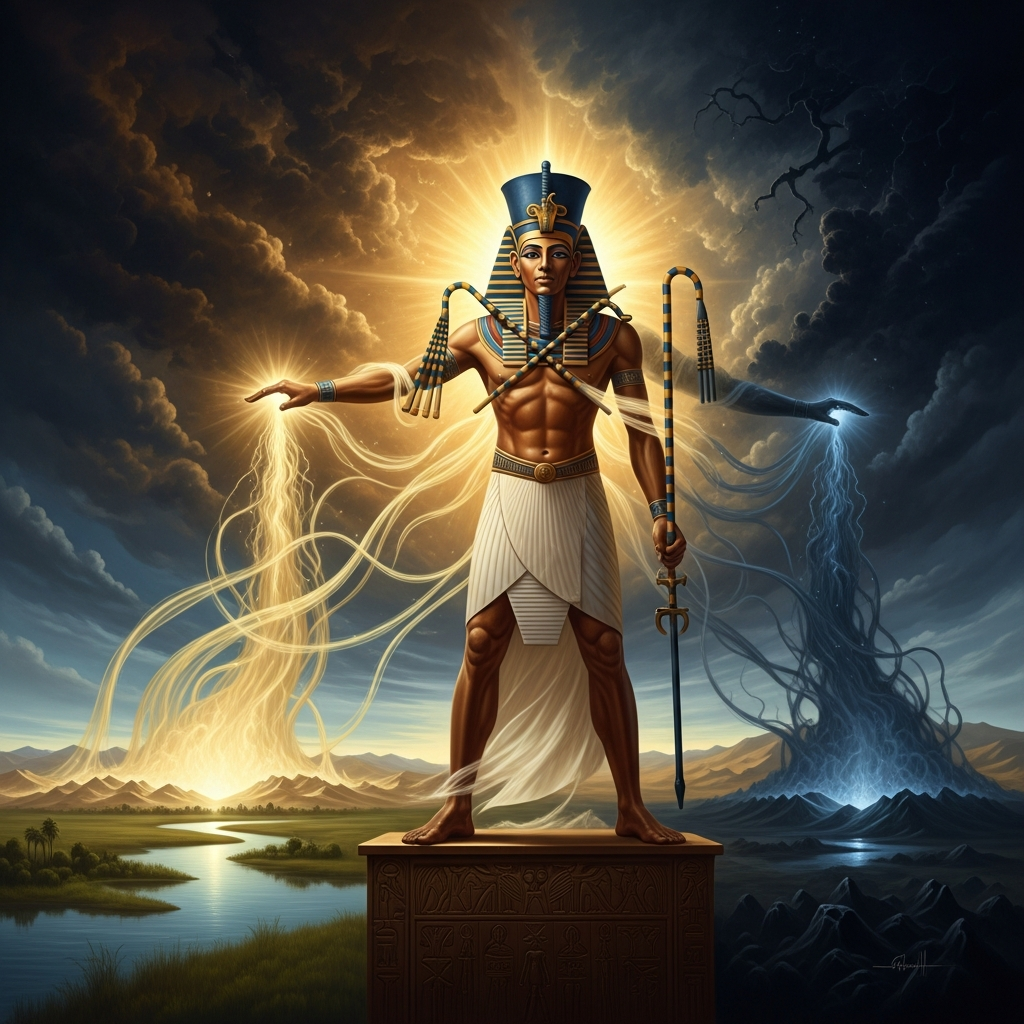
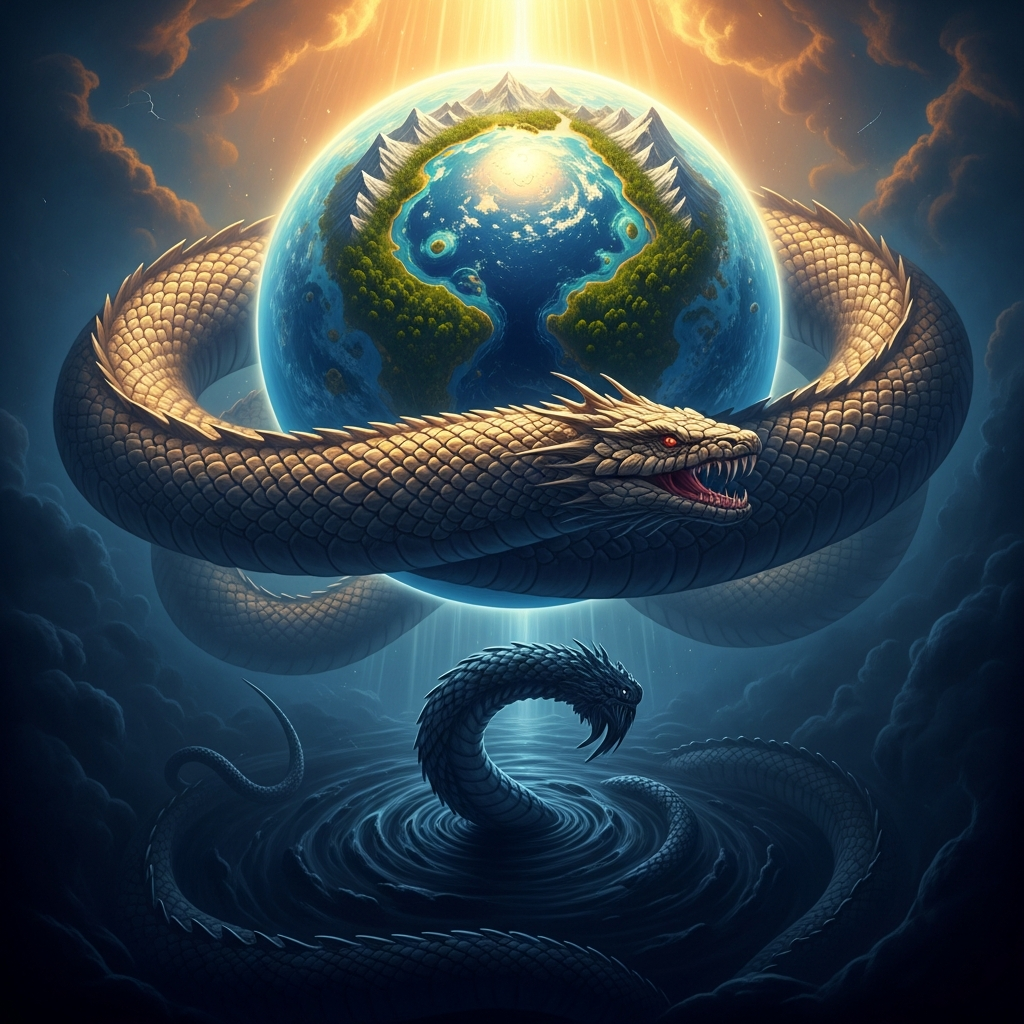
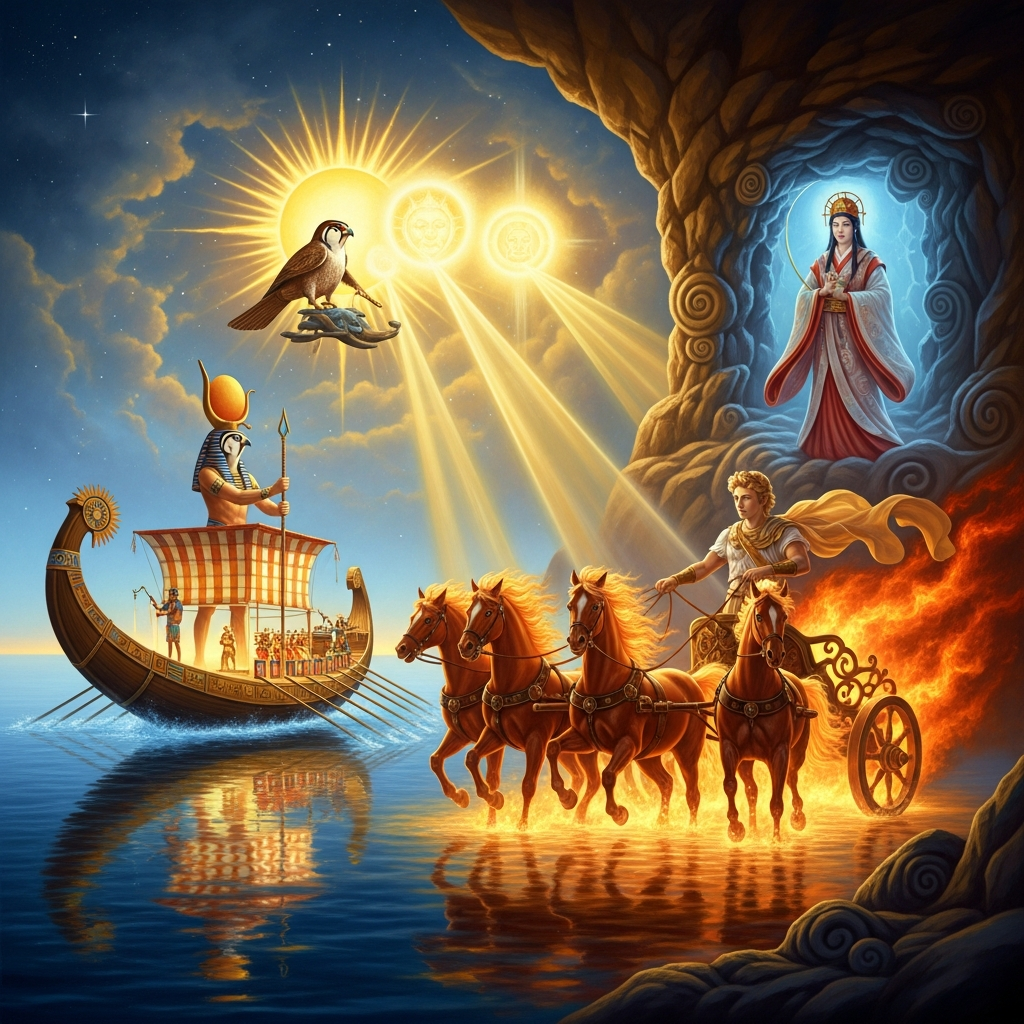
Ra travels the sky each day in the solar bark Mandjet, the Bark of Millions of Years, and each night descends into the Duat — the underworld — in the bark Mesektet. The night journey is not rest. It is battle. In the deepest hour of the night, the bark passes through the domain of Apep, the chaos serpent, who attempts each night to swallow the sun and prevent the dawn. Ra’s crew of lesser gods must repel Apep, bind him, cut him — and they succeed every single night, which is why morning comes.
This theological structure does something that mere solar mythology does not do: it makes every sunrise an event. The dawn is not guaranteed. It is the result of a battle that was fought while you were sleeping. The sun is not merely powerful — it is heroically powerful, in the sense that it maintains order against a force that genuinely wants to end it.
Ra’s centrality in Egyptian theology only grew over time. He merged with Amun to become Amun-Ra, the king of the gods. He merged with Horus to become Ra-Horakhty. The solar disk became the Aten under Akhenaten, briefly the only god in Egypt. The history of Egyptian religion is in significant measure the history of the sun swallowing other divine functions.
Apollo: The Sun That Illuminates Truth
The Greek solar tradition is more complicated than it appears.
Apollo is not originally the sun god. That role belongs to Helios, the literal solar charioteer who drives his horses across the sky each day. But Helios is primarily physical — he sees everything, which is why he tells Hephaestus about Aphrodite’s affair, but he does not judge, does not legislate, does not heal. He is the sun as optics.
Apollo absorbs and supersedes Helios by the classical period, and the absorption transforms the solar function. Apollo is the god of light, yes — but also of prophecy, of medicine, of music, of the rational arts, of the oracle at Delphi where the Pythia spoke the truth hidden beneath events. The key equation in Apollo’s theology is that light equals revelation. The sun does not just make you warm; it makes the hidden thing visible.
This is an enormous theological step. When light becomes the metaphor for truth — when to illuminate and to reveal become the same verb — you have created the intellectual architecture that will eventually underwrite Greek philosophy and, through it, European rationalism. Apollo is the mythological infrastructure of the Enlightenment, which is why later writers would invoke his name at the dawn of the Scientific Revolution.
Surya: The Sun as Cosmic Time
Hindu solar theology operates at a scale that even the Egyptians did not quite reach.
Surya drives a chariot pulled by seven horses, their names corresponding to the seven colors of visible light. His charioteer, Aruna, is the personification of the dawn, perpetually before him. He is described in the Rig Veda as the eye of Mitra and Varuna — the organ through which cosmic law perceives the world. He is simultaneously a physical phenomenon, a divine being, a cosmic principle, and a medical force (his rays purify and heal).
The Gayatri Mantra, addressed to Savitri (a solar aspect overlapping with Surya), is the most repeated prayer in Hinduism. It asks the sun to illuminate the mind — not merely the world. Solar illumination becomes intellectual illumination becomes spiritual illumination in a single ritual gesture. The practitioner who recites the Gayatri at dawn is not worshipping the physical sun; they are asking the cosmic light to activate divine intelligence within themselves.
This interiorization of solar theology — turning the external sun into a symbol of inner awakening — is one of Hindu philosophy’s deepest contributions to the world’s religious vocabulary.
Inti: The Sun as Constitutional Law
The Inca solar theology was explicit about something every other tradition implied: the sun justifies political power.
Inti was the divine father of the Sapa Inca, the emperor. The emperor was not merely beloved by Inti or chosen by him — he was literally Inti’s son, and his power descended directly from that parentage. Cuzco was arranged as Inti’s earthly house. The Coricancha, the Temple of the Sun, was the empire’s religious center, its walls literally covered in gold — the sweat of the sun — as a standing metaphor for divine radiance made material.
The Inti Raymi festival (still held annually in Cuzco) renewed the solar covenant: the sun would continue its journey, the world would continue to be fed, and the empire would continue to function as the solar order made political. Every farmer in the Inca system growing food for the state was participating, in this theology, in a cosmic arrangement ordained by the sun.
No other solar theology was quite so architecturally honest about what solar worship actually accomplished: it made the power structure sacred. The Inca simply said so directly.
Amaterasu: The Solar Exception
And then there is Amaterasu, who breaks every rule.
The Shinto tradition places Amaterasu — Amaterasu-Omikami, the Great Divinity Illuminating Heaven — at the head of the divine hierarchy. She is the sun, and she is female, and she is the highest god in a pantheon that otherwise looks recognizably like the male-dominated solar pantheons of every other major civilization.
Her most famous myth is the withdrawal into the cave. Provoked by her brother Susanoo’s destructive tantrum — he floods her rice paddies, defiles her weaving hall, and ultimately causes one of her weaving maidens to die from shock — Amaterasu retreats into the Ama-no-Iwato, the Cave of Heaven, and seals it shut. The sun disappears. The world falls into darkness. Crops fail. Evil spirits emerge.
The other gods do not fight the darkness. They do not send a champion to battle the night as Ra battles Apep. They throw a party. The goddess Ame-no-Uzume performs a wild, comic, explicitly bawdy dance. The eight million gods roar with laughter. Amaterasu, hearing the celebration, opens the cave a crack to see what could possibly be so funny when the world has lost its sun — and the god Tajikarao yanks her out.
The theological structure here is entirely different from the combat model. The solar deity is not a warrior; she is a presence whose nature is to illuminate and whose withdrawal is its own punishment. The world does not fight the darkness. It performs. It laughs. It reminds the sun that there is something worth illuminating.
The female solar deity who withdraws and must be coaxed back is not a universal pattern — she appears in Japanese mythology, in Hittite solar theology, and in scattered analogues elsewhere. But she is the exception that reveals what the rule actually is: when every other culture makes the sun male and the moon female, it is a choice, not an inevitability. Amaterasu shows that the sun’s qualities — warmth, illumination, life-giving presence, terrible power when absent — are not inherently gendered. The assignment was cultural, and at least one culture assigned it differently.
What the Solar Pattern Tells Us
Five solar deities, five different emphases: survival (Ra), truth (Apollo), inner awakening (Surya), political legitimacy (Inti), irreplaceable presence (Amaterasu). The common ground is this: the sun is the most reliable and most total of all natural phenomena, and every culture that has looked at it has recognized that something this consistent, this powerful, and this necessary must be more than matter.
What they disagree about is what kind of more. And in that disagreement — combat versus illumination versus transcendence versus politics versus relationship — you have a map of each civilization’s deepest assumptions about what the sacred is actually for.
Echoes Across Traditions
Entities


Sources
- Jan Assmann, *The Search for God in Ancient Egypt* (2001)
- Walter Burkert, *Greek Religion* (1985)
- Wendy Doniger, *The Hindus: An Alternative History* (2009)
- Gary Urton, *Inca Myths* (1999)
- Manabu Waida, 'Sacred Kingship in Early Japan,' *History of Religions* 15 (1976)