The World Serpent: Apophis, Jormungandr, Naga, Leviathan, Quetzalcoatl, and Vritra
Ancient, across all periods — from earliest recorded mythology through Mesoamerican classical period · The Egyptian underworld, the World Ocean, the cosmic ocean of Vedic cosmology, the Hebrew deep, the fifth sun's sky
Contents
Dragons and cosmic serpents appear in every culture on earth. Some represent chaos, some wisdom, some the boundary of the world itself. The pattern reveals humanity's oldest theological question: what is the nature of the force that could unmake everything?
- When
- Ancient, across all periods — from earliest recorded mythology through Mesoamerican classical period
- Where
- The Egyptian underworld, the World Ocean, the cosmic ocean of Vedic cosmology, the Hebrew deep, the fifth sun's sky
Dragons appear in every culture on earth, including cultures that had no contact with one another across thousands of miles of ocean and ice.
The Egyptians had the chaos serpent Apophis. The Norse had Jormungandr, coiled around the world’s edge. The Vedic tradition had Vritra and Shesha. The Hebrew tradition had Leviathan lurking in the deep. The Mesoamerican tradition had Quetzalcoatl, the feathered serpent who unified snake and sky. The Chinese tradition had dragons that governed rain and rivers. The European tradition had dragons guarding treasure and threatening kingdoms.
The evolutionary biologist David Jones has argued that the dragon archetype is a composite of the three predators that primates most feared: the big cat (fangs, claws), the eagle (talons, aerial attack), and the snake (venom, constriction). Our brains, shaped by millions of years of vulnerability to these specific animals, generate the dragon as a hyper-predator, the convergence of all the things that can kill us made into a single overwhelming form.
This may be true. And the mythological elaboration built on top of that instinct — the ways different cultures answered the question “what is the great serpent for?” — reveals something that evolutionary psychology alone cannot explain.
Apophis: Chaos That Cannot Be Destroyed
The Egyptian Apophis (also Apep) is not simply a monster. He is the theological category of chaos given a body.
In Egyptian cosmology, the universe is not the natural state of things. The natural state is the Nun — the primordial, undifferentiated dark water that preceded creation and surrounds creation at all times. Apophis is the active principle of the Nun: the will toward uncreation, the force that wants to dissolve the ordered cosmos back into formless dark.
He attacks Ra’s solar bark every night as it passes through the underworld. The priests of major temples performed daily rituals — “Repelling Apophis” — that included burning effigies of the serpent, reciting spells, and symbolically cutting up and binding his body. The purpose was not to kill him. He cannot be killed. The ritual was to keep him temporarily at bay, to repeat the work of maintaining order against the chaos that perpetually wants to dissolve it.
The theological conclusion that the Egyptians reached — and that distinguishes their chaos-serpent from many others — is that chaos cannot be defeated permanently. It can only be managed, daily, through the consistent effort of both gods and humans. The Apophis ritual makes every temple priest a participant in the ongoing maintenance of the cosmos.
Jormungandr: The Horizon That Bites Back
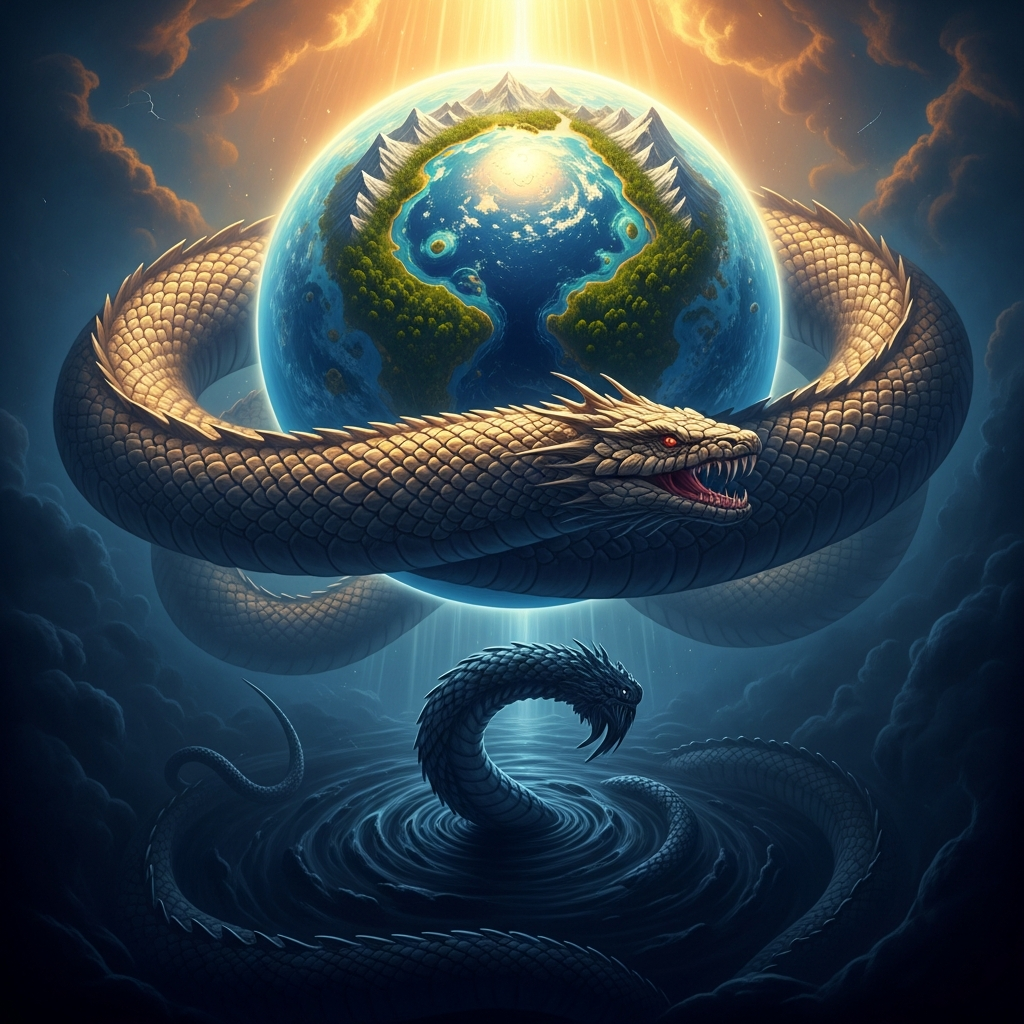
The Norse World Serpent is the son of Loki and the giantess Angrboda, thrown into the encircling ocean by Odin when the gods recognized his dangerous potential. He grew there until he encircled the entire world and could bite his own tail — the Norse version of the ouroboros, the ancient symbol of cyclical infinity.
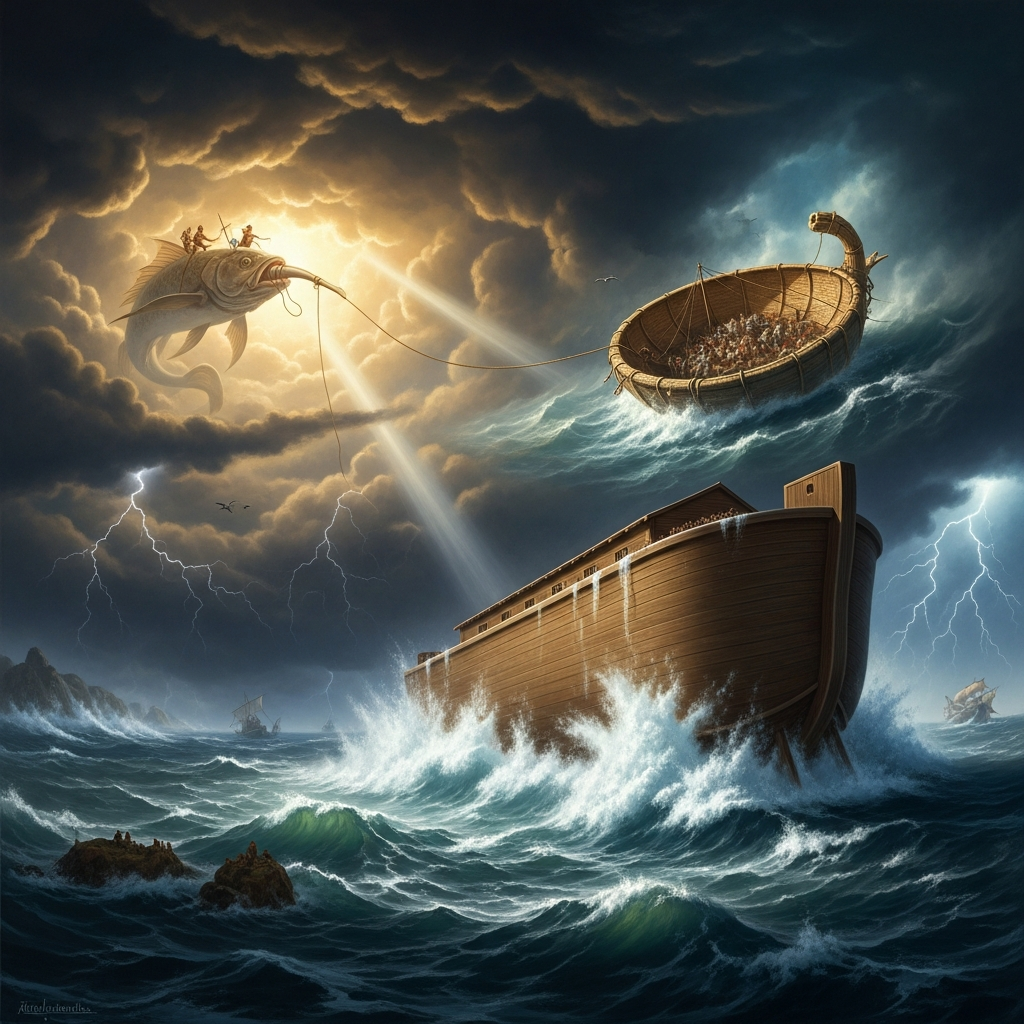
His relationship with Thor is the mythological core of his character: the two are predestined enemies. In their first encounter, Thor nearly lifts him from the sea while fishing, using an ox head as bait, before the giant Hymir cuts the line. In their final encounter at Ragnarok, Thor kills Jormungandr and takes nine steps before dying from the serpent’s venom.
The Norse theological point is stark: the world’s greatest protector and the world’s greatest threat are equal in power, and their mutual destruction is baked into the cosmos from the beginning. Jormungandr does not represent chaos that can be managed or wisdom that can be learned from. He represents the limit — the place where the world ends, which is also the place where the world’s defender must go to die.
The ouroboros symbol (serpent biting its own tail) appears in cultures entirely separate from the Norse tradition — in Egyptian alchemy, in Gnostic cosmology, in Hindu symbolism — and each time it carries a similar meaning: the cosmic serpent as boundary, as the limit of the known, as the thing that circles existence. Something about the image of a snake large enough to encircle the world registers immediately as cosmic, as the edge of what can be thought about.
Naga: The Serpent That Serves the Divine
The Hindu-Buddhist Naga tradition is the most complex serpent theology in this survey, because the Nagas are not a chaos-force but a class of divine beings with full social organization, motivations, and relationships with human and divine communities.
Nagas dwell in underground palaces and in the waters — rivers, lakes, the ocean. They guard hidden treasures. They govern rain and are propitiated for agricultural success. They can be benevolent (sending rain at the right time) or dangerous (flooding, drought, serpent bite). Many Hindu stories involve Nagas intermarrying with humans, producing Naga-human lineages. The serpent in Hindu cosmology is not primarily an enemy but a presence — powerful, potentially dangerous, and deeply embedded in the fabric of the world.
The cosmic serpent Shesha (also Ananta — “endless”) goes further: Shesha is Vishnu’s bed and canopy. Between the dissolution of one universe and the creation of the next, Vishnu rests on Shesha’s coils floating on the cosmic waters. The primordial serpent is not chaos threatening creation — he is the stable ground on which the creator rests before creating again. Chaos, in this theology, is not the enemy of order but its foundation.
This inversion — chaos as ground rather than enemy — is one of the deepest theological moves in the serpent tradition. The Hindu cosmos is not something that was won from a chaos monster and must be defended against it. It is something that grows from the serpent, repeatedly, with the serpent’s cooperation.
Leviathan: The Monster God Holds Back
The Hebrew Leviathan appears primarily in Job and the Psalms, and the context is always the same: God defeated it before or at creation, and holds it back now, and will defeat it again at the end of time.
“You divided the sea by your strength; you broke the heads of the dragons in the waters. You broke the heads of Leviathan in pieces” (Psalm 74:13-14). The creation of the world required a combat with a chaos monster — a pattern familiar from the Babylonian Enuma Elish, where Marduk kills Tiamat to create the world. The Hebrew and Mesopotamian traditions share this combat-cosmogony structure, the cosmos made from the defeat of the primordial chaos-dragon.
But Leviathan is not simply past-tense. In Job, God addresses Job from the whirlwind with a long catalogueof his creation’s overwhelming powers, ending with Leviathan: “Can you draw out Leviathan with a fishhook?” The answer is obviously no. God can. Job cannot. The point is the magnitude of the gap between divine and human power.
In some apocalyptic traditions, Leviathan will be released at the end of time and defeated again — the cosmic battle reenacted as the final act of history. The chaos monster subdued at creation is not destroyed but stored, waiting. Its containment is a divine achievement that must be continually sustained.
Quetzalcoatl: The Exception
The Mesoamerican feathered serpent breaks every rule in this survey.
Quetzalcoatl combines snake and sky-bird in a single body — earth and heaven, matter and spirit, serpent and flight. He is not the enemy of the cosmic order; he is one of its creators. He governs the calendar, the arts, civilization itself, the transmission of maize to humanity, the creation of the current world age. He is a sky deity who has the body of a serpent, or a serpent deity who has the feathers of the quetzal bird. The synthesis is the point.
The feathered serpent tradition at Teotihuacan predates the Aztec religion by a thousand years and influenced every subsequent Mesoamerican civilization. Quetzalcoatl as the god-king of Tula, the culture hero who departed eastward and promised to return, was the legend that Hernan Cortez exploited. The identification of a Spanish conqueror with a returning feathered serpent is one of history’s most catastrophic mythological misreadings.
But the theological substance of Quetzalcoatl is the synthesis: the serpent that flies. Other traditions keep the cosmic serpent in its place — in the water, underground, at the world’s edge, in the dark. Mesoamerica made it ruler of civilization, the deity whose domain is not chaos but the integration of all opposites. The dragon as divine principle, not divine enemy.
Why Everywhere Has Dragons
The convergence of serpent-dragon mythology across unconnected cultures is one of comparative mythology’s most discussed puzzles. Jones’s evolutionary hypothesis (composite predator archetype) and the mythological approach (serpent as cosmic principle) are not mutually exclusive. The deep neural pattern provides the template. The theological elaboration provides the meaning.
What every tradition agreed on is this: the great serpent represents a force that is simultaneously more ancient than the gods and more powerful than ordinary divine force — the primordial potential for both creation and destruction that precedes the ordered cosmos and cannot be fully eliminated from it. Whether that force is chaos to be fought, wisdom to be respected, or the ground on which the divine rests between universes — that is the question each tradition answered for itself.
Echoes Across Traditions
Entities
- Apophis
- Jormungandr
- Naga
- Leviathan
- Quetzalcoatl
- Vritra
- Apep
- Tiamat


Sources
- Jan Assmann, *The Search for God in Ancient Egypt* (2001)
- Snorri Sturluson, *Prose Edda* (c. 1220 CE)
- Wendy Doniger, *The Hindus: An Alternative History* (2009)
- Michael S. Heiser, *The Unseen Realm: Recovering the Supernatural Worldview of the Bible* (2015)
- David Carrasco, *Quetzalcoatl and the Irony of Empire* (1982)
- David E. Jones, *An Instinct for Dragons* (2000)