Contents
When the hero Zāl's wife Rūdāba cannot deliver their impossibly large child, the Sīmorgh descends from her mountain and teaches the midwives how to perform the world's first cesarean section — and Rostam is born laughing.
- When
- The early heroic age of Iran — the reign of King Manuchehr
- Where
- Zāl's palace in Zābolestān — the southeastern province of the Shahnameh world
Rūdāba has been in labor for three days.
She is the most beautiful woman in Iran — daughter of Mehrab of Kābol, who is himself the descendant of Zahhāk, which means the serpent-king’s blood runs in her veins and the blood of the kings of Kābol runs in her veins and none of it has any relevance to what is happening to her now. What is happening is that the child in her womb is too large to be born by ordinary means.
Her husband Zāl is outside the birth chamber, and he is doing what the Shahnameh says he does in crisis: he reaches into his robe and removes a feather.
The feather came from the Sīmorgh.
Zāl was born albino — white-haired, white-eyed, which the Shahnameh presents as a sign of something beyond normal: either divine favor or demonic taint, and no one could immediately tell which. His father Sām, the greatest warrior of the previous generation, abandoned him on a mountainside in shame. The Sīmorgh, the great bird who lives on the summit of the cosmic mountain Alborz, found the infant and raised him as her own. When Zāl grew to manhood and Sām came to take him back, the Sīmorgh gave him three feathers: burn one if you need me.
He burns the feather.
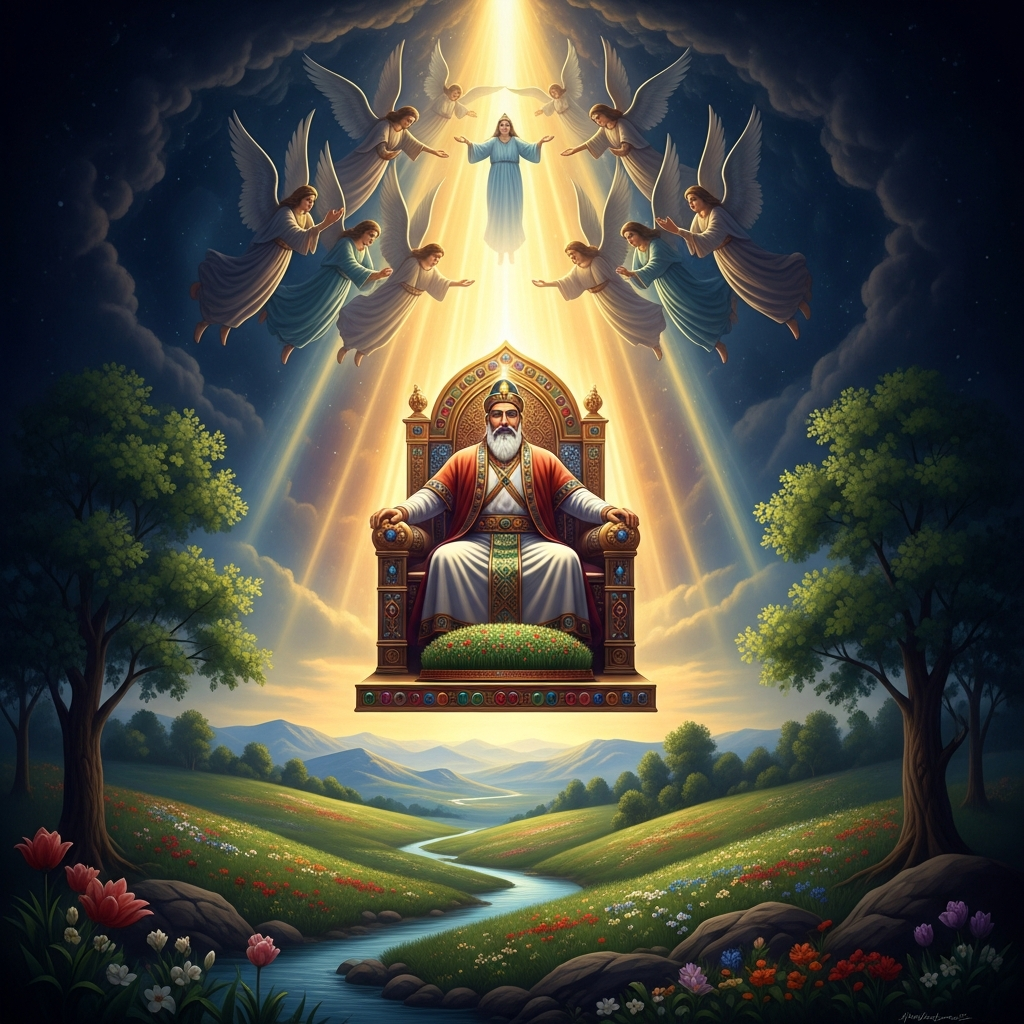
The Sīmorgh arrives from her mountain between the burning and the morning. She is vast — large enough that her shadow darkens the courtyard — and ancient beyond reckoning, and she has midwived births before, though none quite like this. She examines Rūdāba and gives the midwives their instructions: bring old wine, bring musk, bring a sharp blade. Cut the child free.
The procedure the Shahnameh describes in its tenth-century Persian is recognizable: the incision, the child removed, the wound cleaned with wine, the flesh closed and healed with the Sīmorgh’s own feather drawn across it. Rūdāba sleeps through the healing and wakes to find the wound already closing.
The child who emerges from this procedure is not an ordinary infant.
He is as large as a one-year-old at birth. He is the color of a hero — the Shahnameh means broad and gold-skinned and immense. He is not crying. He is laughing. He emerges from the cut in his mother’s side into the hands of the midwives and the first sound he makes is laughter, which is the sign in the Iranian tradition of a soul that has looked at the world clearly and decided it is worth inhabiting with full force.
Zāl names him Rostam.
They put the newborn in a cradle. Five wet nurses are required to keep him fed. Within the year he is eating solid food and requiring the portions of five boys his age. Within a few years he has the size and strength of a man, which the Shahnameh presents not as alarming but as appropriate: the world has need of someone this size, and the world has arranged for him to exist.
He will live, in the Shahnameh’s account, for several centuries — the estimates differ — outlasting every king he serves, witnessing the end of the heroic age he embodies. He will kill his own son without knowing who the young man is. He will be the instrument of both the greatest victories and the greatest tragedies in Iranian legendary history.
None of that is present yet.
What is present is a laughing infant in a reinforced cradle, already larger than most men, already requiring the resources of a small household just to exist. The Sīmorgh has returned to her mountain. Rūdāba is healing. Zāl stands in the doorway of the birth chamber looking at the child he almost lost and that the great bird of the world came down to save.
There will be many stories about this child.
This is the first one, and it is about an ordinary crisis solved by extraordinary intervention — the love of a foster-mother who flew from the top of the world to deliver her human grandson into the world laughing.
Echoes Across Traditions
Entities
- Rostam (Rustam)
- Zāl
- Rūdāba
- Sīmorgh
- Sām
Sources
- Ferdowsi, *Shahnameh*, 'The Birth of Rostam,' translated by Dick Davis
- Dick Davis, 'Rostam,' *Encyclopædia Iranica* (2009)
- Olga Davidson, *Poet and Hero in the Persian Book of Kings* (Cornell, 1994)
- Jerome Clinton, *The Divan of Manuchehri Damghani: A Critical Study* (Mazda, 1972)