Garshasb and the Horned Dragon
The early heroic age — before the reign of Manuchehr, deep in the mythic past · The eastern wilderness of the Iranian world — beyond the known lands
Contents
The warrior Garshasb, son of Sam and ancestor of Rostam, journeys to the eastern edge of the world and defeats a dragon whose horns are as tall as mountains — establishing the prototype of the Iranian dragon-slaying hero before Rostam exists.
- When
- The early heroic age — before the reign of Manuchehr, deep in the mythic past
- Where
- The eastern wilderness of the Iranian world — beyond the known lands
He walks to the edge of the east.
The eastern edge of the Iranian world in the oldest mythological imagination is not merely a geographical direction but a quality of reality — the place where the ordered world of the plateau gives way to something stranger, older, less amenable to the laws that govern the world of fire temples and cattle herds and covenant-keeping. The dragons are in the east.
Garshasb is the grandson of Sām (in the genealogies that connect him to the Shahnameh’s heroes) or simply a great warrior of the primordial age (in the older Avestan texts where he stands on his own). Either way, he goes east when no one else will, because the dragon Gandarewa — the golden-heeled, horse-swallowing, man-eating river dragon who lurks in the cosmic sea — needs to be killed, and dragons of that caliber require heroes of corresponding caliber.
The dragon he fights on his eastern journey has horns.
The horned dragon is a specific creature in the Iranian bestiary — its horns are its most dangerous feature, not its teeth or its fire-breath (Iranian dragons don’t breathe fire; they are primarily creatures of overwhelming physical size). The horns are described as being tall enough to graze the clouds, which is not metaphor but measurement: the creature is so large that it occupies the kind of scale normally associated with mountains.
Garshasb does not have the Sīmorgh’s feathers.
He does not have Rostam’s supernaturally strong horse. He has a club — the weapon of pure force — and the quality the Avestan texts call vərəθrajana, which is the same quality that Verethragna embodies: victory through forward momentum, the will to keep moving toward the obstacle rather than away from it.
He kills the horned dragon.
The method varies: sometimes he traps it, sometimes he clubs it to death through sheer persistence, sometimes the divine yazatas assist. What is consistent across all versions is the eastern journey, the monstrous scale of the opponent, and the victory. The dragon’s body becomes part of the eastern landscape — another wound from the heroic age embedded in the geography of the world.
He also kills Gandarewa, the golden-heeled dragon of the cosmic sea.
The Avestan texts record this with the same laconic confidence they use for all Kersaspa’s monster-killing. He simply goes and does it. The cosmic order requires that the sea-dragon be killed. He is the one to do it.
But the Avestan tradition preserves something unexpected about this great champion.
He sinned.
He cooked food on the back of a dragon — not realizing, apparently, that the creature was alive — and the dragon woke from the heat and threw him off and he survived but the incident is recorded as a ritual impurity. In another tradition, he slept near the sacred fire and let it go out.
These small failures matter because they determine his eschatological fate.
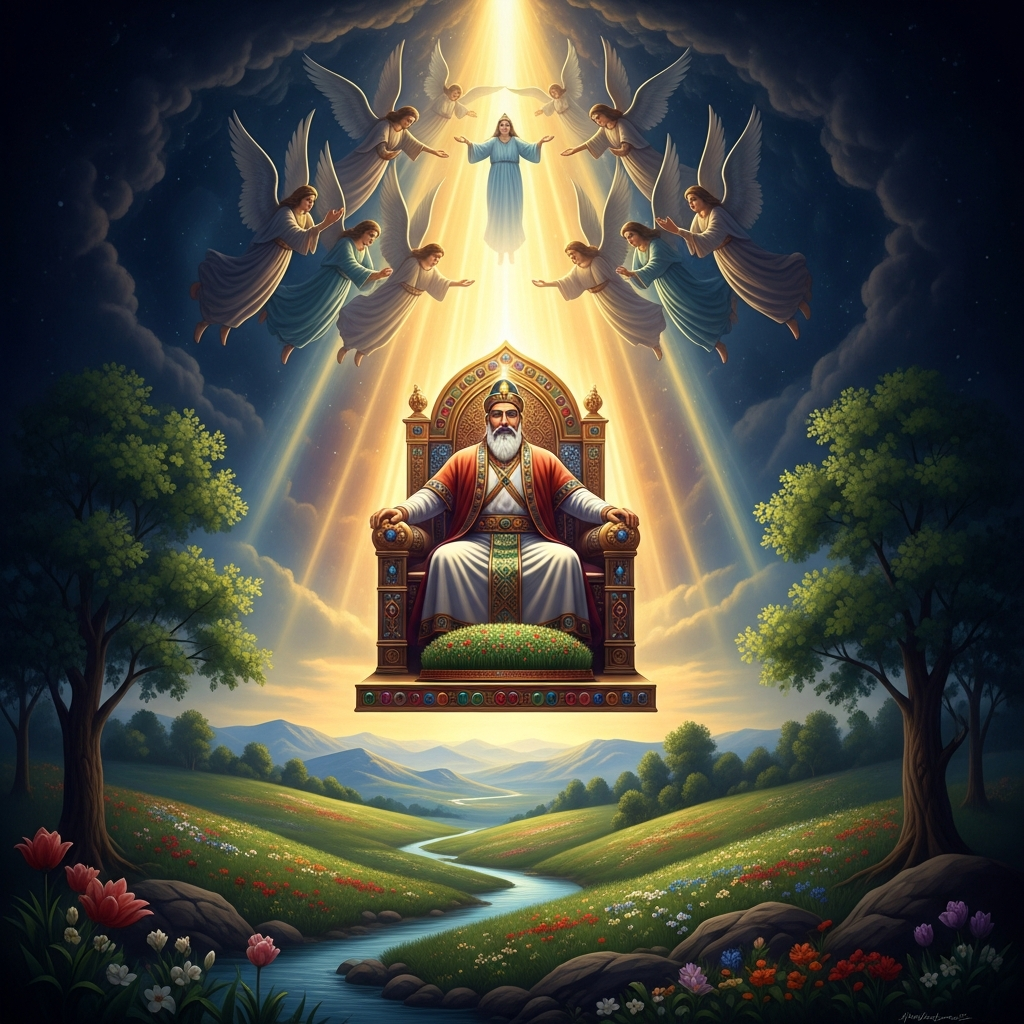
Garshasb did not die — or rather, he sleeps. On the Alborz mountain range, in a cave or a valley or a fortress, the great dragon-slayer lies in an enchanted sleep maintained by divine order for a specific purpose: he will be needed at the end of time. When Zahhāk breaks free from Mount Damāvand — where Ferīdūn chained him and where he has been imprisoned since the heroic age — and the world faces its final monster, Garshasb will be woken.
He will kill the serpent-king.
His small sins have delayed him, which is why he is sleeping rather than present. A yazata tends to his fire to keep him alive. The divine order maintains him in suspension until the moment he is needed.
The dragons are waiting.
So is the man who kills dragons.
He has always been sleeping on the mountain, ready for the last fight.
Echoes Across Traditions
Entities
- Garshasb (Kersaspa)
- Sām
- The Horned Dragon
- Gandarewa
Sources
- Avesta, *Yasna* 9.10 and *Zamyad Yasht* 19 — the Kersaspa references
- Abu Mansur al-Tha'alibi, *Ghurar al-Siyar*, on Garshasb
- Mary Boyce, *A History of Zoroastrianism*, Vol. I (Brill, 1975)
- Khaleghi-Motlagh, 'Garshāsp,' *Encyclopædia Iranica* (2000)