Contents
After four centuries of perfect kingship, Jamshid demands that his subjects worship him as a god — and in that moment the divine royal glory abandons him, leaving him to be hunted down and sawn in half by the tyrant Zahhāk.
- When
- The end of the golden age — four hundred years into Jamshid's reign
- Where
- The royal court of Jamshid's empire, then the world's edges where he flees
In the three hundred and sixteenth year of his reign — or possibly the four hundredth, the sources do not agree precisely, because the fall of perfect things is always imprecisely dated — Jamshid calls his nobles together.
He has been thinking about what he is.
He has given the world iron and silk and medicine and architecture. He has expanded the earth itself three times when it grew too full. He has banished winter and illness and death. He has reigned for so long that the priests who attended his coronation are still alive and serving in his court, preserved by the same divine grace that has preserved him. He looks at what he has accomplished and he reaches a conclusion that feels, in the moment of its reaching, like honesty:
I have no equal. There is no one above me. I am the creator of the world.
He assembles the great men of his kingdom and he says it aloud.
The Shahnameh records the words with terrible precision: I am the one who first showed you how to make armor, how to sew garments, how to navigate ships, how to work stone. I have given you all of this. You owe everything you have to me. Therefore I declare myself your god, and I command you to worship me.
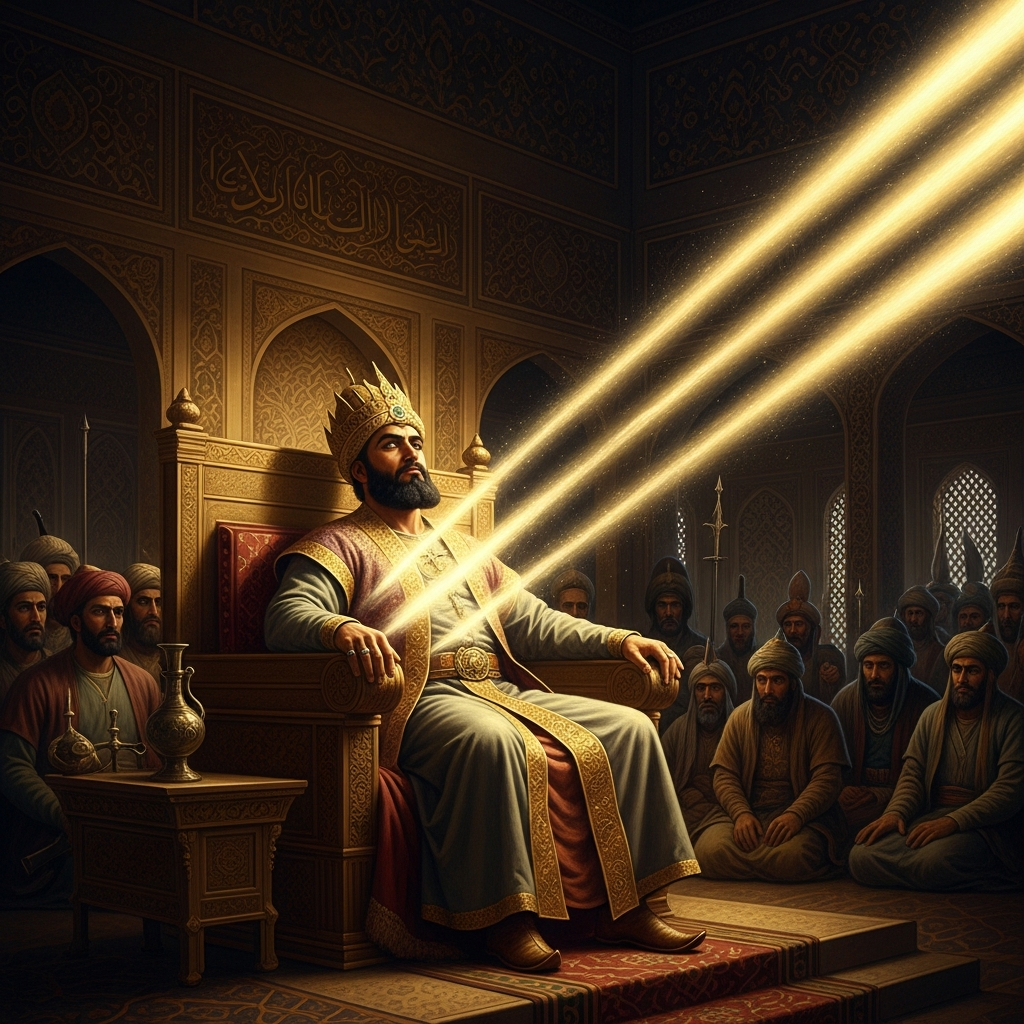
The nobles obey. They are wise men, and they are also prudent men, and a king who has reigned for four centuries without aging in a world that has not known winter tends to produce a combination of those qualities that makes outright refusal difficult to sustain. They worship him. They build him shrines.
The farr leaves.
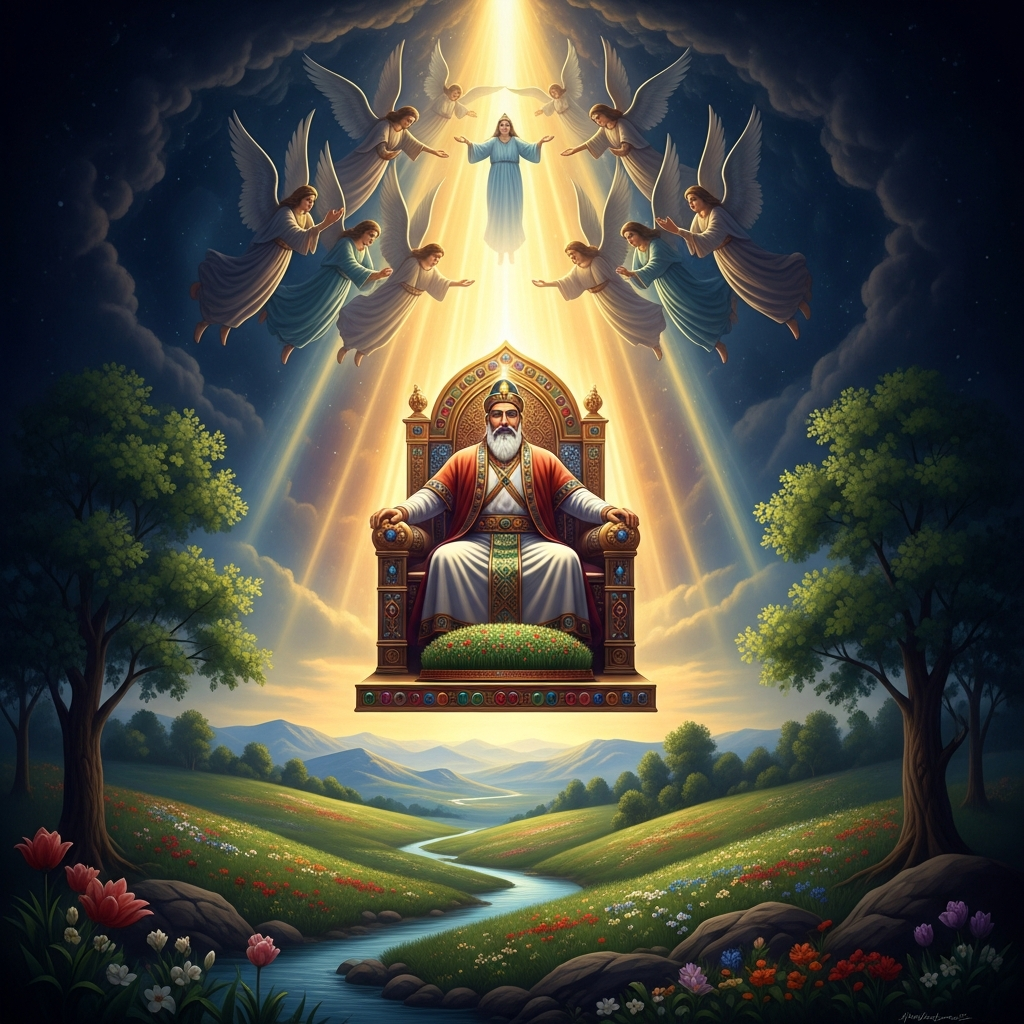
The Avestan tradition preserves a vision of this departure: the divine royal glory, the xvarənah, abandons Jamshid three times, in three separate portions, each portion taken by a different figure who will use it for a different purpose. The first portion of the farr goes to Mithra, the divine guardian of covenant. The second goes to Thraetaona — who in the Shahnameh becomes Ferīdūn — the future king who will defeat the serpent-tyrant. The third goes to Keresaspa, the dragon-slaying hero. The glory does not disappear; it redistributes. It finds its proper vessels.
Jamshid, stripped of the divine light he mistook for his own essence, is visible suddenly as what he is: an aging man in a very large palace. The court sees it. The enemies of Iran see it. The demons, who have been held at bay for four centuries by the farr’s radiance, see it most clearly.
There is a man in Arabia, or in the west, whose name is Zahhāk.
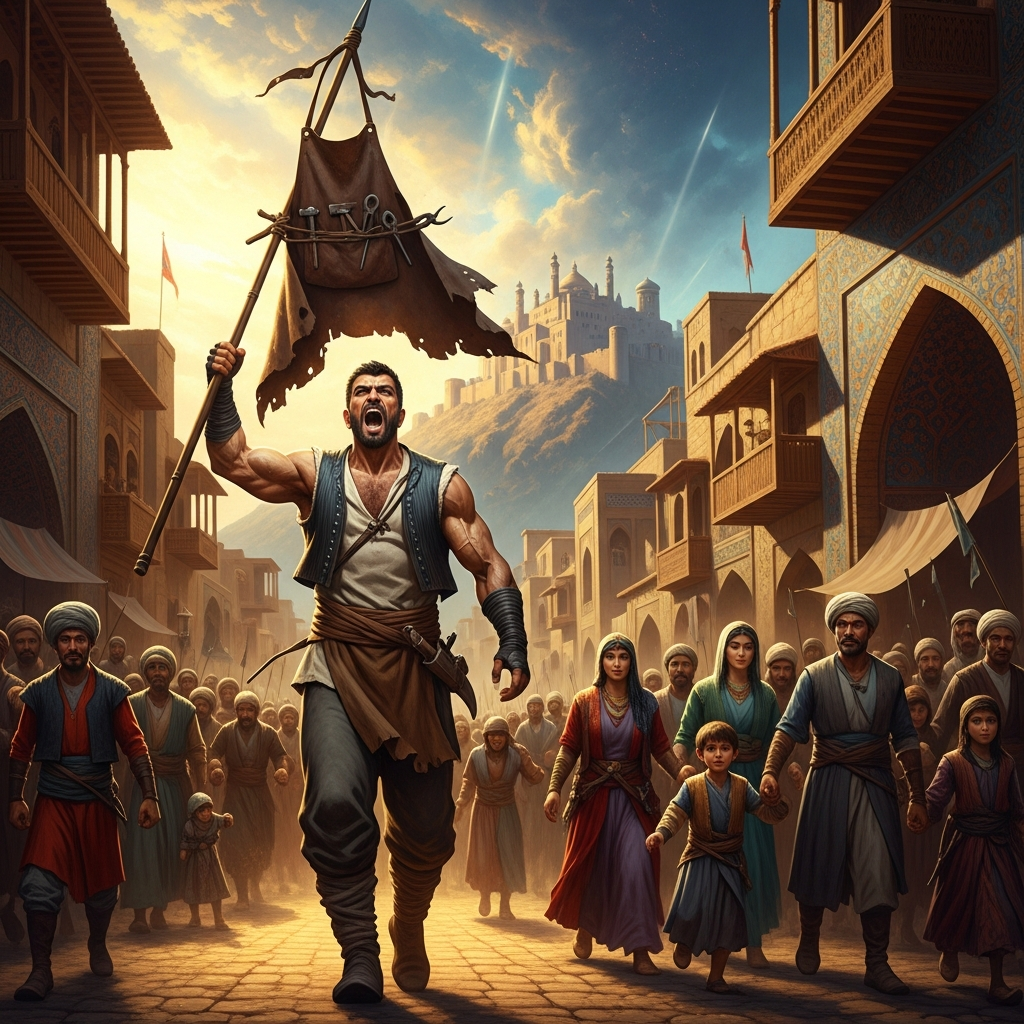
He has two serpents growing from his shoulders — they grew there when, through demonic instruction, he kissed the devil on both shoulders and the kiss took root and grew. The serpents are fed on human brains, one each day, and the arrangement has given Zahhāk a kind of dark kingship, a negative farr, a dominion built on horror rather than righteousness. He marches on Jamshid’s now-undefended kingdom.
Jamshid flees.
For a hundred years — the Shahnameh says a hundred years — Jamshid wanders the earth in hiding. He is the last man in the world who remembers what the world was like when he governed it well, and this memory is both his torment and his only companion. He sees the world he expanded and beautified now under the dominion of the serpent-king. He sees winter return. He sees disease return. He sees the death he banished resume its patient work.
He is caught near the sea of China.
Zahhāk has him sawn in half with a fish-bone saw. The Shahnameh does not linger on the method — it is too precise in its cruelty to require lingering. The great king who expanded the earth and banished death dies in a manner designed to maximize his time in dying.
His reign is called the golden age. His fall is called the warning.
Persian court poets for two thousand years will cite him in the same breath — the proof that the highest human achievement is possible, and that it ends not when enemies are too strong but when the successful man mistakes the source of his success. The light did not abandon Jamshid because he failed. It abandoned him at the peak of his achievement, because achievement convinced him that the light was his.
The throne of the world does not require a god.
It requires a servant.
Echoes Across Traditions
Entities
- Jamshid (Yima)
- Zahhāk
- Farr (Xvarənah)
- Iblis (in Shahnameh framing)
Sources
- Ferdowsi, *Shahnameh*, 'The Reign of Jamshid' and 'The Reign of Zahhāk,' translated by Dick Davis
- Avesta, *Zamyad Yasht* 19.34–38 on the flight of the xvarənah
- A.Sh. Shahbazi, 'Jamšid,' *Encyclopædia Iranica* (2008)
- Abolala Soudavar, *The Aura of Kings: Legitimacy and Divine Sanction in Iranian Kingship* (Mazda, 2003)