Kaveh the Blacksmith Raises His Apron
Near the end of Zahhāk's thousand-year reign — the moment the popular revolt begins · Zahhāk's palace, then the streets of the city, then Ferīdūn's camp
Contents
When Zahhāk demands Kaveh's last sons to feed his serpents, the blacksmith tears off his leather apron and walks out of the palace into the street — lifting it as a banner of revolt that will become the royal standard of Iran.
- When
- Near the end of Zahhāk's thousand-year reign — the moment the popular revolt begins
- Where
- Zahhāk's palace, then the streets of the city, then Ferīdūn's camp
He has seventeen sons.
Kaveh the blacksmith has seventeen sons, and he has already given sixteen of them. Zahhāk’s palace cooks have come to his workshop sixteen separate times, in sixteen separate years, and each time they have taken a son and brought him to the palace where the serpents that grow from the tyrant’s shoulders wait for their daily meal. Kaveh has made the metal things the palace requires — the chains, the hinges, the tools, the armor — and he has been paid for his work and robbed of his children.
Now the cooks have come for the seventeenth son.
The youngest. The last.
There is a point of calculation in any occupied life where the calculation stops being calculation. Kaveh stands in his workshop with the palace cooks waiting at the door and the seventeenth son looking at him from across the forge, and something in his chest that was still making the calculation simply stops. Not a decision exactly. More like the cessation of a noise.
He follows the cooks to the palace.
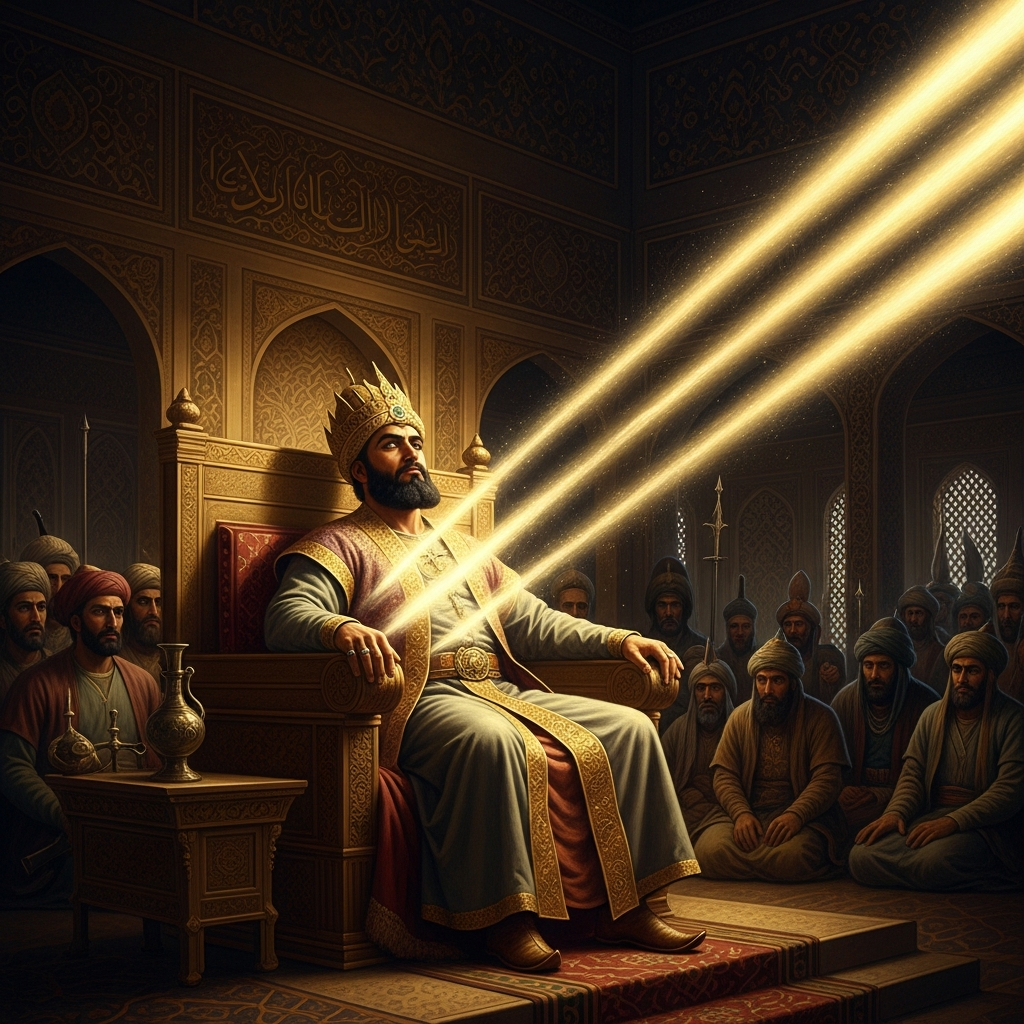
This is unexpected. The fathers of the other sixteen did not come. They knew better. Kaveh walks into Zahhāk’s court where the tyrant sits on his throne with the serpents hanging from his shoulders like living decorations, their eyes tracking the room, their necks thick with a thousand years of human brains. The assembled nobles look at the blacksmith. Kaveh stands before the throne.
He says: My sons have done nothing wrong. The law of the world — the law that existed before you — does not require innocent sons to feed monsters. I refuse.
The Shahnameh preserves a remarkable detail: Zahhāk does not immediately have him killed. Perhaps the directness of it is confusing. Perhaps the presence of the assembled nobles makes an immediate execution tactically awkward. The tyrant produces a statement — a document asserting his own righteousness, his own legitimacy — and demands that Kaveh sign it, as the other petitioners have done, as acknowledgment that his reign is just.
Kaveh takes the document.
He reads it. He reads every word.
He tears it apart.
The Shahnameh gives him a speech at this point — the speech every revolutionary gets, or should get, when the moment is upon them: This is your justice? This document is your righteousness? You have fed my sixteen sons to your demons and now you call yourself a just king? I will not sign. Every righteous man in the world should rise against you.
He turns from the throne and walks out.
He walks through the palace, through the gates, into the street. And here is the moment the tradition has preserved for two thousand years, the moment that every Iranian child who has heard the Shahnameh has been told about:
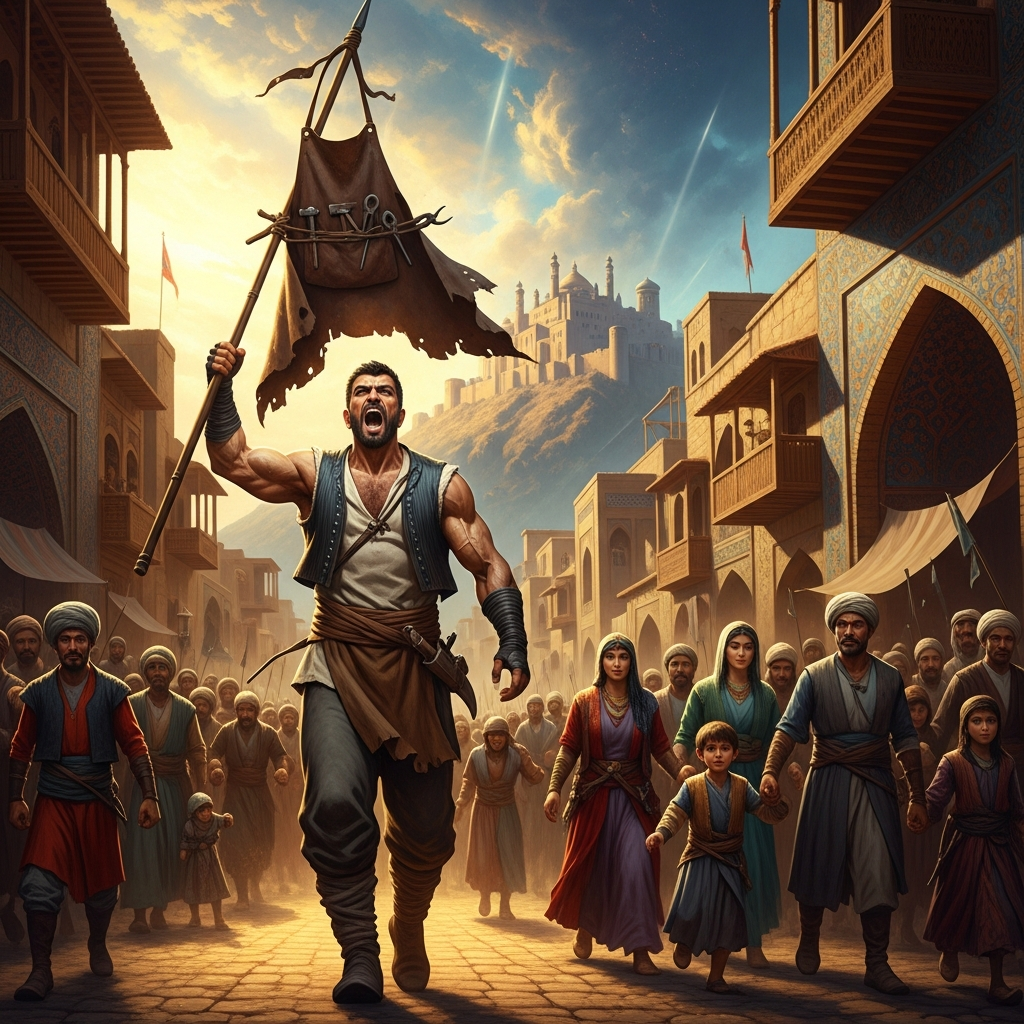
He takes off his leather apron.
It is a blacksmith’s apron — thick cowhide, worn and sooty, shaped by years of work at the forge. He does not throw it away. He ties it to the end of a pole and lifts it above his head, and he walks down the street with this leather banner raised high, and he begins to shout.
The people follow him.
They have been following Zahhāk’s orders for a thousand years. They have been paying the levy of brains. They have been pretending not to hear the sounds from the palace. They have been making the calculations. Now a blacksmith is walking through the street with his apron on a pole, and the calculation has simply, visibly, stopped working for someone. The street fills up behind him.
He walks to Ferīdūn.
The young man with the divine glory receives Kaveh’s banner and does something to it that the Shahnameh records as the founding act of Iranian royal insignia: he takes the leather apron and mounts it on a taller staff and decorates it with gems and golden thread and painted silk, and it becomes the Derafsh Kaviani — the Banner of Kaveh — the royal standard that will fly over the Iranian armies for three thousand years, that will become, in later centuries, the great jeweled standard of the Achaemenid and Sassanid emperors.
Kaveh gets his last son back.
He goes back to his forge. He makes the bull-headed mace that Ferīdūn will carry to the palace. He is, afterward, only a blacksmith again — patron saint of blacksmiths throughout the Iranian world, but not a king, not a general, not a court figure.
The apron that became the royal banner is enough.
Echoes Across Traditions
Entities
- Kaveh the Blacksmith
- Zahhāk
- Ferīdūn
- Derafsh Kaviani (Kaveh's Banner)

Sources
- Ferdowsi, *Shahnameh*, 'The Reign of Zahhāk,' translated by Dick Davis (Viking Penguin, 2006)
- Djalal Khaleghi-Motlagh, 'Derafš Kāvīān,' *Encyclopædia Iranica* (1994)
- Ehsan Yarshater, 'Iranian National History,' *Cambridge History of Iran* Vol. 3
- Dick Davis, *Epic & Sedition: The Case of Ferdowsi's Shahnameh* (Arkansas, 1992)