Jamshid and the Four-Hundred-Year Summer
The mythic golden age — the reign of the first great king, before the coming of Zahhāk · The primordial Iranian kingdom — from the Alborz mountains to the edges of the known world
Contents
King Jamshid receives the divine royal glory and rules an empire of such prosperity that he banishes winter, sickness, and death for four hundred years — until his subjects begin to grow suspicious that he may be more than human.
- When
- The mythic golden age — the reign of the first great king, before the coming of Zahhāk
- Where
- The primordial Iranian kingdom — from the Alborz mountains to the edges of the known world
Jamshid is the fourth king of the world, and the first who matters completely.
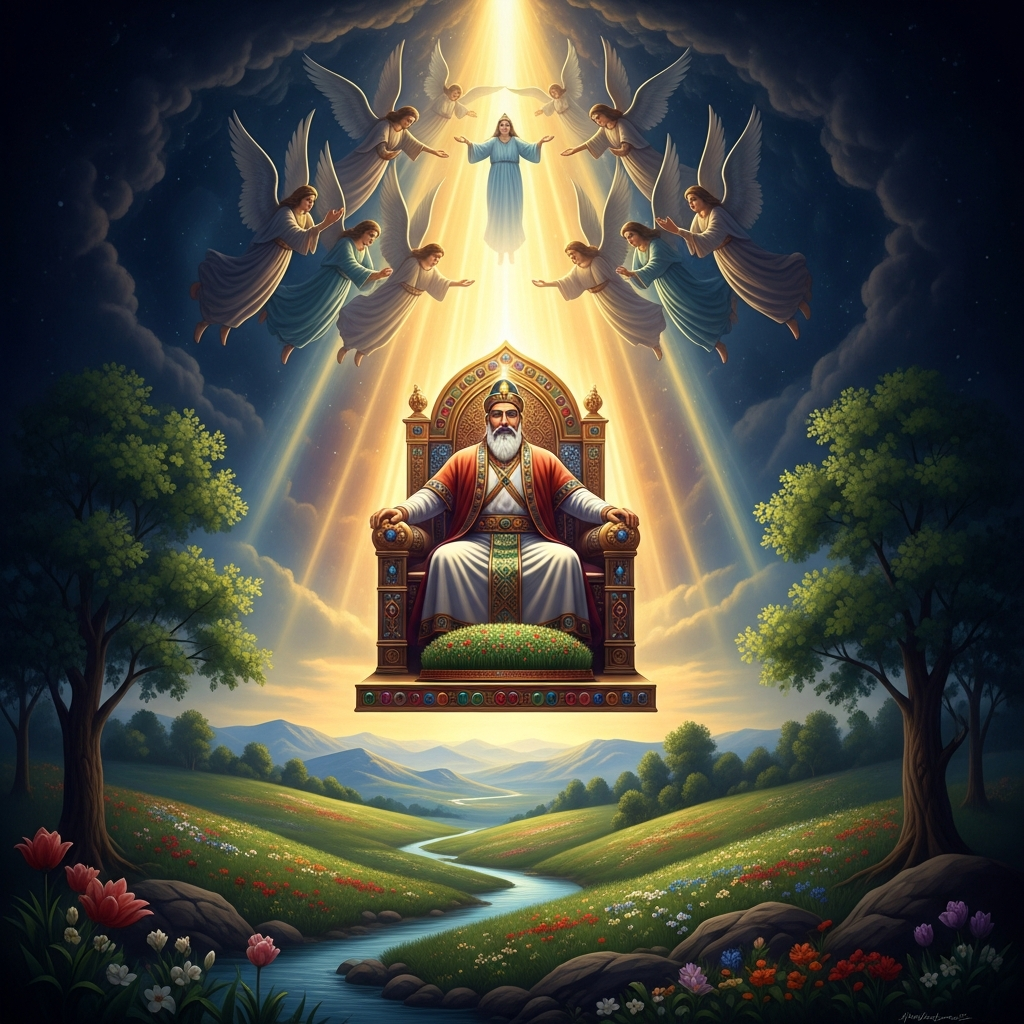
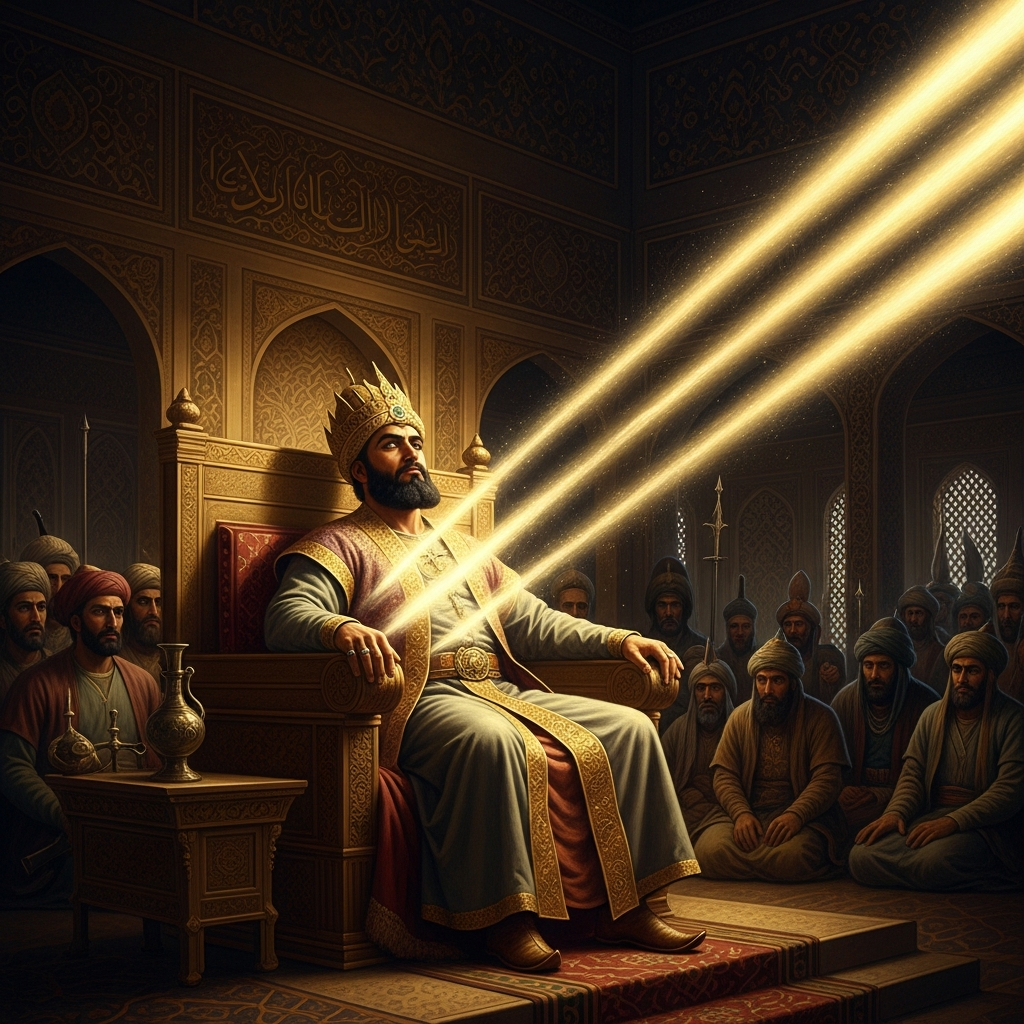
His father Vivanghat pressed and drank the sacred haoma drink and was rewarded with a son who received, at birth, the farr — the divine royal glory, the xvarənah — that luminous essence that makes some men kings and others merely powerful. It surrounds Jamshid like an aura, like the radiance that surrounded Gayōmard before Angra Mainyu’s corruption, and it means something specific: as long as he holds it, the world he governs will be right, will be aligned with Asha, will be under the protection of the cosmic order.
Ahura Mazda appears to him.
Will you undertake to tend the world? the Wise Lord asks. Will you hold my world and nourish it?
Jamshid agrees without hesitation. He is given a golden arrow as a symbol of his mandate and is told: when the earth becomes too full of people and animals, strike the ground with the arrow, and the earth will expand. He strikes the ground. The earth grows. He strikes it three times over the centuries, and each time the earth expands until it is a third again as large as it was, and the overflow of people and animals and plants fills the new space. There is no war over land, no famine, no displacement. There is simply more earth, whenever it is needed.
Under his kingship, Jamshid divides the world into its proper functions.
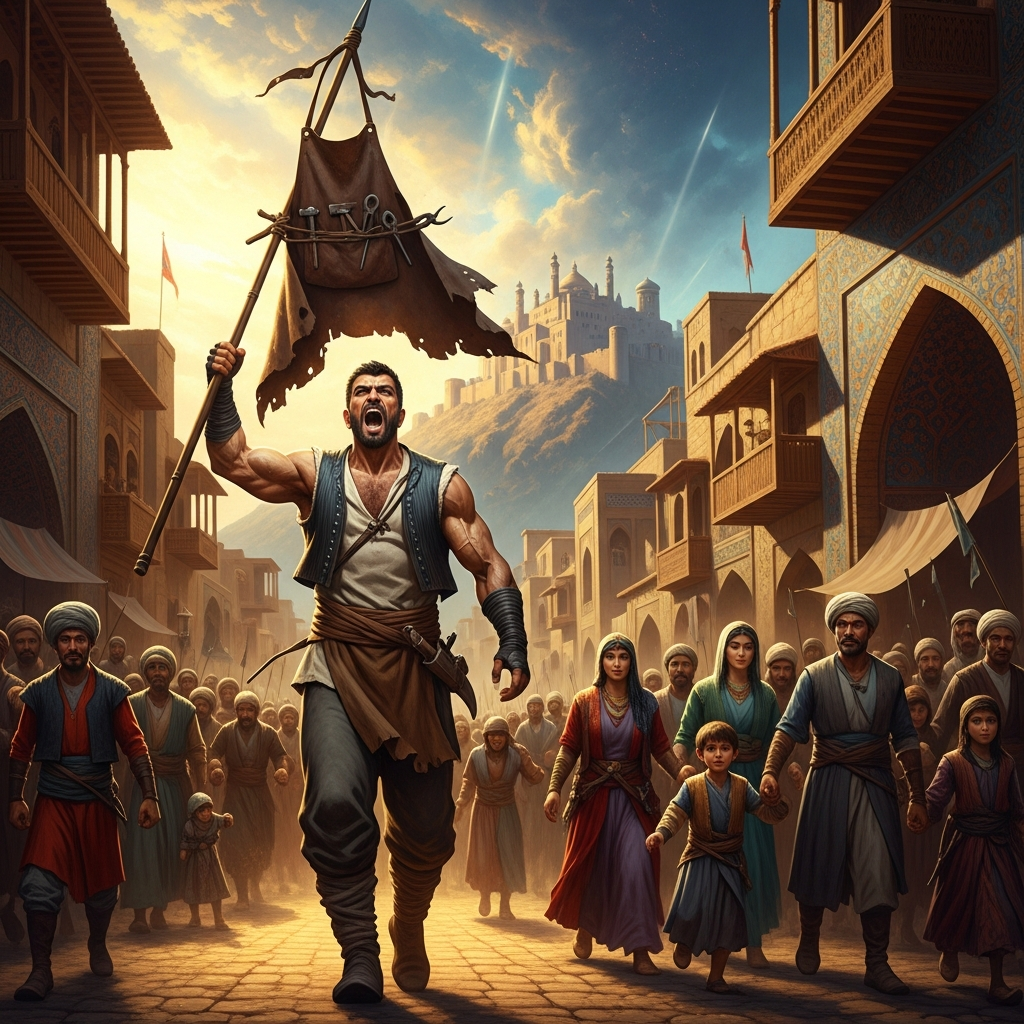
He separates the warriors from the priests and the craftsmen from the farmers — not as a hierarchy of worth but as a recognition that every task has its proper excellence. He teaches the smiths to work iron into tools and armor and blades. He teaches the weavers to separate wool and linen and silk and make garments fitted to the human body. He teaches the builders to work stone. He teaches the sailors to ride the water.
He banishes winter.
This is not metaphor. The Avesta records it as fact: under Jamshid’s reign there is no winter. The earth is as a garden in perpetual spring, the grasses never die, the cattle multiply, the rivers run clear. He also banishes illness — the daevas, those agents of Angra Mainyu, cannot approach those who live under his farr and breathe the air of his righteousness. And he banishes death: the people who live in his kingdom simply do not die. They grow, they flourish, they fill the earth — which is why Ahura Mazda must keep telling him to strike the ground with the arrow, because the earth keeps filling up.
This goes on for four hundred years.
The coronation day — the day Jamshid first sat on his throne and the divine glory blazed from it so brightly that the angels descended to worship and the demons were scattered — becomes the first Nowruz, the first New Year. Every year since, on the first day of spring, Iranians have celebrated that day: the day the perfect king showed what creation could be if righteousness governed it. The throne that rose above the world, bearing the king in whom the divine glory burned, is the image that Persian poets will reach for when they want to describe how good things can be, when they are as good as they can be.
For four hundred years.
The people who live under Jamshid begin, in the four hundredth year, to notice something.
He has not aged. His hair is the same. His hands are the same. The priests who attended his father’s funeral remember the coronation with perfect clarity, because they too have not aged and nothing has made them forget. The world under Jamshid is so pleasant, so complete, so free of the grinding diminishments of ordinary existence, that its very pleasantness has produced something new: leisure. And leisure, once it arrives, brings with it the capacity for a very specific question.
Is this man a god?
Jamshid himself — the Shahnameh is precise about this — does not initiate the claim. He will hear it and not deny it. He will look at his four hundred years of achievement and he will, at some point between hearing the question and answering it, fail to remember clearly who gave him the golden arrow, who told him to strike the ground, whose farr is burning in his chest.
The divine glory begins to consider leaving.
But that is the next story. In this one, it is still summer. The earth is large and fragrant. The cattle are healthy. The people have never known a grave. Jamshid sits on his throne in the light of a glory he has earned and also received as a gift, and for a moment that lasts four centuries, everything that was promised to creation at its beginning seems to have arrived.
Echoes Across Traditions
Entities
- Jamshid (Yima)
- Ahura Mazda
- Vivanghat
- Spenta Armaiti


Sources
- Ferdowsi, *Shahnameh* (Book of Kings), 'The Reign of Jamshid,' translated by Dick Davis (Viking Penguin, 2006)
- Avesta, *Yima Yasht* (*Zamyad Yasht* 19.31–38)
- Mary Boyce, *A History of Zoroastrianism*, Vol. I (Brill, 1975)
- Abolqasem Ferdowsi, *Shahnameh*, translated by Reuben Levy (Chicago, 1967)