Contents
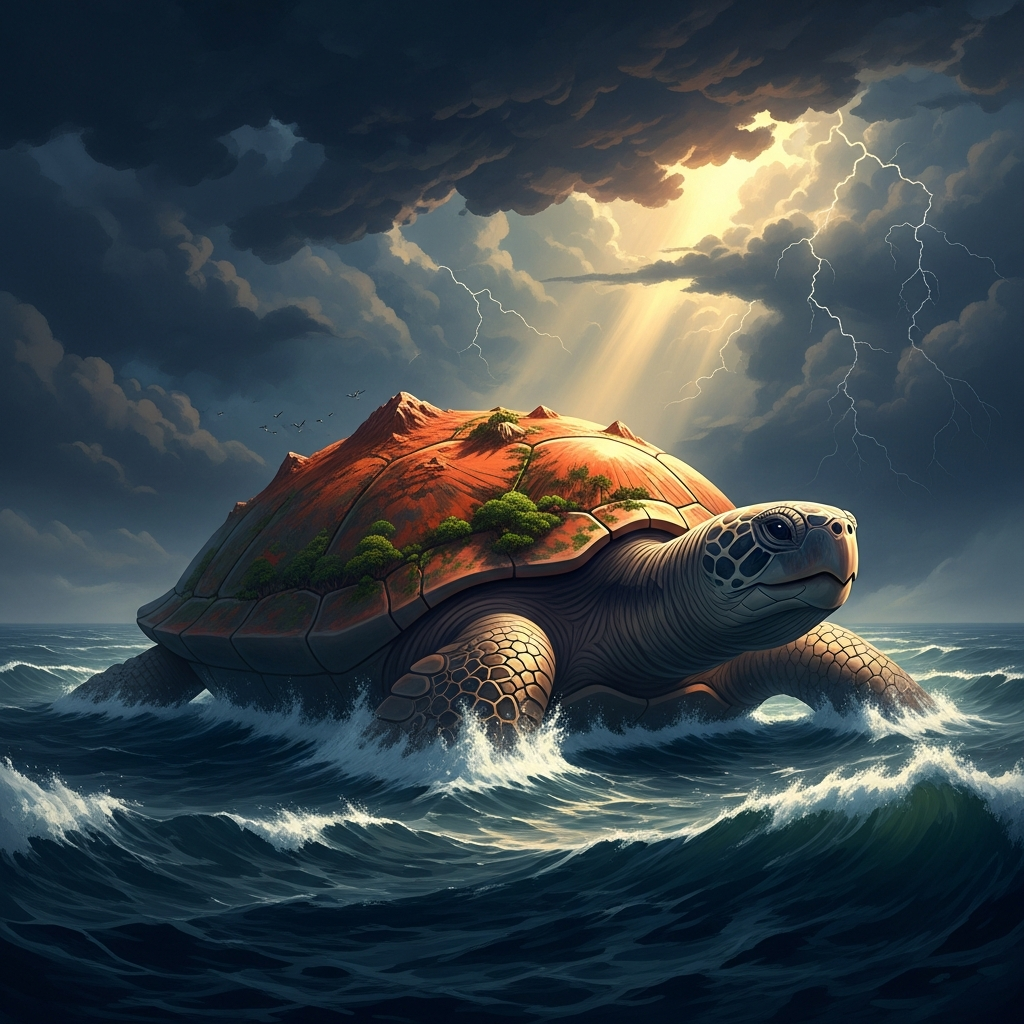
Before the land existed there was only endless water — and when the first beings called out for a place to stand, a turtle rose from the deep and offered its shell, and on that shell the world was built.
- When
- Mythic time — before memory, before the first morning
- Where
- The primordial waters before earth existed; the center of the world
In the beginning there is only Inyan, the Rock, and the darkness around him.
He is the first being. He contains within himself all that will ever exist — every color, every sound, every living thing is folded inside his blue-black form. But Inyan is alone, and loneliness is the one thing even the first being cannot endure. So he opens himself. He lets his own blood flow out into the void, and from that blood comes Maka, the Earth, and from the act of giving so much of himself he becomes brittle and hard and broken into the stones scattered across the world ever after.
The blood fills the space between them.
That blood is Han, the water, the primordial ocean, and it covers everything.
Maka is there, beneath the water. She is the great body, the grandmother of all the living, but she is submerged, formless, dark. And from the void comes Wi, the Sun, drawn into being by the need for something to illuminate what has been made.
But still there is no place to stand.
The beings in that early world — the first animals who exist before they have proper form, the spirits who move through water and light — call out for land. The water is everywhere and there is nowhere to place a foot, nowhere to rest, nowhere to call the center of things. The turtle hears this call.
The turtle has been there from the beginning, older than the stones, patient in a way that no other creature has ever managed. It swims upward from the darkness beneath the primordial waters, and when it breaks the surface it spreads its four legs wide and holds itself steady against the current.
On its shell — domed and ancient, marked with the thirteen plates that will later be said to map the moons of the year — the earth is placed.
Maka rises. She comes up from the water and spreads herself across the turtle’s back. She becomes the land: the plains that roll toward every horizon, the black hills that catch the first light, the rivers that remember where they came from. She is warm and alive because Inyan’s blood is in her and Wi’s light falls on her, and in her warmth the grasses begin to grow.
The turtle does not move. The turtle holds.
The Lakota say that this is why the earth shakes sometimes — not from violence but from the turtle shifting its weight, adjusting its ancient limbs, reminding every living thing that the ground beneath it is a gift that is also a living creature. To live on the earth is to live in gratitude to the turtle. To forget this is to forget that the world requires holding.
The circle is the shape of the turtle’s shell. Every tipi is round for this reason. Every sacred hoop. Every gathering where people sit together so that no one is first and no one is last, all of them curving around the center the way the turtle’s shell curves around the soft body underneath.
Inyan, broken and scattered, becomes the stones that carry memory. Maka becomes the ground beneath the feet. Wi becomes the daily renewal. And the turtle — the turtle simply holds, as it has always held, as it will hold until the last story is told.
That is how the world was made.
Echoes Across Traditions
Entities
- Inyan (the Rock)
- Maka (the Earth)
- Wi (the Sun)
- Wakinyan (the Thunderbeings)
- the Turtle
Sources
- James Walker, *Lakota Belief and Ritual* (University of Nebraska Press, 1980)
- Vine Deloria Jr. and Daniel Wildcat, *Power and Place: Indian Education in America* (Fulcrum, 2001)
- Raymond DeMallie, ed., *Handbook of North American Indians, Vol. 13: Plains* (Smithsonian, 2001)