The Boy Goes Out Alone
Traditional rite of passage — performed at the threshold of adulthood · The high places of the plains and hills — an exposed hilltop, alone, visible to the sky
Contents
At the edge of boyhood, a young man goes alone to a hilltop with no food, no water, no company — and stays for four days and four nights calling out to Wakan Tanka, until the vision that will define his life either comes or doesn't come.
- When
- Traditional rite of passage — performed at the threshold of adulthood
- Where
- The high places of the plains and hills — an exposed hilltop, alone, visible to the sky
The preparation takes days.
The medicine man works with the young man for the entire week before he goes out — purifying him in the sweat lodge, teaching him the prayers, explaining what to do if what comes is frightening and what to do if nothing comes at all. The medicine man has done this before, many times, with many young men. He has his own vision, received on his own hilltop when he was this age. He knows that the vision cannot be manufactured and cannot be predicted, and he also knows that the preparation is what makes the space for it.
He says: you will be alone. That is the whole point.
The young man goes to the hilltop.
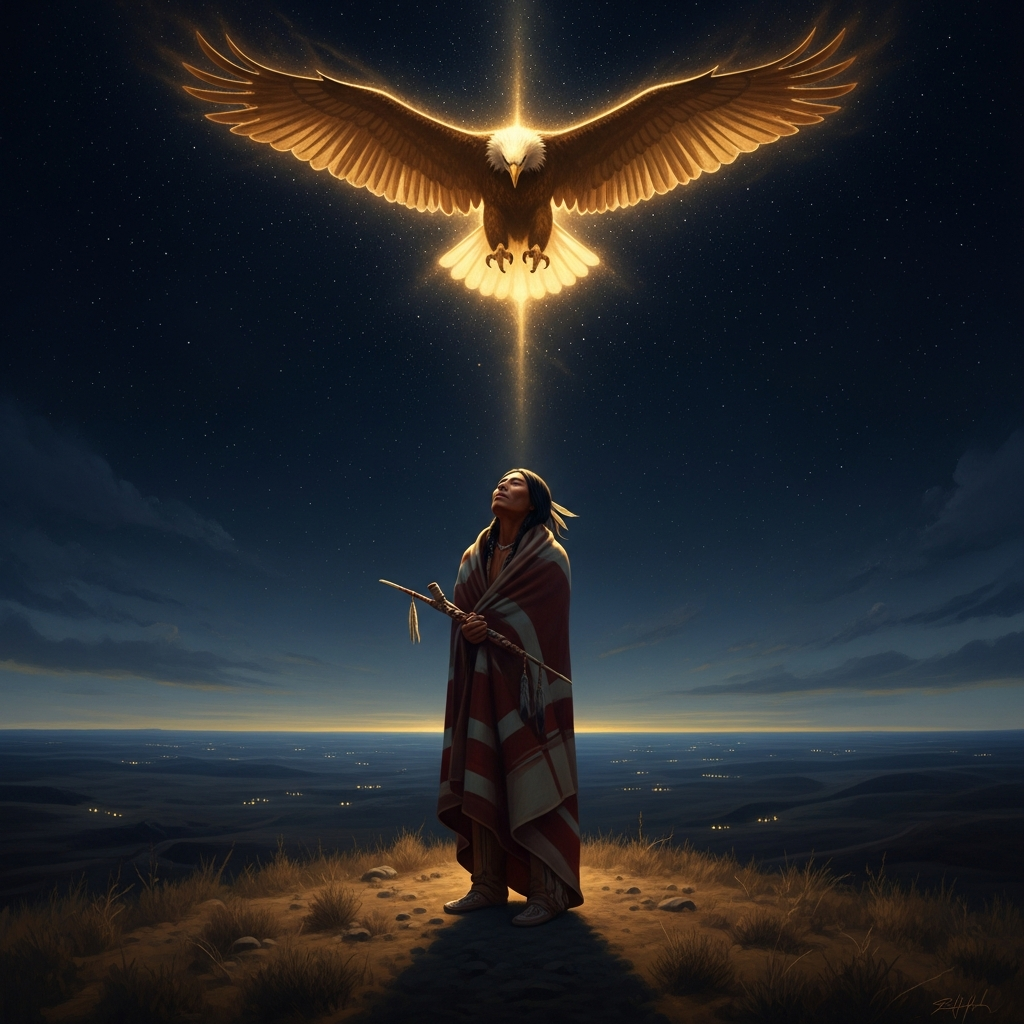
He takes a pipe, tobacco, and a blanket. That is all. The medicine man has chosen the place: an exposed height, visible to the sky in all directions, away from the camp, away from water. The exposure is deliberate — not exposure to danger, but exposure to the sky, the inability to hide from whatever might come.
He marks the four directions with tobacco offerings. He stands in the center of the small sacred space he has made and begins to pray. He calls out — literally calls out, his voice directed at the sky, at the earth, at the four directions. He says: I am here. I am small. I need to know why I am here.
The first day is ordinary. The second day the hunger starts and the thirst becomes constant. The third night is the hardest — the cold and the dark and the absolute silence of the exposed hilltop, the isolation that is different from anything a person feels in the camp. He is genuinely alone in a way he has never been before.
The vision comes when it comes.
Some men report it comes as an animal: a hawk circling, a wolf sitting at the edge of the marked circle, a bear moving in the dark. The animal speaks, or does not speak in words but communicates something that the young man understands with a certainty that has nothing to do with logic. The communication tells him who he is — what his role will be, what medicine he will carry, what name he should receive.
Some visions are auditory: voices, songs, instructions.
Some come as a dream in those brief unconscious periods when the exhaustion overwhelms the effort to stay awake.
Some don’t come at all, or come in a form so subtle — a shift in the quality of the light, a particular breeze — that the young man isn’t sure whether he received a vision or imagined one, and this ambiguity is itself something the medicine man knows how to interpret.
He comes down on the fourth morning.
The medicine man meets him and gives him water. When the young man has recovered enough to speak clearly, the medicine man asks what happened, and what happens next — what the medicine man does with the account — is the final part of the ceremony: the interpretation.
The vision belongs to the young man. No one else has authority over it. But the medicine man has seen many visions and knows the language they tend to speak, and his reading of the young man’s experience is the guidance that turns raw encounter into lived knowledge.
Then the young man rejoins the camp.
He is different. Not dramatically, not visibly. But the community recognizes that something has happened, because something always happens when a person goes out alone to call to Wakan Tanka from a hilltop, naked of everything except the pipe and the willingness to be there.
He has a name now. He has a direction.
The ceremony has done its work.
Echoes Across Traditions
Entities
- the young man seeking his vision
- the medicine man who prepares him
- Wakan Tanka (the Great Mystery)
- the spirit animal or being who appears
Sources
- Black Elk, *The Sacred Pipe*, recorded by Joseph Epes Brown (University of Oklahoma Press, 1953)
- John Lame Deer and Richard Erdoes, *Lame Deer: Seeker of Visions* (Simon & Schuster, 1972)
- Raymond DeMallie, ed., *The Sixth Grandfather* (University of Nebraska Press, 1984)