The 260-Day Calendar and the Day You Were Born
Preclassic Maya, possibly 500 BCE or earlier; in use through the present day in highland Guatemala · Throughout the Maya world; Momostenango, Guatemala — center of living daykeeper practice
Contents
The tzolk'in — the Maya sacred calendar of 260 days — assigns every person a birth day-sign and number that shapes their entire life: their profession, their vulnerabilities, their relationship to the divine, their death.
- When
- Preclassic Maya, possibly 500 BCE or earlier; in use through the present day in highland Guatemala
- Where
- Throughout the Maya world; Momostenango, Guatemala — center of living daykeeper practice
The 260-day calendar begins in a person’s body.
One of the strongest theories about the origin of the tzolk’in — the sacred 260-day calendar that underlies all Maya time-reckoning — is that it is tied to the human gestation period. Two hundred and sixty days is approximately nine months. The time between conception and birth, the time during which a person becomes themselves in the dark, is the same span as one complete cycle of the sacred calendar.
Every person is a full cycle. Every cycle is a person.
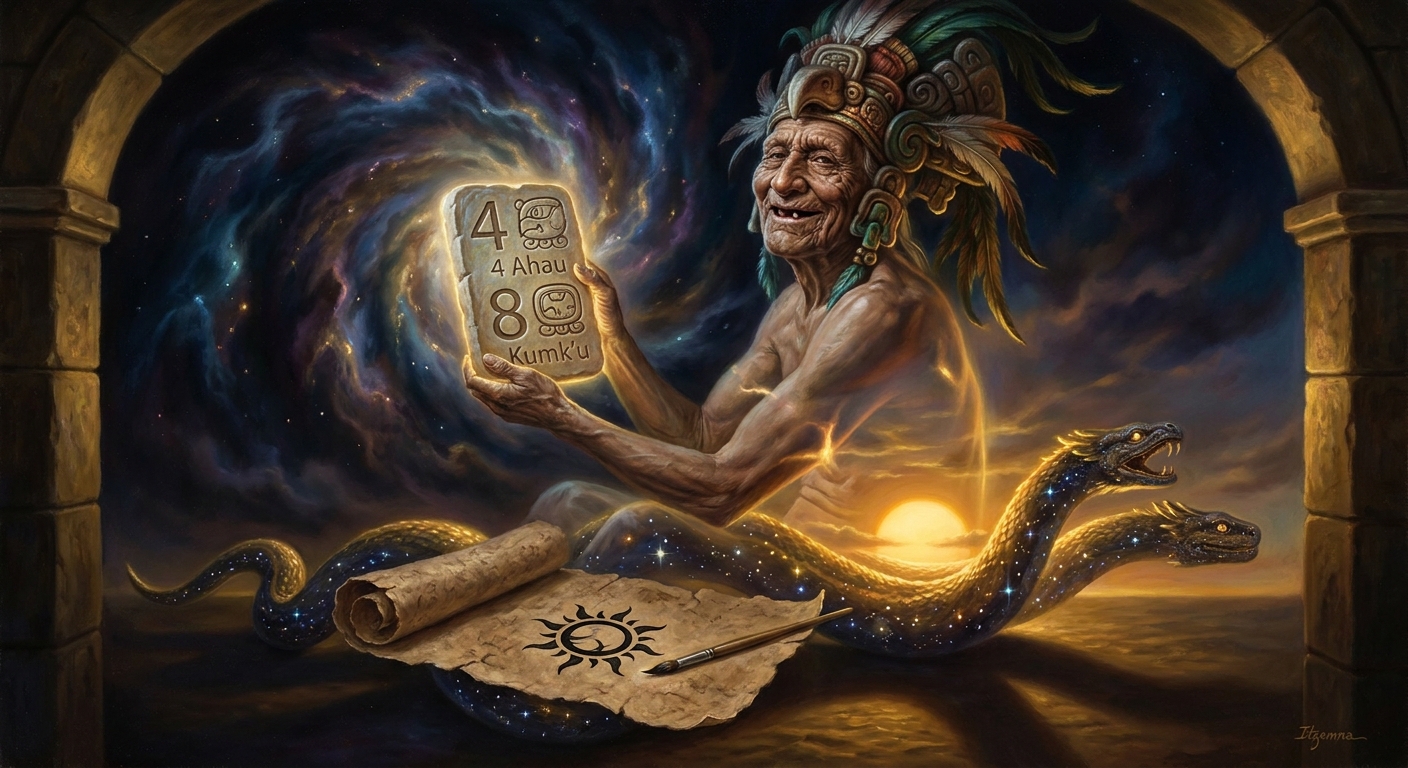
The tzolk’in combines twenty named day-signs — Imix, Ik’, Ak’bal, K’an, Chikchan, Kimi, Manik’, Lamat, Muluk, Ok, Chuwen, Eb’, Ben, Ix, Men, Kib’, Kaban, Etz’nab’, Kawak, Ajaw — with thirteen numbers that count upward and repeat. The combination of twenty signs and thirteen numbers generates 260 unique day-name-and-number combinations before the cycle repeats: 13 Ajaw, 1 Imix, and so around again. You were born on one of these 260 days.
Your day-sign is your character.
The daykeeper — the Maya specialist who reads and advises using the tzolk’in — is called ajq’ij in K’iche’ Maya: the one who counts the days. To become a daykeeper requires a calling that announces itself through physical symptoms: trembling in the blood, a vibration felt in specific parts of the body in response to certain days or questions, a sensitivity to the texture of time that others do not feel.
The training that follows is long and takes place largely with the body.
The apprentice daykeeper learns the meanings of the twenty day-signs and the thirteen numbers, but more importantly learns to feel them — to register in the body what each day brings, to sense the weight of certain combinations, to feel the distinction between a smooth day and a rough one before looking at the calendar. The body becomes the instrument through which the calendar is read.
Barbara Tedlock, the anthropologist who trained as a daykeeper in Momostenango in the 1970s, described the experience of feeling the calendar as a physical trembling — jaloj k’exoj, the blood lightning — that confirmed or disconfirmed interpretations. The calendar is not read in the abstract. It is read through embodied response.
When a child is born, the daykeeper is consulted.
The birth day-sign tells the family what kind of person this child is oriented to become: Ajaw is the day of royalty, ceremony, and endings; Kimi is the day of death and the ancestors; Ix is the jaguar, the earth, the shamanic; Chuwen is the monkey, creativity, artistry. Each sign has positive aspects and challenges. The number modifies the sign — a 1-Ajaw is different from a 13-Ajaw, the first number carrying fresh beginning energy, the thirteenth carrying completion and intensity.
The daykeeper’s advice is not destiny.
This is the crucial distinction from fatalism. The tzolk’in does not tell you what will happen — it tells you what kind of energy is present, what the day is predisposed toward, what you will need to work with or work against. A child born on a day associated with difficulty is not condemned; they are warned, and the warning is an invitation to develop particular strengths.
The daykeeper may prescribe a ceremony. On the child’s birth day-sign — which returns every 260 days — they perform rituals at specific outdoor altars, burning candles and copal, addressing the day-sign directly, asking it to support rather than challenge the person who was born in its charge.
The tzolk’in still runs.
In Momostenango and other highland Guatemala communities, the 260-day count has never been broken — it has been kept continuously since before the Spanish arrived, adjusted to align with the Gregorian calendar but internally consistent, the count uninterrupted. A daykeeper in 2026 can tell you, exactly, which tzolk’in day it is today, and the calendar they consult is the same calendar that named the Hero Twins’ birth, that named the day Pacal was buried in his pyramid at Palenque, that named the day the Spanish arrived and the daykeepers felt in their blood that the day was a difficult one.
The count runs.
Your day is still in it.
Echoes Across Traditions
Entities
- the daykeepers
- Itzamna
- Xmucane

Sources
- Barbara Tedlock, *Time and the Highland Maya* (University of New Mexico Press, 1982)
- Allen J. Christenson, *Popol Vuh: The Sacred Book of the Maya* (University of Oklahoma Press, 2007)
- Anthony F. Aveni, *Skywatchers of Ancient Mexico* (University of Texas Press, 1980)