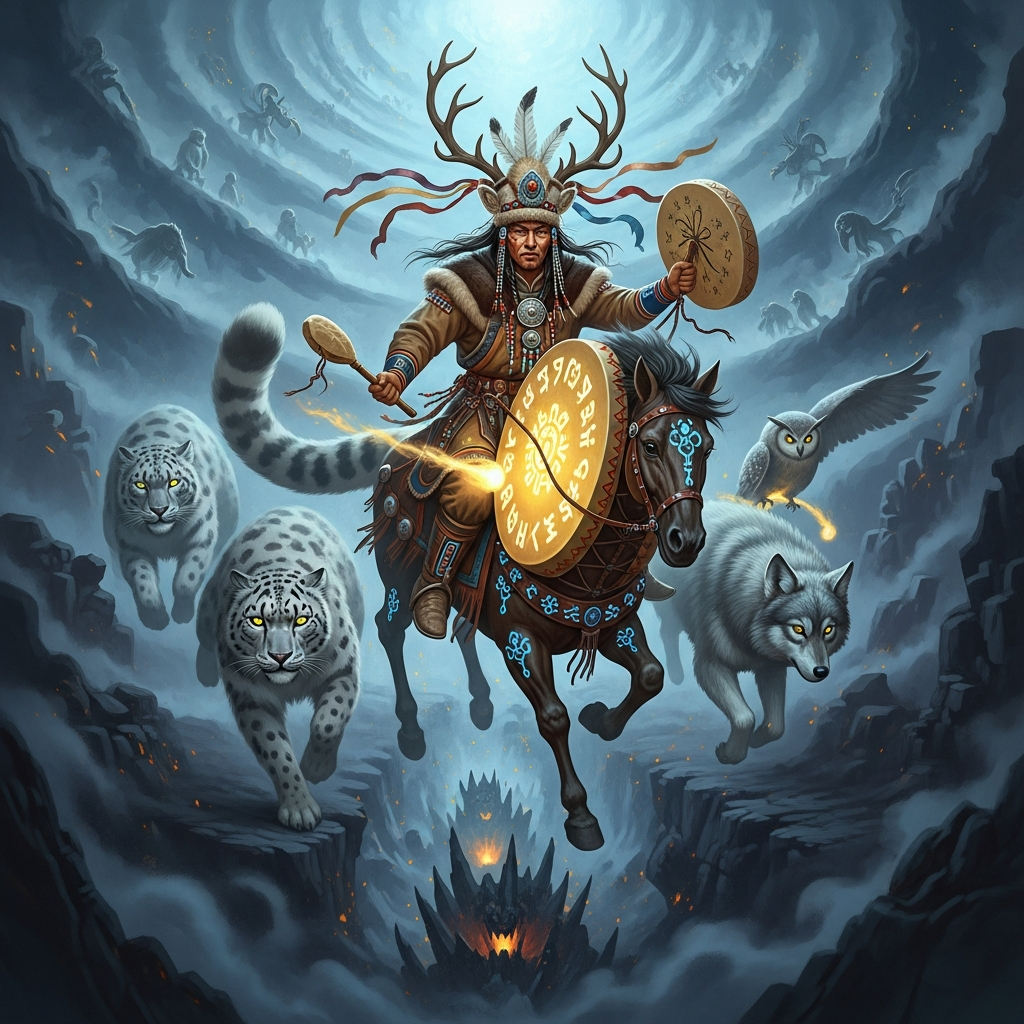
The Tuvan Shaman's Descent
Tuvan oral tradition; documented by ethnographers in the 19th–20th century CE; UNESCO intangible cultural heritage 2009 · The Tuvan steppe; the World Tree; the Lower World
Contents
A Tuvan shaman (ham) is not chosen — they are made, through illness. The spirits select a candidate by making them sick in a very specific way: the body-soul is taken by spirits who crack it open, teach it, and put it back. After the initiation illness, the shaman learns to drum — to ride the drum like a horse into the Lower World — and to negotiate with the masters of illness and death for the lives of the living.
- When
- Tuvan oral tradition; documented by ethnographers in the 19th–20th century CE; UNESCO intangible cultural heritage 2009
- Where
- The Tuvan steppe; the World Tree; the Lower World
The sickness comes first.
Not an ordinary sickness — the ordinary sicknesses of the steppe have ordinary treatments, and the Tuvan healers know them. This sickness is different. It arrives with a quality that the experienced recognize immediately: the sick person does not respond normally to treatment, the fever follows unusual patterns, the person is sometimes absent from themselves in a way that is not the absence of unconsciousness but something more directed — as if they are elsewhere, as if part of them has been taken somewhere and is learning things.
The old shaman in the community sees it. They have seen it before. They come to the family and they say: the spirits are calling this person. This is not illness to be cured. This is illness to be survived.
The Tuvan word is ham: the shaman, the one who will drum and travel. But the word means more than a function. It means a person who has been cracked open by the spirits and put back together differently.
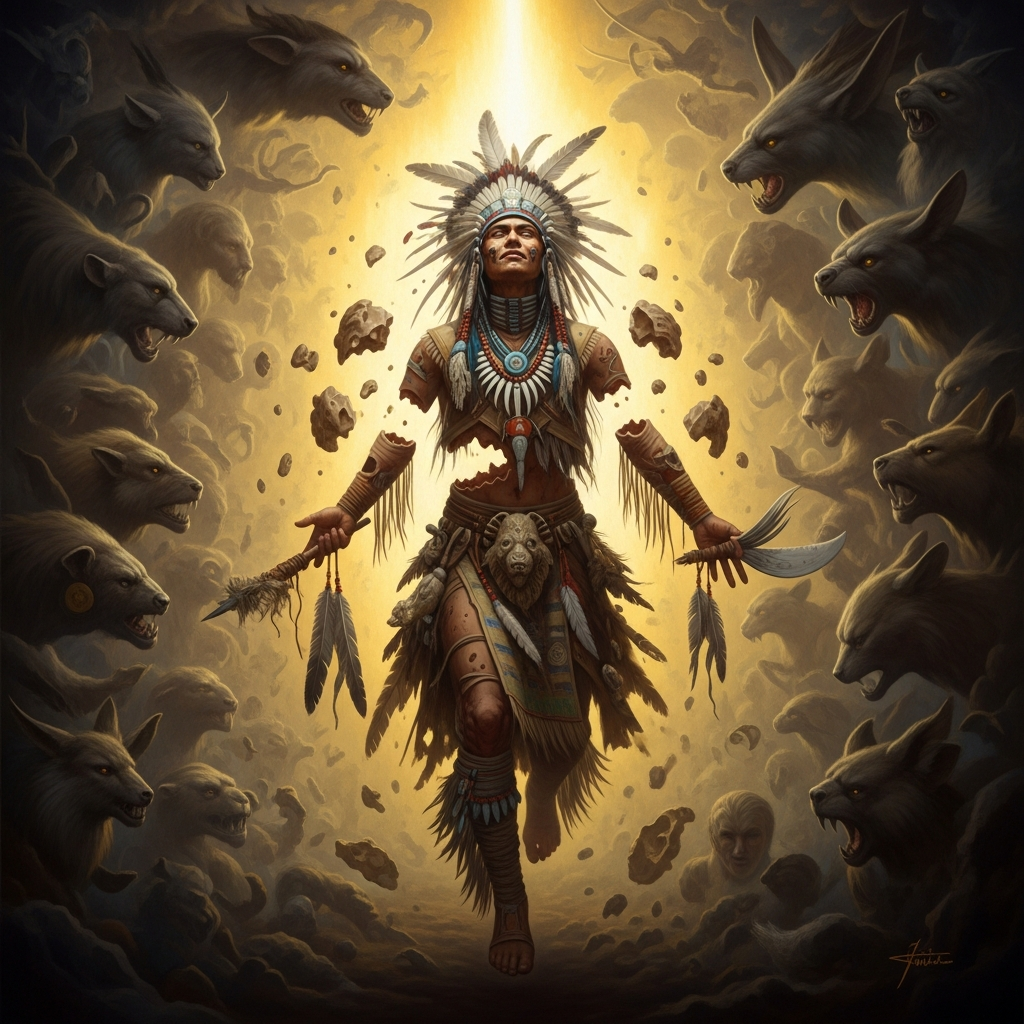
The cracking is literal, in the tradition’s understanding of it: the spirits of the Lower World — the cher eezi, the masters of particular places and forces, the spirits associated with illness and with death — take the candidate’s soul out of the body. They carry it down into the Lower World. They disassemble it.
This is not a metaphor for a difficult emotional experience. The Tuvan tradition is precise: the spirits disassemble the body-soul — they crack the bones, they remove the organs, they examine the pieces. They are not torturing the candidate. They are teaching them anatomy — spiritual anatomy, the anatomy of the invisible body that the shaman will need to understand in order to do their work. You cannot heal what you do not understand. You cannot remove something from a soul-body that you have not had the contents of your own soul-body taken out and shown to you.
The process takes days or weeks. The candidate’s ordinary body lies in a stupor. The family watches.
One of two things happens next.
Either the spirits put the candidate back together and return the soul to the body — the candidate recovers from the initiation illness and wakes into a different relationship with the invisible world — or they do not, and the candidate dies. This is understood in the tradition as the spirits’ final assessment: some candidates can hold the knowledge they’ve been given. Some cannot. The illness that looked like a calling turns out to be something else.
The shaman who survives the initiation illness does not immediately begin practicing. There is a period of training: finding a teacher, learning the songs, learning the cosmological geography, learning which spirits answer to which invocations and what they expect to receive. The drum must be made — and the making of a shaman’s drum is itself a ceremony, the tree selected for the frame requiring permission from its spirit, the skin from an animal whose spirit becomes a co-traveler.
The drum is the horse.
This is the central technical metaphor of Tuvan shamanism: the drum carries the shaman. When the drumbeat begins, it is the sound of hooves on the spirit-road, and the shaman’s attention rides the sound into the world that is not visible to ordinary people. The drumming is not music in the entertainment sense; it is a vehicle, and the shaman knows how to drive it.
The ceremony for the sick begins at night.
The shaman dresses. The costume is specific to the individual shaman — built up over years of practice, decorated with the images of spirit helpers, hung with metal ornaments that jingle with the movement and produce their own sound, a continuous secondary percussion that the spirits can hear from a distance. The costume is not clothing; it is an instrument.
The fire is lit. The family gathers. The sick person — or the person whose soul has been stolen, whose child is ill, whose livestock have sickened in patterns that suggest spiritual disruption rather than natural disease — is present.
The shaman begins to drum.
The rhythm starts slow and deepens. The shaman begins to call — the throat-singing that Tuva is known for in the outside world, the khoomei and kargyraa and sygyt, the technique of producing multiple tones simultaneously, the human voice doing what instruments do. The calling is addressed to specific spirits: the spirit helpers who travel with this shaman, the earth-spirit masters of this specific place, the ancestors of the family who may be able to help or who may themselves be causing the disruption.
The shaman’s attention leaves the room. The body continues to drum. The spirit travels.
In the Lower World, the shaman moves through a landscape that is familiar and strange simultaneously: familiar because every shaman who has traveled here has mapped it, and the maps are transmitted through the training, and the spirits who live here are known by their names and their habits; strange because it is the Lower World and its quality is not the Middle World’s quality and the shaman never fully adjusts to the difference.
They find what they came for. A stolen soul-piece, held by a spirit who took it when the sick person was frightened — fright being one of the common mechanisms of soul-loss in Tuvan belief, the sudden shock that dislodges a piece of the soul from the body. Or a hostile spirit that has attached itself to the sick person’s energy body and is feeding on it. Or something more complex, requiring negotiation with Erlik himself or with one of his administrators.
The shaman trades. The shaman argues. The shaman uses what they were given in the initiation illness — the knowledge of spiritual anatomy, the relationships with the spirit helpers, the cosmological geography that lets them navigate — and they do the work.
They come back.
The drumming changes when the shaman returns. The people in the room feel it before they hear it: the quality of the ceremony shifts, the fire burns differently, the air changes. The shaman’s eyes open. They return to the room with the information they found.
They say what they found. They perform the physical actions that seal the healing: the soul piece returned, pushed back into the body with specific gestures that the tradition preserves. The hostile spirit expelled. The ancestral communication relayed.
The patient sleeps.
The shaman sits with the drum across their knees, breathing.
They will do this again. The spirits who selected them in the initiation illness will call them into service for the rest of their life, and each journey is a repetition of the first one: the descent, the navigation, the negotiation, the return. The knowledge they were given when the spirits cracked them open becomes more refined with each journey, more precise, more capable.
The initiation illness never fully ends. The shaman carries it — carries the awareness that they were once taken apart, that the invisible world has handled them and put them back, that they are not the same person they would have been if the spirits had not called.
This is the gift and the cost: they can go where other people cannot go, and they cannot fully return from those places. Part of them is always below, in the dark, at the bottom of the World Tree, where the roots know what the branches have forgotten.
The drum waits.
When someone gets sick in the way the shaman recognizes — in the way that looks like illness but feels like calling — the drum will know what to do.
Echoes Across Traditions
Entities
- the shaman (ham)
- the cher eezi (earth-spirit)
- the drum and drumstick
- the spirit helpers
- Erlik
Sources
- Mircea Eliade, *Shamanism: Archaic Techniques of Ecstasy* (Bollingen/Princeton, 1951/1964)
- Kenin-Lopsan Mongush, *Shamanic Songs and Myths of Tuva* (ISTOR Books, 1997)
- Sevyan Vainshtein, *Nomads of South Siberia: The Pastoral Economies of Tuva* (Cambridge University Press, 1980)
- Caroline Humphrey, *Shamans and Elders: Experience, Knowledge, and Power among the Daur Mongols* (Oxford University Press, 1996)
- Ronald Hutton, *Shamans: Siberian Spirituality and the Western Imagination* (Hambledon and London, 2001)
- UNESCO Intangible Cultural Heritage: Traditional craftsmanship of the Khoomei (Tuvan throat-singing), 2009