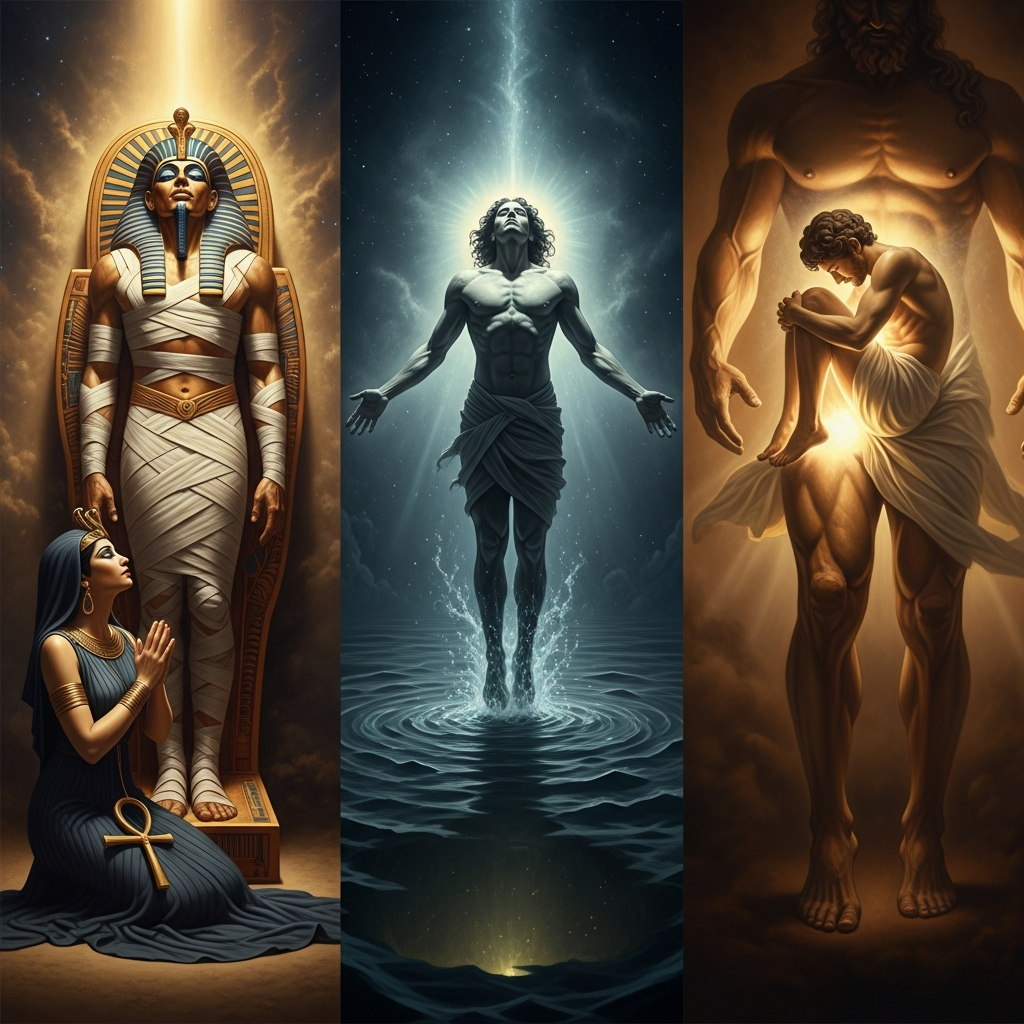
You Must Die Before You Can Begin: Initiation Rites Across World Religion
Eleusinian Mysteries practiced from at least c. 1600 BCE through 396 CE; shamanic traditions documented ethnographically from c. 19th century onward, though practices are ancient; Vodou initiation documented from 17th century CE in Haiti · The Telesterion at Eleusis (Greece), the vision quest site in the wilderness (across Native American traditions), the peristyle in Haitian Vodou, the cosmic axis during shamanic initiation — always a threshold between two worlds
Contents
Every culture that has initiation rites encodes the same structure: the candidate dies symbolically and is reborn as someone new. Eleusinian Mysteries, vision quests, shamanic dismemberment.
- When
- Eleusinian Mysteries practiced from at least c. 1600 BCE through 396 CE; shamanic traditions documented ethnographically from c. 19th century onward, though practices are ancient; Vodou initiation documented from 17th century CE in Haiti
- Where
- The Telesterion at Eleusis (Greece), the vision quest site in the wilderness (across Native American traditions), the peristyle in Haitian Vodou, the cosmic axis during shamanic initiation — always a threshold between two worlds
Somewhere in the city of Athens, in the late summer of any year between roughly 1600 BCE and 396 CE, a person was preparing to die.
Not literally. Or not only literally. They were preparing for the Eleusinian Mysteries — the nine-day initiation rites that more Athenians undertook than any other religious ceremony in the ancient Greek world. The preparation involved a bath in the sea at Phaleron, the sacrifice of a piglet (their own death by proxy), a procession of fifteen miles along the Sacred Way to the sanctuary at Eleusis, and then several days of fasting, ritual, and finally the night ceremony inside the great Telesterion — the initiation hall where what happened was never written down, has never been reliably transmitted, and is the most successfully kept secret in the history of Western religion.
What the initiates brought back from that night was a different relationship to death. Pindar described it: “Blessed is he who has seen these things before going beneath the earth; he knows the end of life, he knows also its divine beginning.” Cicero, who was initiated, wrote that Athens had given many excellent things to the world, but nothing greater than the Mysteries.
Something happened in that room. We do not know what. What we know is that people walked in afraid and walked out changed.
The Structure That Appears Everywhere
Arnold van Gennep, the French ethnographer, published The Rites of Passage in 1909 after surveying initiation practices across dozens of cultures. His finding was simple and extraordinary: all initiation rites have the same three-part structure, regardless of culture, religion, or historical period.
Separation: the candidate is removed from ordinary society and their previous social identity is systematically dissolved. They may be isolated, silenced, stripped of their names and clothing, made to act as if helpless and newborn.
Liminality (from the Latin limen, threshold): the candidate exists in a threshold space that is neither here nor there, neither old identity nor new. They are socially dead. This is the dangerous period — the period of dismemberment, ordeal, vision, revelation. What happens in the liminal space is what transforms.
Incorporation: the candidate is reintegrated into society, now with a new identity, new knowledge, and new responsibilities. They are not the same person who was separated. That person is gone.
Victor Turner, who extended van Gennep’s work in the 1960s, called the liminal phase the place where the “betwixt and between” becomes creative — where normal social structures dissolve and something new can form. The liminal space is simultaneously the most dangerous and the most generative in human social life.
Eleusis: The Secret That Held for a Thousand Years
The mythological charter of the Eleusinian Mysteries is the Homeric Hymn to Demeter — one of the great narrative poems of the ancient world. Persephone is abducted to the underworld by Hades. Demeter, her mother and the goddess of grain, withdraws in grief and the earth stops producing. The gods, facing the extinction of humanity through famine, negotiate Persephone’s partial return: she spends a portion of each year below and a portion above, generating the cycle of seasons.
The myth explains the seasonal cycle — winter as Demeter’s grief, spring as her reunion with Persephone. But it also encodes the initiatory logic: Persephone descends to the underworld (death), dwells there (liminality), and returns (rebirth). She is not the same when she returns. She is the Queen of the Dead as well as the goddess of spring. She has incorporated death into her identity.
Initiates at Eleusis reenacted this descent in some form. The fast, the kykeon (a special drink, possibly containing ergot — a fungus with psychoactive compounds, though this is debated), the darkness, the experience inside the Telesterion — these reconstructed the myth as personal experience. You did not merely hear that Persephone returned. You went down and came back.
The secrecy was not incidental. It was structural. What happens in the liminal phase is, by definition, not communicable to those who have not undergone it. The knowledge of the Mysteries is not propositional — not a set of facts you could transcribe — but experiential. Writing it down would not convey it. The secrecy preserved the experience as the only valid form of transmission.
The Vision Quest: Identity Received from Outside
The vision quest practices of the Plains nations operate on a logic that shares the tripartite structure but draws the liminal experience from the non-human world rather than from a mystery cult.
In the Lakota hanblecheyapi (“crying for a vision”), the young man prepares through sweat lodge purification, then goes alone to a hilltop or remote site for up to four days without food or water. He prays continuously. He waits for a vision — an encounter with a spirit being who will give him his adult identity, his medicine, his sacred name or direction.
The preparation dismantles the boy-identity: the sweat lodge strips away accumulated impurity, the isolation removes all social support, the fasting removes the bodily comfort that anchors ordinary consciousness. The candidate is, in the most literal physical sense, reduced to essentials.
The vision, when it comes, is not generated from within the candidate’s psychology. It comes from outside — from the spirit world, from the non-human persons who are the real population of the world. The man the initiate becomes is not the man he was working toward becoming. He is the man the spirits designated. His adult identity is a gift, not an achievement.
This is the most striking feature of vision quest logic from a Western psychological perspective: the self is not developed from within but received from without. The liminal dissolution of the old identity is precisely for the purpose of creating an opening through which the new identity can enter.
Shamanic Dismemberment: The Credential of Destruction
Mircea Eliade’s survey of shamanic traditions across Siberia, Central Asia, the Americas, and Oceania identified a pattern he called the “shamanic illness” or “vocation sickness” — a period of involuntary crisis, usually involving serious illness or psychological breakdown, during which the candidate experiences, in trance or in dreams, being killed.
The killing is specific: the body is torn apart, the flesh stripped from the bones, the bones cleaned and counted (sometimes new bones are discovered, made of crystal or other spirit-materials), the organs removed and replaced with spirit-equivalents, and the body reassembled. The candidate wakes from this experience as a shaman.
The logic is precise: a shaman’s primary function is healing — the retrieval of lost souls, the extraction of illness-causing intrusions, the mediation between the living and the dead. To do any of this, the shaman must be able to navigate the spirit world — the world where illness originates, where souls go when they are lost, where the dead dwell. You cannot enter that world as an ordinary person. You can only enter it as someone who has already died there and come back. The dismemberment is the credential.
Different traditions describe the agents of dismemberment differently: ancestor spirits in Siberian shamanism, spirit-animals in American traditions, demons in some Buddhist contexts. But the structural experience is consistent across traditions separated by vast distances and without historical contact. Something about the specific dissolution — not just death but dissolution, the reduction to bare bones and then reconstruction — keeps appearing as the initiatory experience of those whose job is to travel between worlds.
What the Child Knows That the Adult Cannot
Every initiation rite, across its enormous cultural variation, encodes a single message: the person you were before cannot do what you are now required to do. The child’s identity, the uninitiated person’s identity, is not a lesser version of the adult identity. It is a different kind of identity, incompatible with adult function.
This is why initiation requires death rather than graduation. Graduation is incremental — you know more, you can do more. Death is absolute. The old self does not continue into the new existence. Initiates in many traditions receive new names. The old name belongs to the person who no longer exists.
The Eleusinian initiates came back with something they would carry to their own deaths — the memory of what they had experienced, and the relationship to death that the experience had given them. They had been down. They knew the way back.
That is what initiation gives: not knowledge about the threshold, but knowledge of having crossed it. The credential is the crossing itself.
Echoes Across Traditions
Entities
- Demeter
- Persephone
- Dionysus
- Osiris
- White Buffalo Calf Woman


Sources
- Homer, *Hymn to Demeter* (c. 650-550 BCE) — the mythological charter of Eleusis
- Cicero, *De Legibus* II.14.36 (on Eleusinian Mysteries)
- George Mylonas, *Eleusis and the Eleusinian Mysteries* (1961)
- Arnold van Gennep, *The Rites of Passage* (1909)
- Victor Turner, *The Ritual Process* (1969)
- Mircea Eliade, *Shamanism: Archaic Techniques of Ecstasy* (1951)
- Karen McCarthy Brown, *Mama Lola: A Vodou Priestess in Brooklyn* (1991)
- Paul, *Letter to the Romans* 6:1-11
- Joseph Henderson, *Thresholds of Initiation* (1967)