Contents
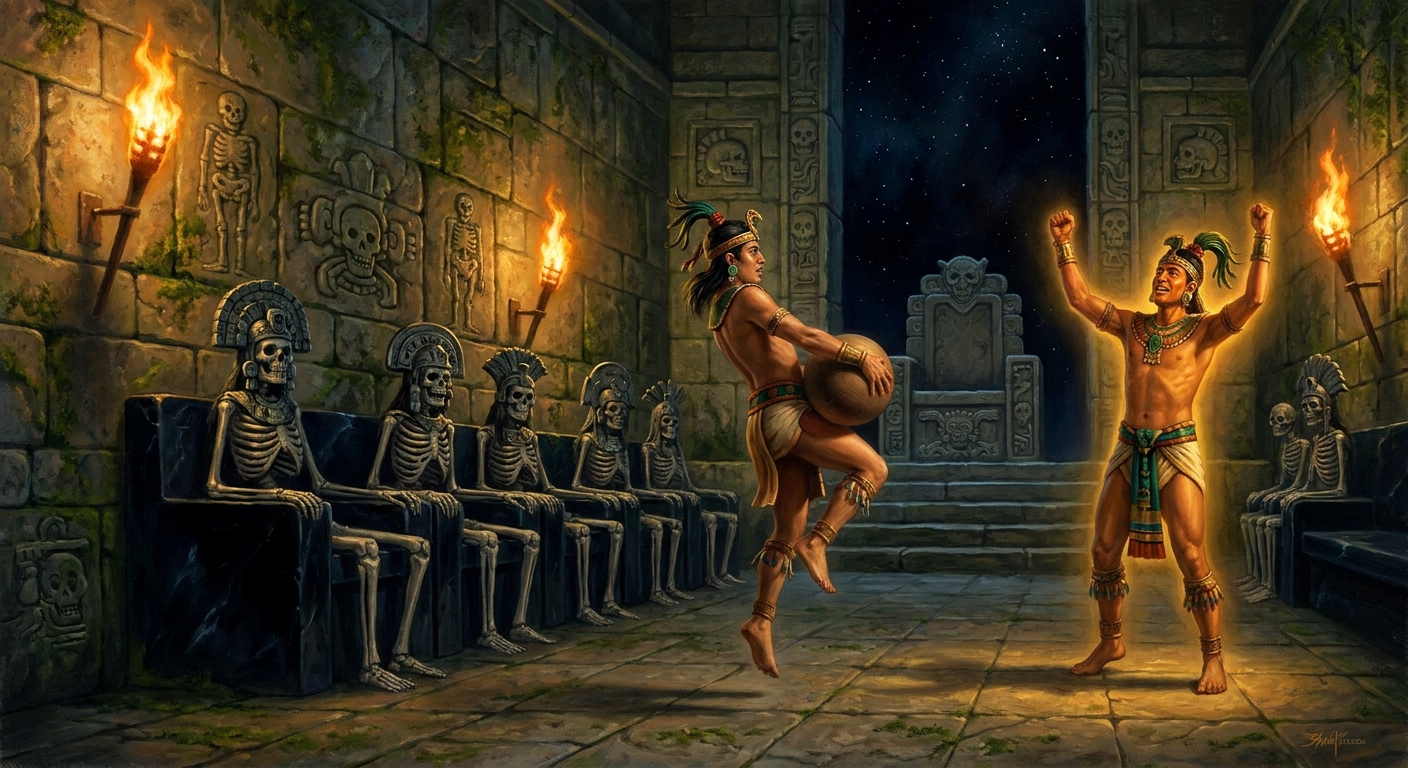
Hunahpú and Xbalanqué play the ball game so loudly that the lords of the underworld summon them to play below, sending four owls as messengers — and the twins accept, knowing they are walking into the place that killed their father.
- When
- Mythic time — Classic Maya tradition; Preclassic origins
- Where
- The ball court on the surface of the earth; the road descending to Xibalbá
The twins are already extraordinary before they go below.
Hunahpú and Xbalanqué grow up in the house of Xmucane sleeping on anthills while the old woman favors their half-brothers, Hunbatz and Hunchouén, who are musicians and artisans and who have a scholar’s contempt for the younger boys. The twins endure this. They observe everything. They play the ball game on the court that was their father’s court, and the rubber ball rises and falls with a sound like thunder rolling through the morning.
It is the sound that causes the trouble.
One Death and Seven Death, the lords of Xibalbá, are sitting in their house below the earth when the sound reaches them. It is the same sound that reached their predecessors when Hun Hunahpú played. They recognize it. They are already irritated; they were irritated before they heard it. They call for their council — Scab Stripper, Blood Gatherer, Demon of Pus, Demon of Jaundice, Bone Staff, Skull Staff — the full roster of the lords of disease and death and they make a decision together: invite them down.
The four owls are sent as messengers. White Owl, One-Legged Owl, Macaw Owl, Skull Owl — they fly up through the layers of the earth and arrive at the ball court on the surface. They deliver the message with the full weight of the lords’ authority: your presence is required in Xibalbá. Come at once.
The twins go to their grandmother.
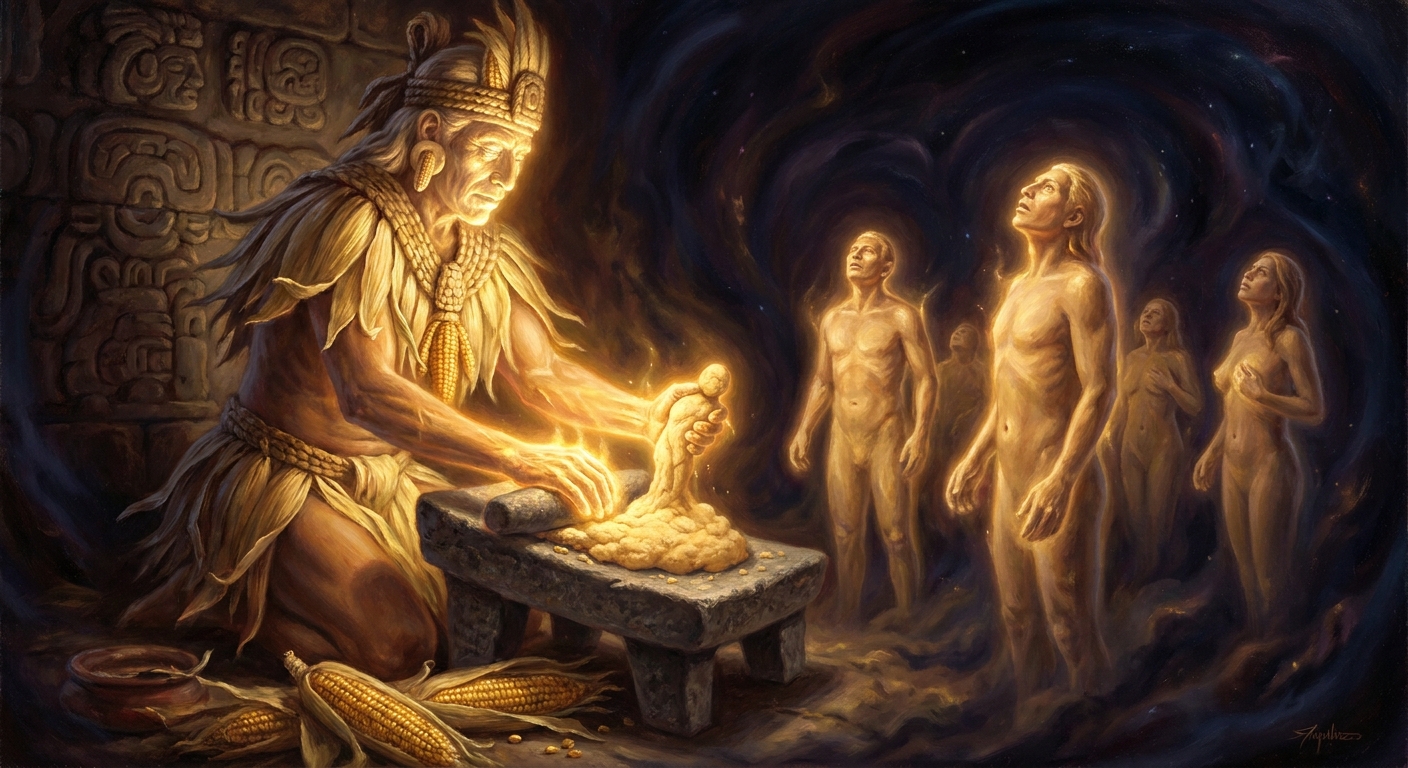
Xmucane is grinding corn when they find her. They tell her that the lords of the underworld are calling. The grandmother weeps. She remembers what happened to her son Hun Hunahpú, who went down that same road and did not come back. She has been raising these boys since Xquic arrived pregnant from below, and now the same summons has found the next generation.
The twins have prepared for this.
Before they leave, Hunahpú and Xbalanqué plant ears of corn in the middle of the old woman’s house — one ear in each corner of the room. They tell her to watch the corn. If the corn dries up and withers, it means they have died. If the corn sprouts green, it means they are alive. The corn will speak on their behalf from a distance, tracking their state through the sympathetic resonance that connects all living things.
Then they gather their rubber ball and their protective gear and they go.
They go by the road that goes down, the long dark descending road that passes through rivers you would not want to wade and across places where the wrong turn means the end. Their fathers went this way without preparation, without intelligence about what waited below, walking into the houses of Xibalbá as though it were an ordinary visit to an ordinary lord’s house. The sons go differently. They have grown up knowing the road exists, knowing what it cost, and they have spent their youth becoming the kind of people who might survive it.
The road to Xibalbá is designed to confuse.
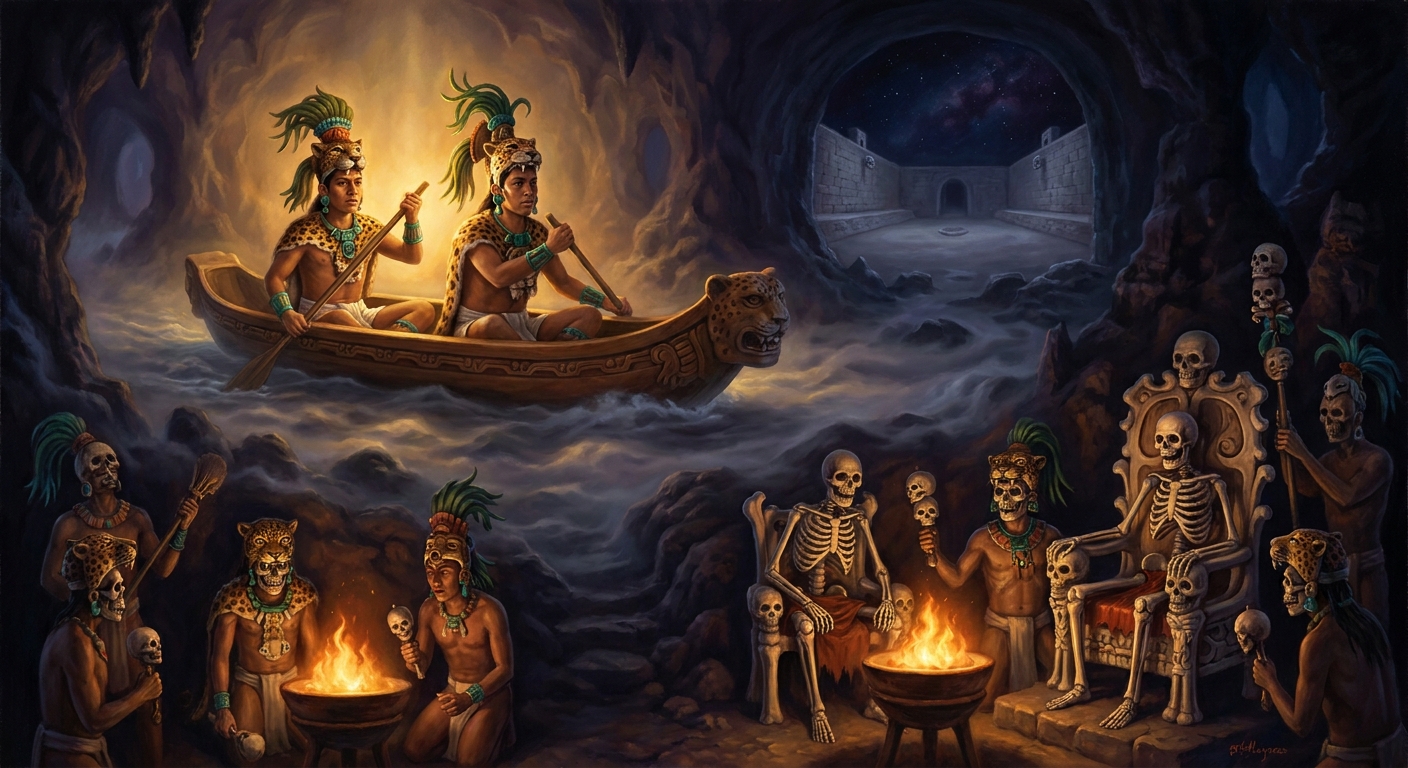
There are four crossings on the rivers: the first river flows with pus, the second with blood. These the twins cross without hesitation, because they do not wade into the rivers but send a small mosquito-like animal ahead to test each one. At the crossroads where four roads meet — one red road, one black road, one white road, one yellow road — the lords of Xibalbá have placed their dummies: wooden mannequins dressed to look like lords, seated in place to receive travelers.
The twins’ father and uncle sat down before the dummies and greeted them as living lords. The dummies did not respond — they could not respond, being wood — and the embarrassment of the failure broke something in the brothers’ composure before they ever met the real lords.
The twins have a mosquito bite each dummy first, reporting back which ones speak and which do not.
They know every trap before they walk into it.
They arrive before the real lords of Xibalbá and greet them correctly, naming each lord by name, refusing to greet the dummies. The lords had expected another confused pair of ballplayers walking dazzled into the darkness. They find instead two young men who know where they are, who show no fear of what they see, and who carry themselves with the focused calm of people who have decided to see this through whatever it costs.
The tests are about to begin.
Echoes Across Traditions
Entities
- Hunahpú
- Xbalanqué
- One Death
- Seven Death
- Xmucane
- The Four Owls of Xibalbá
Sources
- Popol Vuh, translated by Dennis Tedlock (Simon & Schuster, 1985)
- Allen J. Christenson, *Popol Vuh: The Sacred Book of the Maya* (University of Oklahoma Press, 2007)
- Linda Schele and David Freidel, *A Forest of Kings* (William Morrow, 1990)