Contents
Before anything exists, the creators speak in the darkness over the primordial water, and the act of speech itself — deliberate, collaborative, purposeful — calls the world into being.
- When
- Mythic time — before the first creation; the primordial moment
- Where
- The void before creation — darkness above still water, silence before the first word
This is the account of when everything was still still.
The sky is there but it is empty. The sea is there but it is flat and dark, lying quiet beneath the sky without moving. There is no land. There is no animal. There is no fish, no crab, no tree, no stone, no ravine, no canyon, no forest, no meadow. Only the sky exists, and the face of the earth does not yet appear. Only the still pooled sea and the sky, in the dark, together, not yet touching.
Nothing stands. Nothing makes a sound. The water lies smooth. It lies flat. There is nothing — no existence, no creature, no person, no sound of persons.
Within the darkness, the creators think.
Heart of Sky has three aspects: Huracán is the first, Chipi Caculhá the second, Raxa Caculhá the third. He is the one-legged one, the storm, the hurricane whose name has entered every language that lives beside the sea. He thinks. He deliberates.
Tepeu and Gucumatz are there too, in the water, wrapped in quetzal feathers that float in the dark like something alive. They are great knowers. They are great thinkers. Their names mean Sovereign and Feathered Serpent, and together they speak.
How shall it be sown? How shall it dawn? Who is to provide, who is to nurture?
The word they use for sowing is the same word they use for dawn. Creation is a planting. Creation is a sunrise. The thing that comes into being is something that was already present as a seed, waiting for the right conditions, for the right word to give it permission to grow.
They speak with each other. This is the thing the Popol Vuh emphasizes: they consult, they confer, they deliberate together. Heart of Sky and Feathered Serpent are thinking in the dark, their words flowing back and forth between them, each thought building on the last, and out of the accumulated conversation a plan emerges.
Let the earth arise.
Earth, they say.
And immediately the earth is there. It rises up like a cloud, like a mist, like the lifting fog. The mountains emerge at once from the water, the great peaks gathering themselves up out of the flat surface, cypress and pine appearing on the slopes the moment the slopes exist, ravines opening between the mountains the moment the mountains are there to have ravines between them.
It happens as fast as speech. That is the point.
The creators look at what they have said and they are pleased. They repeat what they see, which is also a form of praise: it is good that you have come, O Heart of the Mountains. They address the mountains. They address the valleys. They speak to what they have made, giving it names, acknowledging its presence, and the giving of names is also a form of creation — a thing fully named is more fully there.
The animals come next. Deer in the forest, birds in the canopy, jaguars and serpents in the undergrowth. Each is placed in its home, each given its path. The birds are given the trees; the jaguars and serpents are given the thicket.
The creators say to each: speak our names, call upon us, honor us. The animals open their mouths and honk and hiss and screech and roar. But they cannot form the words. They cannot say the names. They cannot give the thanks.
The creators shake their heads, but they are not yet finished.
The first experiment is the failure of mud. The second is the failure of wood. These failures are not tragedies. They are steps in a conversation that the creators are having with the question of what a person is.
Each failed creation teaches something. Mud reveals that form without inner coherence cannot last. Wood reveals that endurance without interiority is not enough. After each failure the creators come back to each other in the dark and confer again — the same collaborative speech that called the world into being in the first place. Creation is not a single act but a process, a conversation, a consultation that continues across time.
Heart of Sky does not give up.
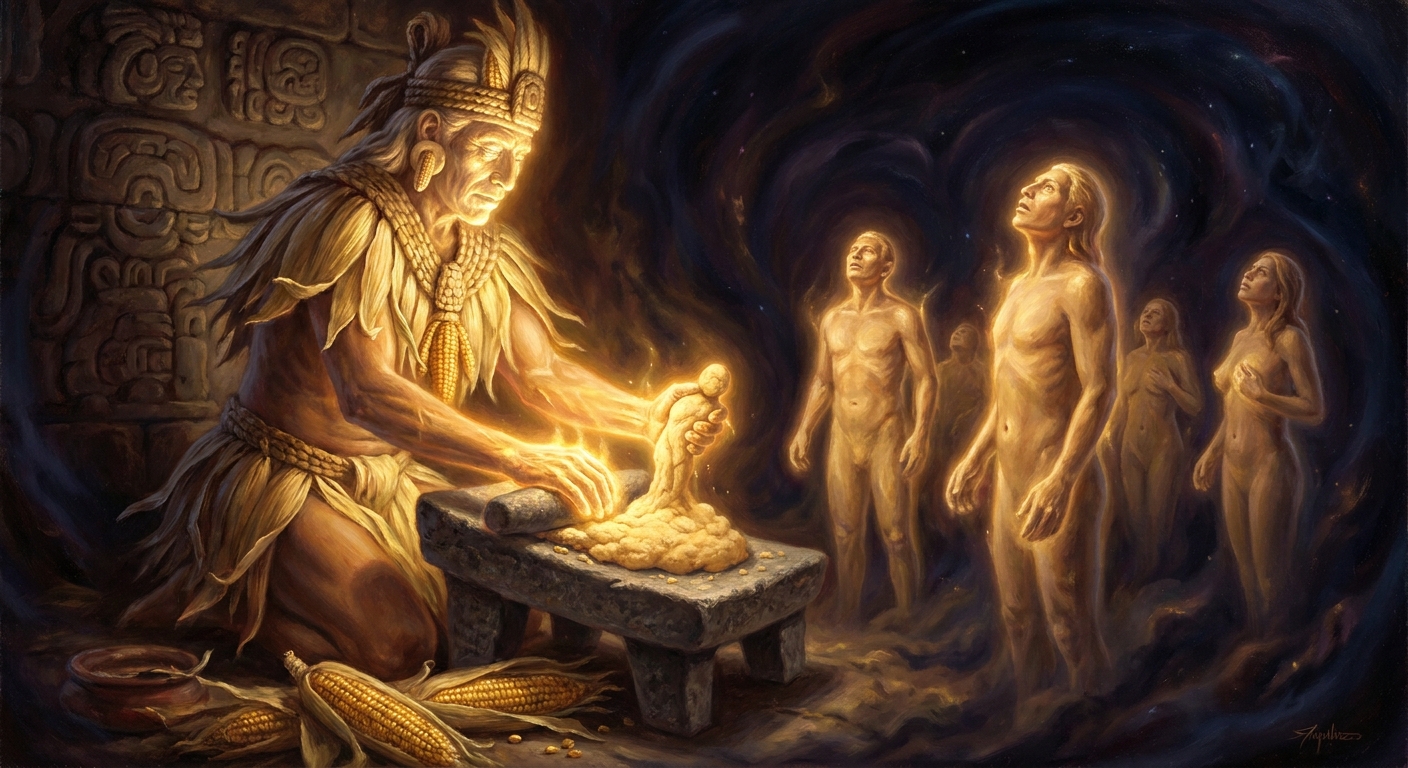
The stillness before the word is the stillness of a question held patiently. What the Popol Vuh knows, from its first lines, is that the answer will come — not because the universe owes an answer but because the creators are willing to ask the question again, and again, and again until the corn is found and ground and mixed with the water from nine gourds, and the first four men open their eyes and see the world and give thanks in the dark before the dawn.
The word that made everything is still being spoken.
Echoes Across Traditions
Entities
- Heart of Sky
- Huracán
- Tepeu
- Gucumatz
- Heart of Earth
Sources
- Popol Vuh, translated by Dennis Tedlock (Simon & Schuster, 1985) — opening stanzas
- Allen J. Christenson, *Popol Vuh: The Sacred Book of the Maya* (University of Oklahoma Press, 2007)
- Barbara Tedlock, *Time and the Highland Maya* (University of New Mexico Press, 1982)