The Milpa: How the Maya Clear Forest by Fire
c. 2000 BCE — earliest evidence of milpa agriculture in Mesoamerica; continuous through present day · Throughout the Maya lowlands and highlands — the Petén, Yucatán, Chiapas, Guatemala
Contents
The milpa — the Maya system of slash-and-burn forest agriculture, polyculture of corn, beans, and squash — is not merely a farming technique but a ritual relationship with the forest: you clear, you burn, you plant, you give thanks, you let the forest return.
- When
- c. 2000 BCE — earliest evidence of milpa agriculture in Mesoamerica; continuous through present day
- Where
- Throughout the Maya lowlands and highlands — the Petén, Yucatán, Chiapas, Guatemala
The forest must be asked before it is cut.
A Maya farmer — in the Classic period, in the contemporary highland Guatemala community that still practices the traditional milpa, in the time between — does not simply walk into the forest and begin clearing. The clearing requires ceremony. The trees are alive. The forest has a spirit, a patron, a presence that must be negotiated with. You go to the forest first as a visitor, as a petitioner, asking permission to take some portion of it for your fields.
The prayer acknowledges the exchange.
The milpa system — milpa is a Nahuatl word for the Maya polyculture field, the Spanish recorded it and the name stuck — works by rotation. You clear a section of forest, burn the fallen wood in the dry season, plant corn with beans and squash and chili in the ash-enriched soil when the rains begin, harvest for one to three years, and then leave the section fallow, letting the forest reclaim it. In ten to twenty years, the forest has grown back enough to be cleared again.
The burning is ritual as well as practical.
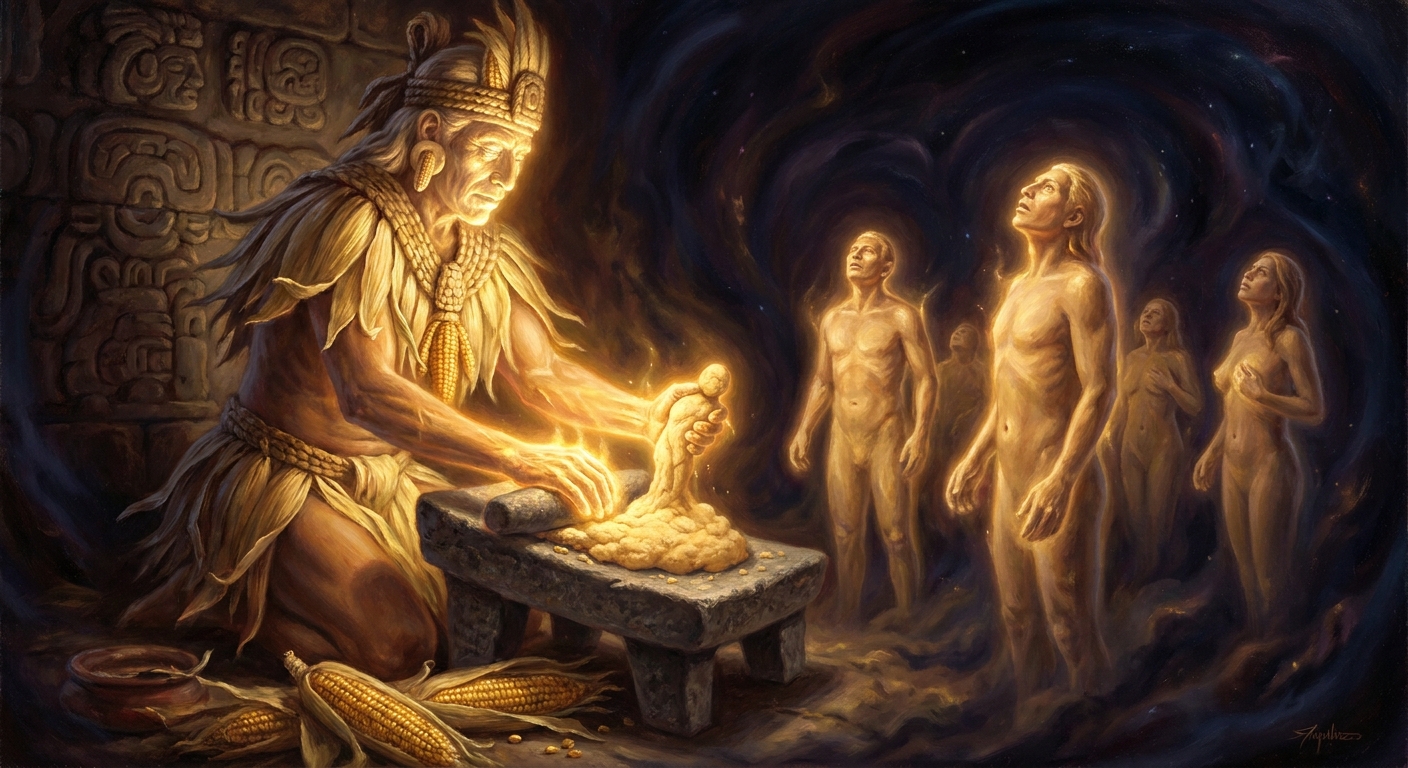
When you burn the cleared field, you are doing what the gods did to the wooden people: clearing what did not work to make room for what might. The ash enriches the soil the way the bones of the previous creation enrich the next one. The fire is the same fire that Huracán sent as the flood that ended the wooden people’s world — destructive and generative in the same motion.
Three sisters grow together in the milpa.
Corn, beans, and squash are planted together not because the Maya lacked the concept of monoculture but because polyculture is more productive. The corn stalk supports the climbing bean plant. The bean plant fixes nitrogen in the soil that the corn exhausted. The squash covers the ground between the stalks, suppressing weeds and retaining moisture. The three together are more productive than any one alone, and they are nutritionally complementary: corn provides carbohydrates, beans provide protein and amino acids the corn lacks, squash provides vitamins and minerals.
The Maya knew this empirically over thousands of years.
They also knew it theologically. The three plants are understood as sisters — three aspects of a single food gift from the gods, three forms of the abundance that Chaac’s rain and the Maize God’s sacrifice enable. You do not separate them. They belong together in the field the way they belong together in the body: complementary, interdependent, each making the others more fully what they are.
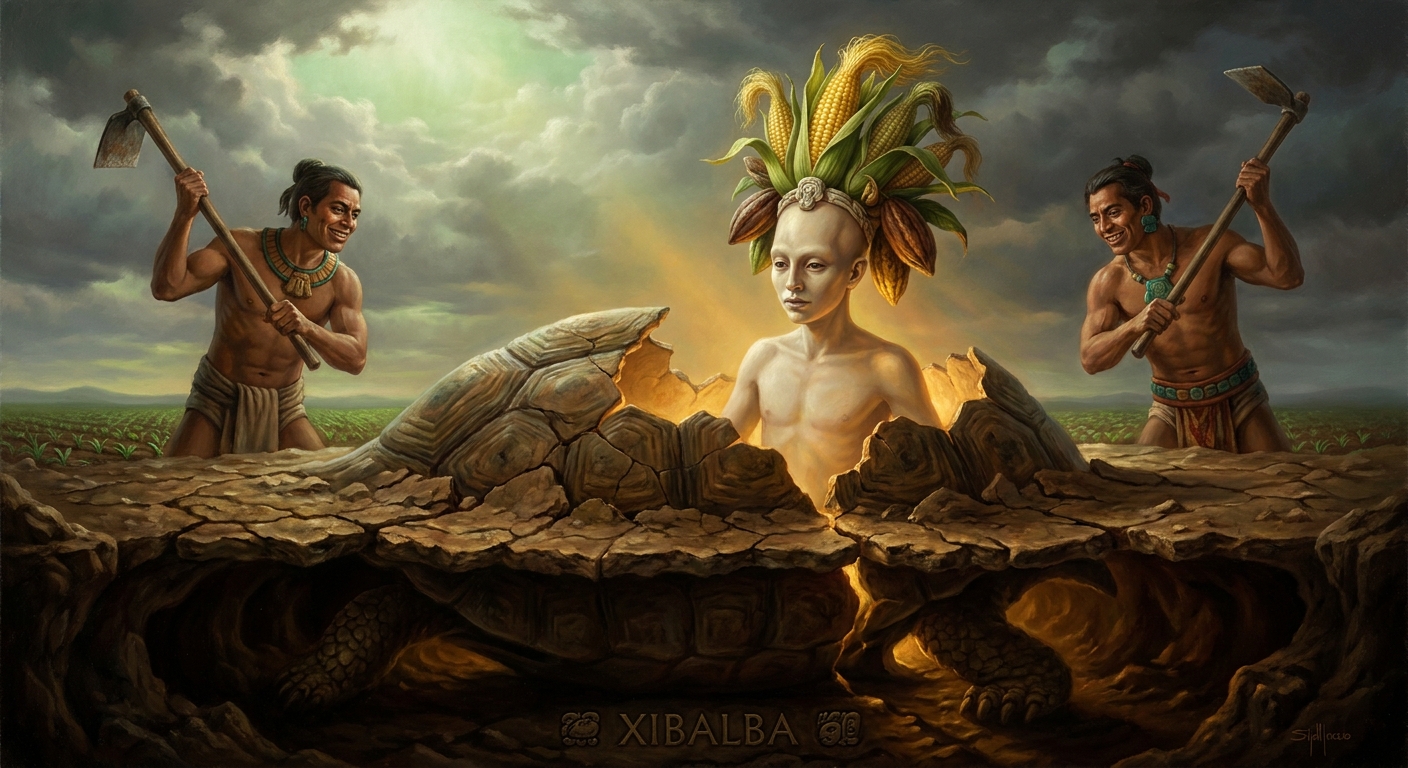
The planting ceremony involves the daykeeper consulting the calendar for the right day — a day favorable to agricultural beginnings, a day associated with growth and abundance rather than conflict or restriction. On the right day, the farmer makes a hole with a digging stick. The hole is the crack in the turtle’s back. Three to five seeds go in: the Maize God’s multiple children, entering the dark together.
The harvest ceremony is when the gratitude becomes most explicit.
When the corn is ready — when the ears have dried on the stalk and the husks have gone papery and the kernels are hard — the farmer does not simply pick the corn. The first harvested corn ears are placed on the altar. Copal is burned. The prayer names what was given: the rain, the soil, the seed, the time, the labor. The prayer names the givers: Chaac, the Maize God, the daykeeper who chose the planting day. The prayer names what is being asked for: that the relationship continue, that the rain come again, that the seed from this harvest will germinate in the next planting.
The milpa farmer is not a producer using land as input.
The milpa farmer is in a relationship with the corn, the forest, the rain, the soil, and the gods who give all of these — a relationship that requires ceremony because ceremony is the explicit acknowledgment of relationship. You do ceremony because you know what you owe and you want the other party to know that you know.
The forest at the edge of the cleared field grows back during the fallow years.
In twenty years, when the rotation brings you back to this section, you will ask again.
You will burn again.
The corn will rise again from the ash.
Echoes Across Traditions
Entities
- the Maize God
- Chaac
- the milpa farmers
Sources
- Betty Fussell, *The Story of Corn* (North Point Press, 1992)
- Arturo Gómez-Pompa, *The Role of the Maya as a Managing Society in the History of Mesoamerica* (Dumbarton Oaks, 1987)
- Michael D. Coe, *The Maya* (Thames & Hudson, 8th ed., 2011)