The King Is the God: Sacred Kingship and Divine Right Across World Religion
Pharaonic sacred kingship from c. 3100 BCE (First Dynasty); Mandate of Heaven doctrine in Zhou Dynasty from c. 1046 BCE; Chakravartin concept in Indian texts from c. 300 BCE; Divine Right of Kings in European political theology from c. 13th century CE, systematized in 17th century · The Nile valley, where the Pharaoh's body is the land's health; the Chinese empire, where the Son of Heaven rules because Heaven approves; medieval Europe, where kings rule by God's appointment; the Indian subcontinent, where the wheel-turning king creates peace by the force of his righteousness
Contents
The Pharaoh as Horus incarnate, the Mandate of Heaven, the Divine Right of Kings, the Chakravartin: when the ruler IS the god, the theology of power becomes indistinguishable from the power of theology.
- When
- Pharaonic sacred kingship from c. 3100 BCE (First Dynasty); Mandate of Heaven doctrine in Zhou Dynasty from c. 1046 BCE; Chakravartin concept in Indian texts from c. 300 BCE; Divine Right of Kings in European political theology from c. 13th century CE, systematized in 17th century
- Where
- The Nile valley, where the Pharaoh's body is the land's health; the Chinese empire, where the Son of Heaven rules because Heaven approves; medieval Europe, where kings rule by God's appointment; the Indian subcontinent, where the wheel-turning king creates peace by the force of his righteousness
In the summer of 1649, the Parliament of England executed its king.
Charles I, son of James I (who had written the most systematic defense of the Divine Right of Kings in the English language), was tried by a court he refused to recognize — because a king, his lawyers argued, could not be tried by any human court, only by God. The court disagreed. He was convicted of being a “tyrant, traitor, murderer and public enemy.” He was beheaded on a scaffold outside his own banqueting hall, which was decorated on the ceiling with a painting of his father James I ascending into heaven to receive his divine kingship.
The crowd groaned when the axe fell.
The execution of Charles I is the moment when the sacred kingship theology in its most explicit Western form met its most explicit refutation: a human institution decided that a king could be tried, convicted, and executed like any other criminal. The divine right did not protect him. The divine had, in the view of his executioners, already withdrawn its favor and transferred it to Parliament.
The Mandate of Heaven, in English, in January 1649.
The Pharaoh’s Cosmic Body
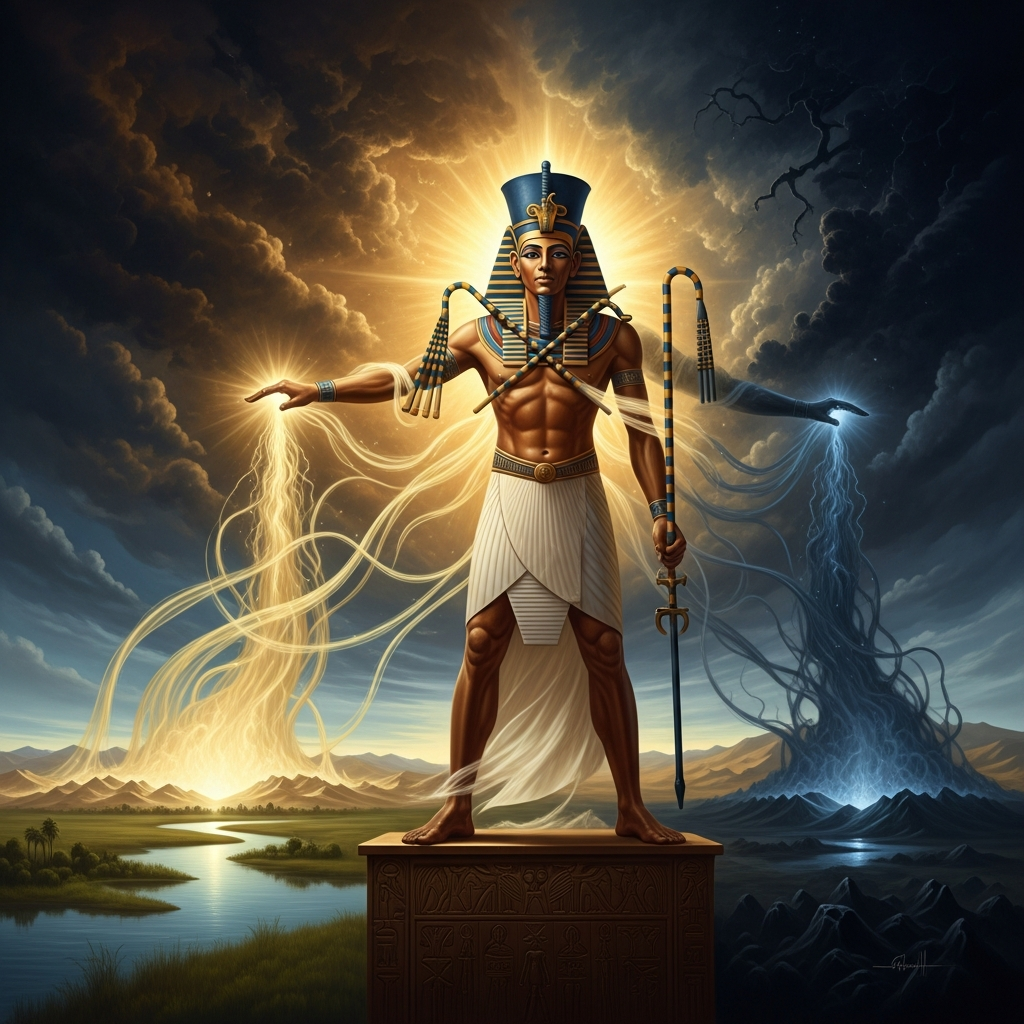
The identification of the Pharaoh with Horus was not a metaphor or a title. It was, in the Egyptian theological framework, a cosmological reality: the Pharaoh was the divine principle of just rule incarnate in a human body. Without this incarnation, Ma’at — the cosmic order that structured everything from the movement of the stars to the flooding of the Nile to the just verdict in a lawsuit — would not be maintained in the material world.
The implication was total. The Pharaoh’s health was the land’s health. When a Pharaoh weakened, the priests performed renewal rituals (the Heb Sed festival, celebrated at the 30-year mark and periodically thereafter) to restore his divine vitality. When a Pharaoh died, the entire cosmic order was threatened until the coronation of his successor completed the Horus-to-Osiris and new-Horus transition.
The administrative consequence was also total: every act of the state — tax collection, canal maintenance, the judgment of criminals, military campaigns — was simultaneously an act of cosmic maintenance. The state was not a secular institution. It was the mechanism by which the divine order was enacted in the material world, and the Pharaoh was its living embodiment.
Henri Frankfort, in Kingship and the Gods (1948), identified this as the Egyptian answer to the problem of political authority: the state does not need to justify itself by its consequences (prosperity, justice, stability) because the state is the presence of the divine in the material world. Its justification is its nature, not its results.
The Mandate of Heaven: Sacred Kingship with an Exit Clause
The Chinese Mandate of Heaven was the most sophisticated version of sacred kingship theology ever developed, precisely because it built in its own refutation. The Mandate was conditional: Heaven granted it to virtuous rulers and withdrew it from corrupt ones. The evidence of withdrawal was natural disaster, famine, military defeat, and popular uprising — exactly the evidence that accompanied any successful revolution.
This created a permanent ideological instrument available to every rebel who had succeeded. If your revolution succeeded, that proved Heaven had transferred its mandate to you. If it failed, that proved Heaven had not. The Mandate of Heaven theology made rebellion against it impossible to disprove from the outside in advance, and impossible to claim in advance of success.
The Zhou Dynasty used this argument to justify their overthrow of the Shang. Every subsequent dynasty used the same argument. The last dynasty to fall in China — the Qing, in 1912 — collapsed in part because the natural disasters, foreign military defeats (the Opium Wars, the Sino-Japanese War), and popular uprisings of the late Qing period were read, by Chinese and non-Chinese observers alike, as evidence of Heaven’s withdrawal of the mandate.
Sun Yat-sen, the founder of the Republic of China, was a Christian who did not believe in the Mandate of Heaven theology. But the revolution he led was read through that theological framework by the population he was leading. The secular revolution was understood as a divine political transition.
Ashoka and the Dharma-Conquest
The Chakravartin ideal in Indian political thought is the most ethically demanding version of sacred kingship. The wheel-turning king’s universal rule is not achieved through military conquest but through the force of righteous governance — the dharma spreads because it is attractive, not because it is coerced.
Ashoka Maurya’s transformation after the Kalinga War (c. 261 BCE) — in which his forces killed approximately 100,000 people and displaced hundreds of thousands more — is the most dramatic instance of a ruler attempting to re-configure themselves according to the Chakravartin ideal. His Rock Edicts, inscribed in Prakrit across his empire, document this transformation: he renounces military conquest, mandates tolerance for all religious sects, establishes medical facilities for humans and animals, plants trees along roads, and instructs his officials to ensure the welfare of all subjects.
What is theologically significant is what Ashoka understood the Chakravartin ideal to require: not simply personal virtue but the transformation of state administration. Sacred kingship in the Buddhist form is not about the king’s divine nature; it is about the king’s enacted dharma — the specific, measurable, accountable ways in which governance serves the welfare of all beings.
The Ashokan edicts are, in effect, the first surviving state-level articulation of the idea that political authority is legitimized by its service to the governed — a claim with implications that extend far beyond the Buddhist context in which Ashoka made it.
When the King Dies, the Land Dies
The anthropologist James Frazer, in The Golden Bough (1890), made the controversial argument that sacred kingship in its most ancient form included the ritual killing of the king — that the identification of the king’s body with the land’s fertility led, in early agricultural societies, to the deliberate sacrifice of the king to renew the land’s power, either at the end of a fixed term or when his physical vigor showed signs of decline.
Frazer’s comparative evidence was extensively criticized by later anthropologists, and the “ritual regicide” hypothesis is now regarded as vastly overstated. But the underlying observation — that many sacred kingship traditions identify the king’s body with the land’s health in a way that makes the king’s vitality cosmologically significant — has survived the criticism. The Egyptian Heb Sed festival was designed to ritually renew the Pharaoh’s divine vitality. The Norse blót at Uppsala involved sacrificing the king as a symbolic exchange with the divine powers. The Irish sovereignty goddess tradition associated the king’s ritual marriage with the land’s fertility.
The king’s body is never purely personal. The sacred king owns, embodied in their physical existence, a portion of the cosmic health that sustains the community. This is the most intimate version of the divine right: not a legal claim but a physical one.
Who Judges the King?
The persistence of sacred kingship across traditions, and its eventual erosion in most of them, follows a consistent pattern: the same divine authority that legitimizes the king is deployed, by prophets, priests, or constitutional theorists, to limit or depose the king.
In ancient Israel, the prophet Nathan walks into David’s court after the king has arranged the death of Uriah to take his wife Bathsheba, and tells the king a parable. When David (who has not recognized himself in the story) pronounces judgment on the guilty man, Nathan says: “You are the man.” The prophet who serves the same God who anointed David has the authority to condemn the king — and in the biblical account, David accepts the judgment. The divine authority is not the king’s possession. It is the standard he is measured against.
Every tradition that has developed a full theory of sacred kingship has eventually had to develop a version of Nathan’s confrontation — the moment when the divine authority that legitimates the king is used to hold the king accountable. The prophet, the parliament, the imam, the dharmic tradition, the Mandate of Heaven — all are mechanisms by which the divine endorsement is shown to be conditional.
The sacred king rules by divine authority. And divine authority, in every tradition, is the authority that judges everyone, including the one who holds it.
The king is the god. And the god is not impressed by the king.
Echoes Across Traditions
Entities


Sources
- James I of England, *The True Law of Free Monarchies* (1598)
- Shu Jing (Book of Documents), 'Announcement of Zhonghui' and related Zhou texts (on Tianming)
- Wm. Theodore de Bary, ed., *Sources of Chinese Tradition* (1960)
- Ashoka's Rock Edicts and Pillar Edicts (c. 257-240 BCE)
- *Cakkavatti-Sihanada Sutta*, Digha Nikaya 26 (on the Chakravartin)
- Henri Frankfort, *Kingship and the Gods: A Study of Ancient Near Eastern Religion as the Integration of Society and Nature* (1948)
- 1 Samuel 8-12 (institution of Israelite kingship)
- 2 Samuel 12 (Nathan's rebuke of David)
- Paul, *Letter to the Romans* 13:1-7 (on governing authorities)
- Marc Bloch, *The Royal Touch: Sacred Monarchy and Scrofula in England and France* (1924)