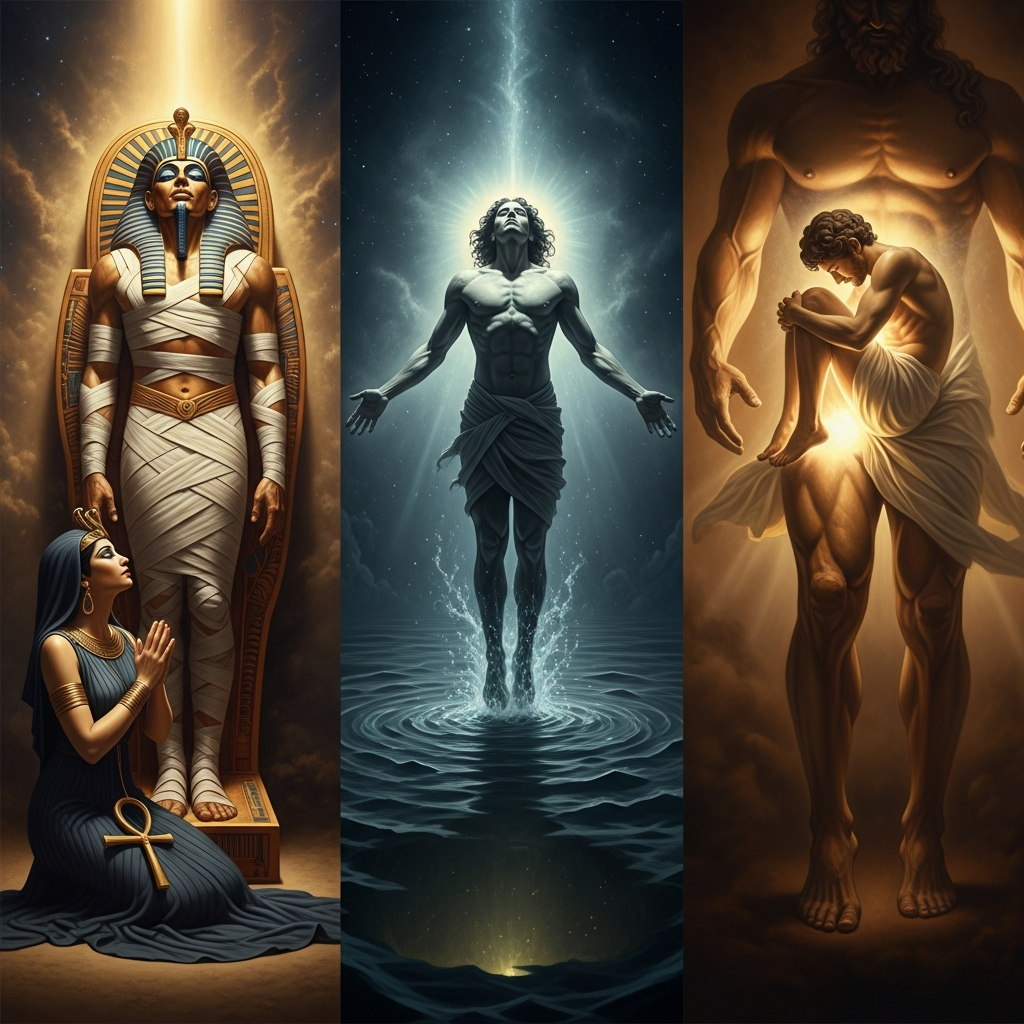
The Gods Who Die and Return: Osiris, Dionysus, Tammuz, Baldr, and the Scholarly Debate About Jesus
Mythic time · textual attestations from c. 2400 BCE (Pyramid Texts) through the Roman Imperial period · The Nile delta and the Egyptian underworld, the vineyards of Thrace and Phrygia, the Mesopotamian grain fields, the Phoenician coast, the Norse realm before Ragnarok, the Roman province of Judea
Contents
A god is killed. The world mourns. The god returns — changed, transformed, ruling a different domain. This pattern appears across dozens of traditions. What does it mean, and where does it end?
- When
- Mythic time · textual attestations from c. 2400 BCE (Pyramid Texts) through the Roman Imperial period
- Where
- The Nile delta and the Egyptian underworld, the vineyards of Thrace and Phrygia, the Mesopotamian grain fields, the Phoenician coast, the Norse realm before Ragnarok, the Roman province of Judea
Osiris is dead on the floor of a feast-hall, inside a sealed chest, on his way down the Nile.
His brother Set has tricked him into lying down inside the chest — told the assembled company that whoever fit its dimensions exactly would receive it as a gift — and when Osiris lay in it, Set’s servants slammed the lid, sealed it with molten lead, and threw it into the Nile. This is the first death. The chest floats to the Phoenician coast, where it is found and enclosed in the trunk of a tamarisk tree, which grows so beautifully that the king of Byblos makes it a column in his palace.
Isis, Osiris’s sister and wife, searches the world for him. She finds the tree. She recovers the chest. She brings it back to Egypt and hides it in the marshes.
Set finds it.
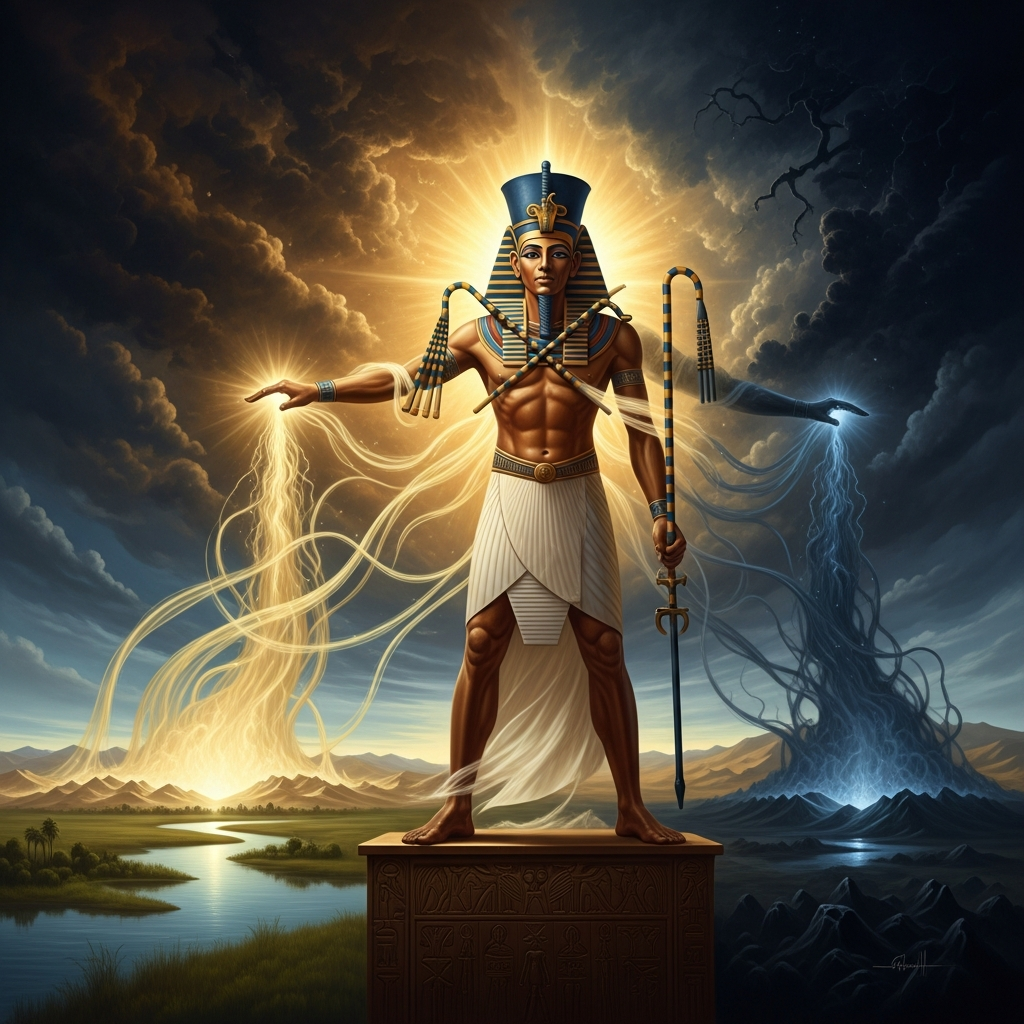
He cuts the body of Osiris into fourteen pieces — the number varies across versions, ranging from fourteen to forty-two — and scatters them across Egypt. Isis searches again, collects the pieces, reassembles the body. She is not able to find one piece: the phallus, which has been eaten by a fish in the Nile. She fashions a replacement from gold. She breathes life back into the body long enough to conceive a son, Horus. Then Osiris dies a second time, this final time completely, and descends to rule the kingdom of the dead.
He does not return to the upper world. He reigns in the underworld. Every Egyptian who dies becomes Osiris.
This is the oldest fully attested dying-and-rising god in the written record, and it is already, in its oldest versions, more complicated than the category name suggests.
Dionysus: The God of What Is Torn Apart
The Dionysus of Greek state religion was the god of wine, theater, and ecstatic festival — unruly, dangerous in excess, patron of transformation. The Dionysus of the Orphic mystery tradition was something more precisely mythological: a god who had been killed, dismembered, and reborn, whose body was the universe.
In the Orphic account, the infant Dionysus was lured by the Titans with toys — a top, a ball, dice, a mirror — and while he was distracted, they killed him, dismembered him, and cooked him. Zeus, enraged, incinerated the Titans with his thunderbolt, and from the ash of the Titans — mixed with the divine substance of Dionysus, whom they had consumed — humanity was formed. Humanity is thus made of Titan-nature (brutal, destructive) and Dionysian-nature (divine, vital) in combination.
Dionysus was reconstituted from the recovered pieces — or from his preserved heart, swallowed by Semele, or by other variants — and reborn. His second birth, from the thigh of Zeus after Semele’s death by divine fire, is the canonical mythological event, though the Orphic tradition layers additional resurrections underneath it.
The Dionysian pattern is not agricultural in its primary logic. It is cosmogonic: the tearing-apart is the moment of creation. The world is made from a god’s scattered body. His resurrection is the reassembly of the divine into a single point. The ecstasy of the Dionysian cult replicated this in human experience — the dissolution of individual identity in the group frenzy, the temporary loss of the self’s edges, followed by return.
Tammuz and Dumuzi: The Seasonal God
The Mesopotamian tradition is where the agricultural logic of the dying-and-rising god is most explicit.
Dumuzi is a shepherd deity, the consort of Inanna, the great goddess of love and war. In the Sumerian Descent of Inanna, she descends to the underworld — her sister Ereshkigal’s realm — for reasons the text does not fully clarify, perhaps to expand her dominion. She is killed there and hung on a hook. She is rescued through a complicated divine intervention involving the creation of mourning figures who earn her release — but the underworld demands a substitute. When she returns to the upper world, she is accompanied by demons who must bring someone back in her place.
She looks at her husband Dumuzi, who has not mourned her absence but has been sitting on his throne in her clothes. She hands him to the demons.
His annual death is the dry season. His annual rescue — negotiated eventually so that his sister Geshtinanna takes his place for half the year — corresponds to the return of fertility. The myth is a direct narrative encoding of the agricultural calendar: Dumuzi’s death is summer; his return is the planting season.
The prophet Ezekiel, in the eighth century BCE, describes women at the gate of the Jerusalem Temple “weeping for Tammuz” — evidence that the cult survived long enough and spread far enough to become a target of prophetic condemnation in the Hebrew tradition.
Adonis: The Beautiful and the Brief
The Adonis myth arrives in Greek literature from Phoenicia, and it carries the regional agricultural logic most transparently. He is loved simultaneously by Aphrodite (love, the upper world) and Persephone (death, the lower world). Zeus’s compromise — he spends part of the year in each domain — maps directly onto the division of the agricultural year.
His death is always by boar. In Ovid’s Metamorphoses, the boar is sent by a jealous Ares; in other versions, Adonis’s own hunting ambition kills him. Blood falls on the earth; anemones spring from it. The flower that grows from a god’s blood is the standard form of this myth-type’s consolation: the god does not survive, but something beautiful grows in his place.
His cult is documented by the “Gardens of Adonis” ritual: small containers of rapidly sprouting, rapidly dying grain were carried in procession by women mourning the beautiful dead god. They grew quickly and died quickly, enacting in miniature the patron’s life cycle. It is one of the most direct ritual translations of a myth into repeated embodied performance.
Baldr: The Resurrection Deferred
The Norse version is the outlier, and the most structurally interesting.
Baldr, the beloved, the radiant, the good — the one god the entire Norse pantheon agreed to protect — is killed by Loki’s manipulation, which is characteristic. The mistletoe was too young to take the oath of harmlessness that every other substance in the world had sworn. Loki made a spear of it and guided the blind god Hodr’s throw.
Baldr dies and descends to Hel’s realm. Hel agrees to release him on a single condition: every living thing must weep for him. Every living thing does weep — except one old woman, Thokk, who is widely understood to be Loki in disguise, who refuses to weep. The one dry eye condemns Baldr to the underworld until Ragnarok.
He will return after the end. After the world-fire and the wolf and the serpent, Baldr will emerge from Hel’s realm and walk on the new earth with the other survivors. His resurrection is not a reversal of death but a post-apocalyptic future, a promise attached to the far side of total cosmic destruction.
The Norse version is the dying-and-rising god as eschatological hope rather than seasonal cycle. He will come back, but not yet, and not until everything else is over.
The Jesus Question: What Scholars Actually Say
No question in comparative religion has generated more heat, and generated it in more directions, than whether Jesus belongs in the category of dying-and-rising gods.
The popular argument — articulated by Frazer and widely reproduced in the twentieth century — holds that the death and resurrection of Jesus follows the same structural pattern as Osiris, Tammuz, Adonis, and Dionysus, and that the early Christian theology of resurrection was assembled in a cultural environment saturated with these cults. On this reading, the disciples’ interpretation of Jesus’s death through the resurrection lens was shaped by the dying-god template the first-century Mediterranean world already provided.
Serious scholars are divided, and the division is instructive. Jonathan Z. Smith, one of the most rigorous historians of religion of the twentieth century, argued in 1987 that the “dying and rising gods” category was based on bad evidence: that several of the figures traditionally included — Adonis, Attis, Osiris — do not actually resurrect in their primary sources. They die. They are mourned. They may be transformed or relocated. But the full pattern of death followed by return to life as a transformed being is present clearly only in some of the cases.
T.N.D. Mettinger, in The Riddle of Resurrection (2001), argued the opposite: that the dying-and-rising pattern is real and well-attested in the ancient Near East, and that the pattern’s presence does not by itself determine the question of Jesus’s historicity or the validity of Christian theological claims. The structural parallel can be acknowledged without reducing one to the other.
N.T. Wright, from the opposite direction in The Resurrection of the Son of God (2003), argues that the early Christian claim for Jesus’s resurrection is structurally different from the pagan dying-god myths in a precise way: the dying gods go through a repeated cycle tied to the agricultural calendar. The Christian claim is for a single, unrepeatable historical event in which a specific person was raised bodily, permanently, in a way that the disciples themselves contrasted explicitly with the general resurrection they expected at the end of history. The claim is not that Jesus enacted the spring; it is that his resurrection was the beginning of the resurrection of all the dead, a one-time pivot in historical time.
The structural comparison, on this reading, illuminates both how the early Christians communicated their claim — in a world that already had the conceptual vocabulary for gods who conquered death — and how their claim differed: not a cycle, but a hinge.
The Pattern and Its Limits
James Frazer’s core insight was correct but incomplete. There is a real pattern: across cultures that had no contact with one another, the death and transformation of a divine figure is linked to renewal — of the earth, of the soul, of the cosmic order. The pattern is too widely distributed to be purely accidental.
But the pattern obscures as much as it reveals. Osiris does not return to the upper world; he rules the dead. Baldr does not return yet; he waits after Ragnarok. Tammuz returns for half the year as a calendar mechanism. Dionysus is reconstituted from a cosmogony. Adonis is mourned annually in a fertility rite. Each case uses the template differently, and the differences encode different claims about death, renewal, and what is preserved through transformation.
The dying-and-rising god is a category that every tradition in the ancient world was thinking through independently, because every tradition had to reckon with the same problem: things die. The earth dies every year and returns. People die and do not return, or do they? The god who dies and is transformed is the mythological attempt to hold those two facts together — the irreversibility of individual death and the continuity of life across death — and find in their tension something that can be called meaning.
Every civilization that reached a sufficient level of complexity eventually had to write that myth. They wrote it differently. Those differences tell you more about each tradition’s theological commitments than the structural similarity does.
The pattern is the question. The versions are the answers. And the answers do not all agree.
Echoes Across Traditions
Entities


Sources
- James George Frazer, *The Golden Bough* (1890; 3rd ed. 1906-15)
- Pyramid Texts, Utterances 532-36 (c. 2400-2300 BCE)
- *Descent of Inanna to the Netherworld* (Sumerian, c. 1900-1600 BCE)
- Snorri Sturluson, *Prose Edda*, Gylfaginning 49 (c. 1220 CE)
- Ovid, *Metamorphoses* X.503-739 (8 CE)
- T.N.D. Mettinger, *The Riddle of Resurrection: 'Dying and Rising Gods' in the Ancient Near East* (2001)
- Jonathan Z. Smith, 'Dying and Rising Gods,' *Encyclopedia of Religion* (1987)
- Mark S. Smith, *The Origins of Biblical Monotheism* (2001)
- N.T. Wright, *The Resurrection of the Son of God* (2003)
- Tryggve Mettinger, *In Search of God: The Meaning and Message of the Everlasting Names* (1987)
- Walter Burkert, *Ancient Mystery Cults* (1987)