Egyptian Mythology: Ma'at, the Gods, and Three Thousand Years of the Dead
Earliest written sources c. 2400 BCE (Pyramid Texts) · tradition continuous through c. 400 CE · The Nile Valley — from the Delta to Nubia, the cosmos organized around the river's annual flood
Contents
A comprehensive guide to ancient Egyptian religion — Ma'at as cosmic order, the Ennead of Heliopolis, Ra's solar journey, the Osiris myth, the Duat, the Book of the Dead, and 3,000 years of change.
- When
- Earliest written sources c. 2400 BCE (Pyramid Texts) · tradition continuous through c. 400 CE
- Where
- The Nile Valley — from the Delta to Nubia, the cosmos organized around the river's annual flood
At the beginning, there is nothing.
Not darkness — darkness requires something for light to be absent from. Not silence — silence requires a medium sound could travel through. The Egyptian word for this primordial state is Nun: the inert, undifferentiated waters before there was a world to float on them, the not-yet-anything from which everything will come. Nun is not evil. Nun is not good. Nun is the background against which the first act of creation is measured, and it never fully goes away. The desert beyond the Nile’s reach is still Nun. The sky at night is Nun. The abyss beneath the earth through which the sun travels in darkness is Nun. Egyptian cosmology does not imagine a creation that permanently replaces chaos. It imagines a cosmos that holds the boundary against chaos, every day, maintained by the principle that makes maintenance possible.
That principle is Ma’at.
Ma’at: The Foundation of Everything
Ma’at is usually translated as “truth” or “justice” but neither captures what the Egyptians meant. Ma’at is the cosmic principle of right order — the fact that the sun rises, that the Nile floods on schedule, that grain grows, that seasons turn, that the strong do not simply consume the weak without consequence. She is also a goddess: a woman with an ostrich feather in her hair, the feather against which the heart of the dead is weighed. But the goddess is an expression of the principle, not its source. Ma’at predates the gods. It is the condition that makes divine action meaningful.
The pharaoh’s primary theological function was not military or economic. It was to maintain Ma’at. Every ritual act, every correct offering, every properly conducted ceremony was a contribution to the ongoing project of keeping the universe in right order. When a pharaoh failed — through injustice, through neglect of the temples, through moral corruption — Ma’at weakened, and the consequences were literal: floods came at the wrong time, crops failed, foreign enemies grew bold. The connection between ethical order and natural order was not metaphorical in the Egyptian understanding. They were the same thing.
The Ennead of Heliopolis: The Family Tree of Gods
Egyptian theology had multiple competing creation accounts centered in different cult cities — Heliopolis, Memphis, Hermopolis, Thebes — and the Egyptians never resolved these into a single canonical narrative. They held them simultaneously, which is either intellectually sophisticated or confusing, depending on your expectations. The Heliopolis account, organized around the Ennead (nine gods), was the most influential and the template for the major myths.
At the beginning, the self-created god Atum rises from Nun on the primordial mound — the first dry land, which the city of Heliopolis claimed to be — and creates the first pair of gods through masturbation (some texts say sneezing), producing Shu (air) and Tefnut (moisture). Shu and Tefnut produce Geb (earth) and Nut (sky). Geb and Nut produce the four siblings whose story structures Egyptian religion for three thousand years: Osiris, Isis, Set, and Nephthys.
In the Memphis theology, it was Ptah who created the world through his heart (thought) and tongue (speech) — a strikingly intellectual creation theology that may have influenced the Logos theology of Greek philosophy and eventually John’s Gospel (“in the beginning was the Word”). In Hermopolis, eight primordial forces (the Ogdoad) preceded the Ennead. In Thebes, Amun was the hidden force behind all creation. The Egyptians did not experience these as contradictions. They experienced them as different angles on the same ultimate reality that no single human city could fully contain.
Ra and the Solar Theology
Ra — the sun-god, later fused with Amun as Amun-Ra in the New Kingdom’s most powerful theological synthesis — is not simply the sun. Ra is the creative force that animates existence, the light that makes Ma’at visible, the eye of the cosmos. His daily journey is the organizing rhythm of Egyptian religious life.
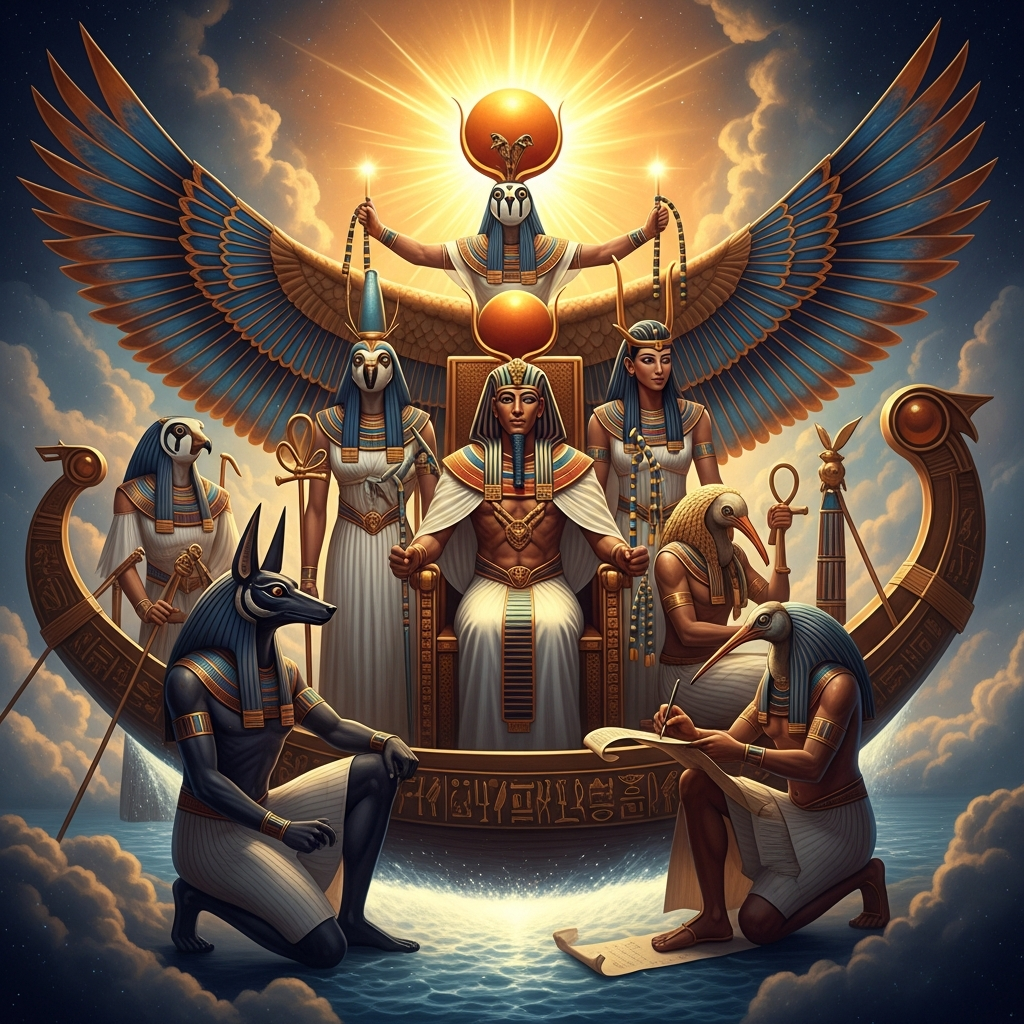
In the morning, Ra is born as Khepri — the scarab beetle rolling the solar disk over the horizon, just as a scarab rolls a dung ball, an image that is at once humble and cosmically serious. Through the day, he sails the sky in the day-bark (Mandjet), accompanied by the gods of his crew, the sun disk blazing over the world below. At evening he becomes Ra-Atum, the aged sun, and descends into the Duat, the Egyptian underworld, to begin the night journey in the night-bark (Mesektet).
The night journey is a battle. In the deepest hour of the night, Ra’s bark encounters Apep (Apophis) — the serpent of chaos, enormous, ancient, the enemy of the solar order. Apep must be defeated every night. The priests in Ra’s temples performed rituals throughout the night hours to assist the cosmic battle — they recited spells against Apep, they spat on effigies, they burned them. The sun rising in the morning was not taken for granted. It was the result of a battle won, assistance given, rituals correctly performed. This is the same theology as the Babylonian Akitu: the cosmos is maintained, not automatic. The world exists because people do the work of holding it open.
The Osiris Myth: The Central Family Drama
The most important story in Egyptian religion is also its most human: a family conflict over power, loyalty, betrayal, and the question of what happens after death.
Osiris inherits the kingship of earth from Geb and rules justly, teaching agriculture, law, and civilization. His brother Set — god of the desert, storms, and foreign lands, a figure of chaotic necessary energy — grows jealous of Osiris’s authority. Set murders Osiris by trapping him in a chest he has had built to Osiris’s exact measurements, sealing it, and throwing it in the Nile. In the later and most complete version (Plutarch’s, from c. 100 CE, drawing on older Egyptian traditions), Set dismembers the body and scatters the parts across Egypt.
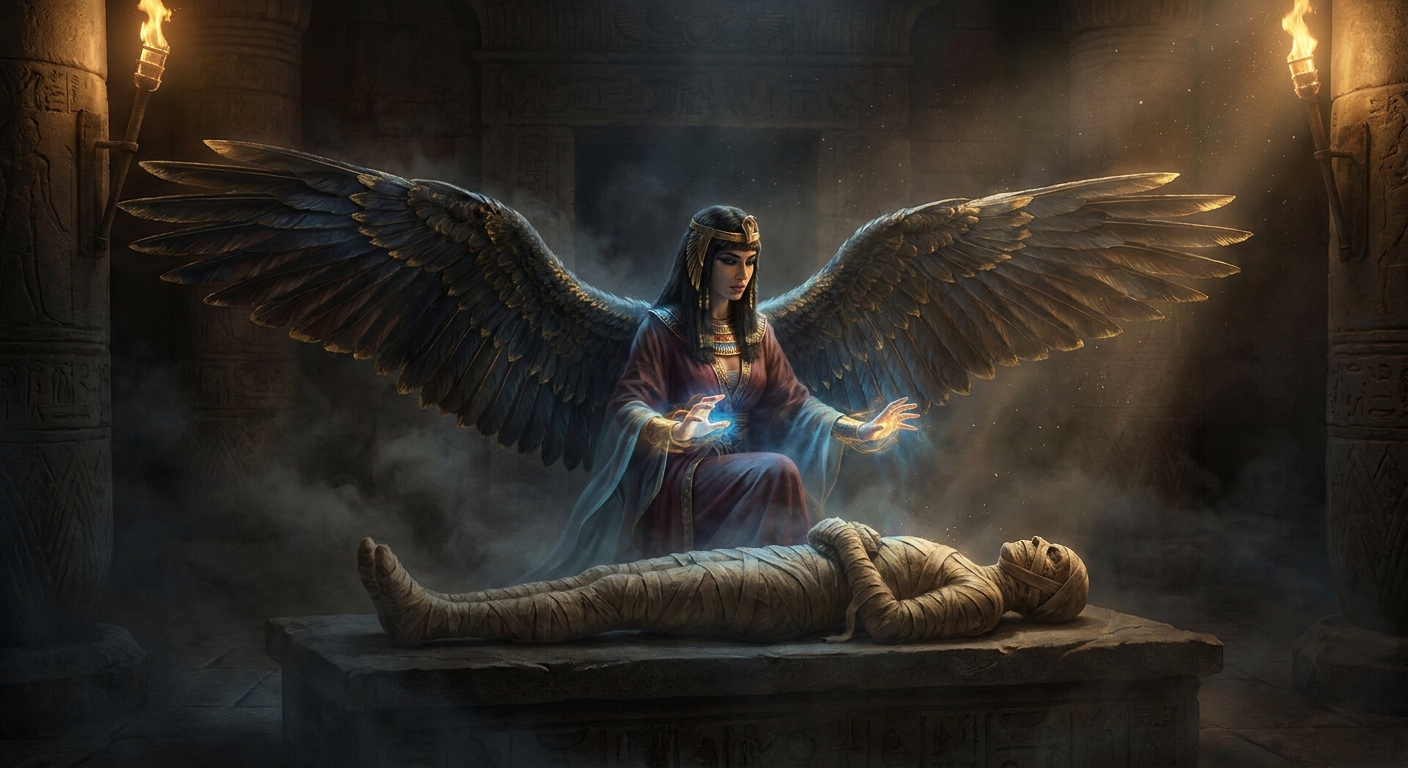
Isis — wife and sister of Osiris, the greatest magician among the gods — searches for the scattered body parts and reassembles them, fashioning a replacement phallus from gold where the original was lost to the Nile. She and her sister Nephthys wrap the body in linen, and Isis conceives Horus by hovering over the mummy in the form of a kite. She then hides in the delta marshes of Khemmis to raise Horus in secret, protecting him from Set until he is old enough to claim his father’s throne.
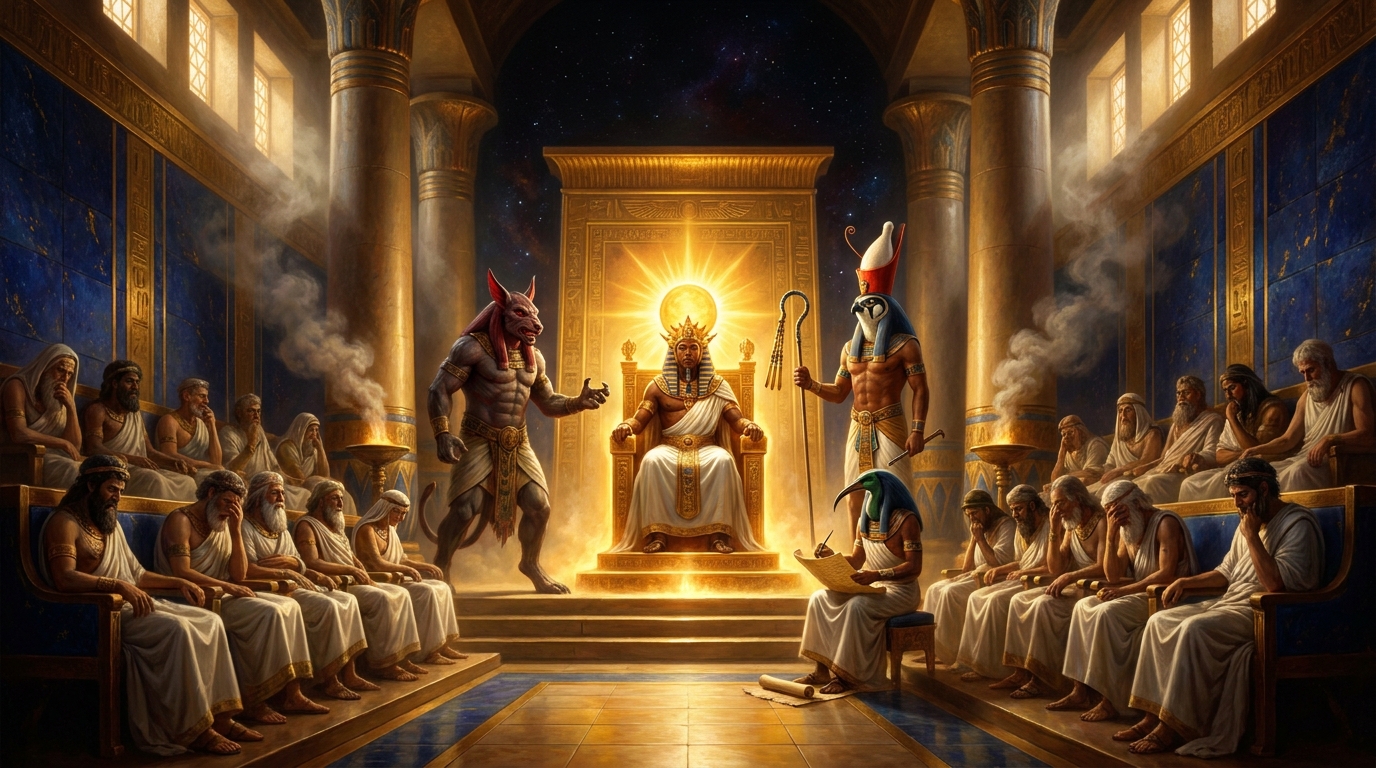
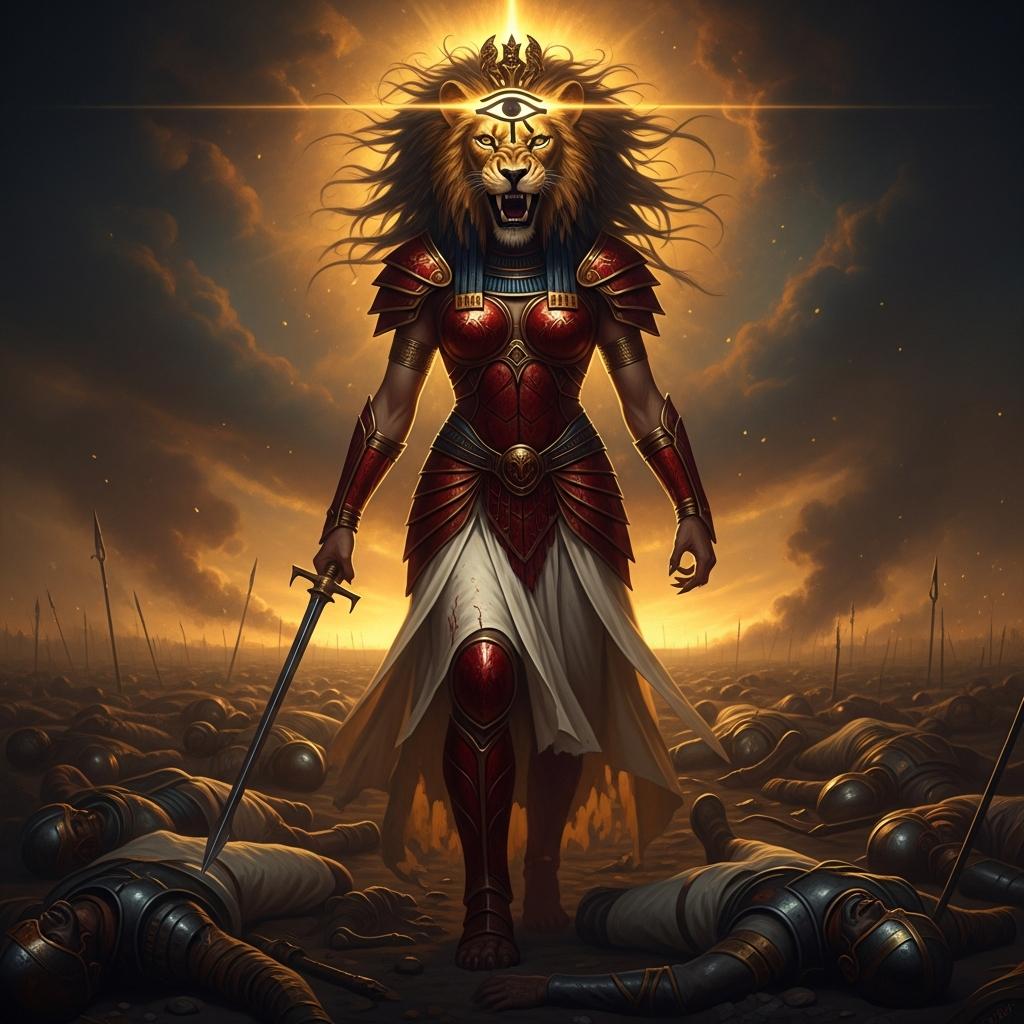
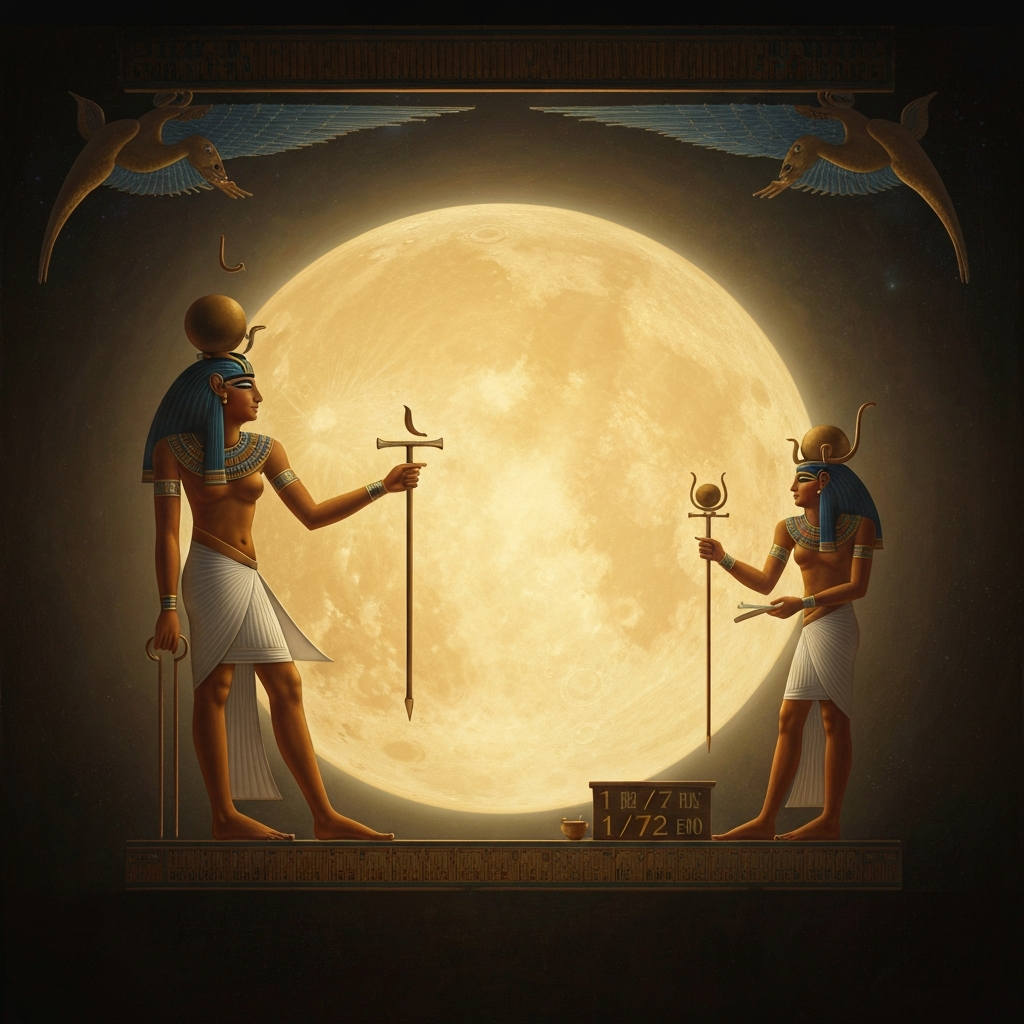
Horus and Set fight a war for the kingship of Egypt that lasts eighty years in some tellings. The contests involve physical combat, magical duels, and a tribunal before Ra and the Ennead. Set tears out one of Horus’s eyes (the lunar eye). Horus retaliates in kind. The eye of Horus — the wedjat — restored by Thoth, becomes the most powerful protective symbol in Egyptian religion: the eye that was destroyed and healed, representing restoration, divine protection, the capacity of order to recover from damage.
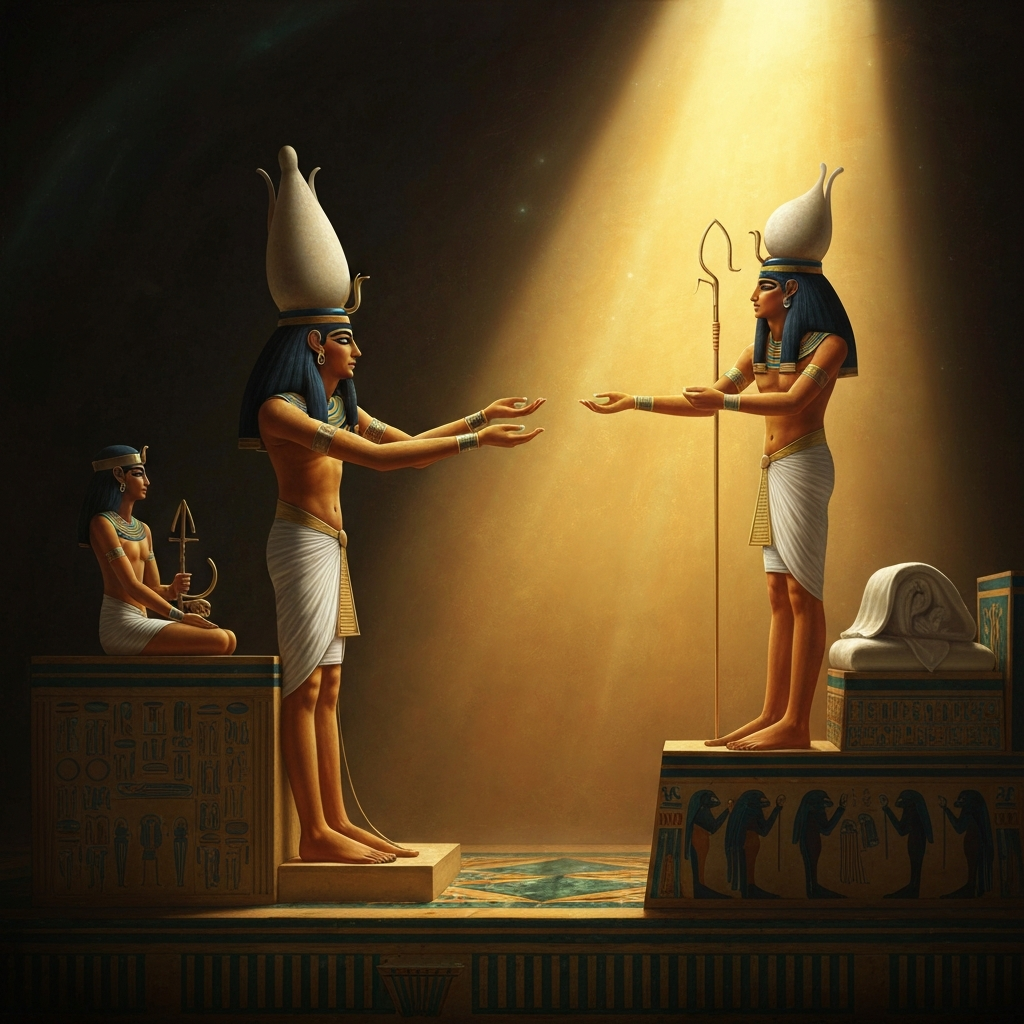
Osiris does not return to rule the living world. He becomes king of the dead, judge of the Duat, the one who presides over the afterlife. This is the theological pivot: death is not defeat. It is transformation into a different kind of sovereignty. Osiris is more powerful dead than he was alive. The dead pharaoh becomes Osiris. The living pharaoh is Horus. The same logic will hold for the humblest person with the right burial rites — “I am Osiris” is the formula that begins the transformation.
The Duat and the Weighing of the Heart
The Egyptian underworld is not a place of punishment for sinners. It is a journey — specifically, a journey through twelve hours of night, each guarded by gatekeepers who require passwords, spells, and correct identification to pass. The dead do not travel this road blind. They travel it with a guidebook.
The Book of the Dead (more accurately, the Book of Coming Forth by Day — the Egyptian title suggests not burial but emergence) is a collection of spells, passwords, and instructions compiled from the New Kingdom onward and placed in tombs on papyrus scrolls. Earlier versions appear in the Old Kingdom Pyramid Texts (inscribed on tomb walls for the exclusive use of royalty) and the Middle Kingdom Coffin Texts (democratized to the wealthy nonroyal). By the New Kingdom, a version was available to anyone who could afford a scribe.
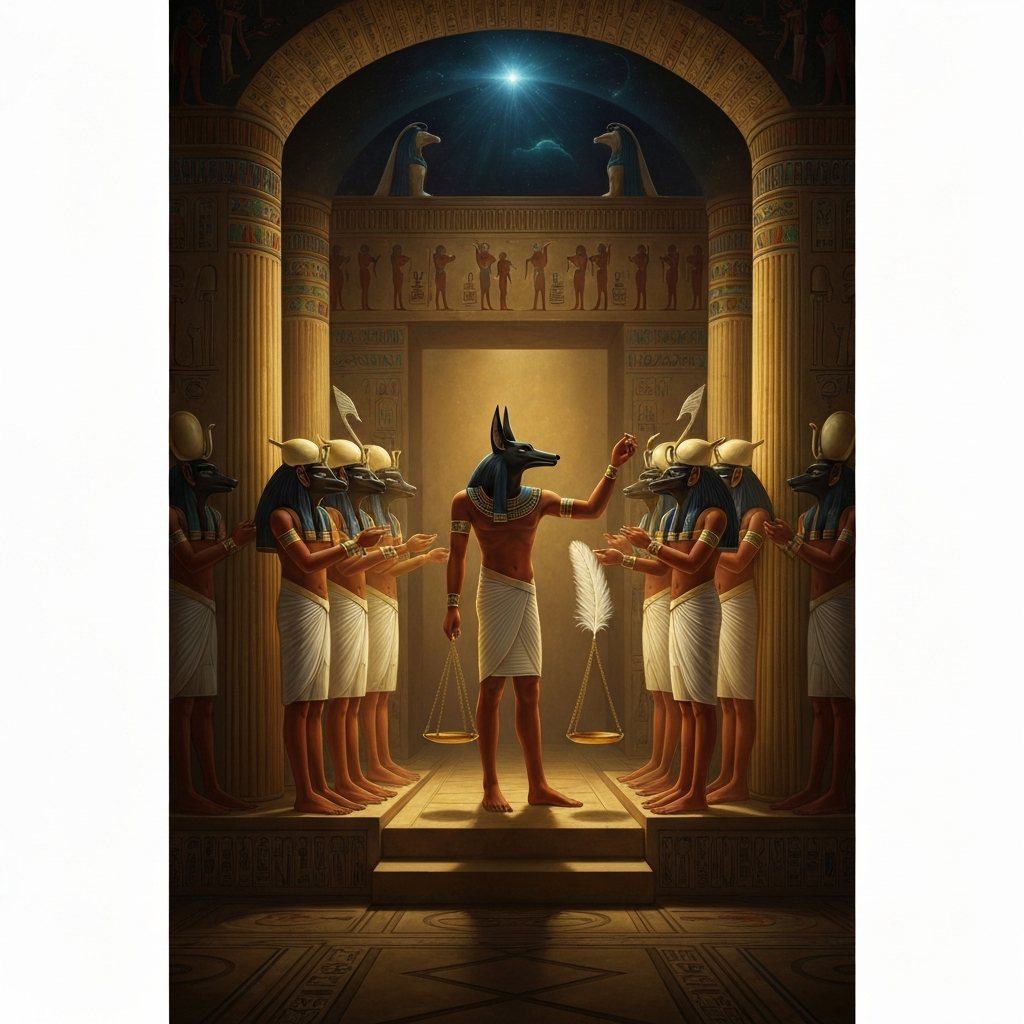
The climax of the journey is the Hall of Two Truths, where the dead person’s heart is placed on a scale against the feather of Ma’at. Anubis — the jackal-headed god who presides over mummification and escorts the dead — manages the weighing. Thoth — the ibis-headed god of writing, wisdom, and divine accounting — records the result. Forty-two assessors, each responsible for a specific sin, listen as the deceased recites the Negative Confession: “I have not killed. I have not stolen. I have not spoken falsehood. I have not caused anyone to weep. I have not been covetous.” The heart is weighed. If it balances against the feather of Ma’at — if the heart is as light as truth, unburdened by the weight of wrongdoing — the deceased is welcomed into the Field of Reeds, the Egyptian paradise.
If the heart is heavier than the feather, Ammit waits — a composite creature with a crocodile’s jaws, a lion’s forequarters, and a hippopotamus’s hindquarters — and devours it. The soul ceases to exist. This is the Egyptian second death, the one that cannot be undone.
The moral logic here is startling in its clarity: what you carry from life is what you are weighed against. Not your wealth, not your status, not your lineage — the lightness of your heart against the standard of cosmic justice. This is one of the earliest formulations of individual moral accountability in the afterlife in human history, and its influence on Judaism, Christianity, and Islam has been persistently underestimated.
How Egyptian Religion Changed Over 3,000 Years
Egyptian religion was not static. It changed constantly, absorbed foreign elements (Baal arrived via the Hyksos occupation, Aten was briefly elevated to sole deity under Akhenaten in the 14th century BCE), and responded to political reality. The Amarna Period (c. 1353–1336 BCE), when Akhenaten suppressed all other cults in favor of the sun-disk Aten, is the most dramatic rupture — arguably the world’s first attempted monotheism — and it was so thoroughly reversed after his death that his successors chiseled his name from monuments.
But the more constant change is subtler: the same god appears with different names in different periods, different gods are fused (Amun-Ra, Ptah-Sokar-Osiris, Ra-Horakhty), and the same myth is told with different emphases depending on which priesthood is telling it and what political claims they are making. The flexibility is a feature, not a bug. A religion that lasts three thousand years in a civilization that repeatedly changes rulers, foreign influences, and economic conditions requires the ability to renegotiate its own theology without losing its core. Egyptian religion renegotiated constantly. Ma’at, Osiris, and the feather endured.
The final act of Egyptian religion took place at the temple of Philae, on an island in the first cataract of the Nile, where Isis worship continued long after the rest of Egypt had converted to Christianity. The last dated hieroglyphic inscription was carved there in 394 CE. The last Demotic inscription, in 452 CE. The temple was finally closed by the emperor Justinian in 535–537 CE — and the priests, by some accounts, wept.
What survived the closure of Philae’s temple was not just a collection of myths but a set of ideas so structurally useful that the traditions replacing Egyptian religion were already using them. The soul judged after death. The divine mother nursing the divine child. The sun that must be aided to rise. The word that creates reality. These ideas did not originate in Egypt. But they were refined there, over three thousand years, to their most durable form — and from Egypt they entered the world.
Echoes Across Traditions
Entities


Sources
- *Pyramid Texts* — Old Kingdom, c. 2400–2300 BCE (Faulkner trans., Aris & Phillips, 1969)
- *Coffin Texts* — Middle Kingdom, c. 2000–1650 BCE
- *Book of the Dead* (*Book of Coming Forth by Day*) — New Kingdom onward (Faulkner trans., British Museum Press, 1985)
- Erik Hornung, *Conceptions of God in Ancient Egypt: The One and the Many* (Cornell, 1982)
- Jan Assmann, *Death and Salvation in Ancient Egypt* (Cornell, 2005)
- Richard Wilkinson, *The Complete Gods and Goddesses of Ancient Egypt* (Thames & Hudson, 2003)
- Plutarch, *On Isis and Osiris* — c. 100 CE (Griffiths trans., University of Wales Press, 1970)