Contents
The Me are the divine decrees that organize civilization — kingship, priesthood, truth, music, descent to the underworld, the art of war. Enki has them all. Inanna goes to Eridu, drinks with him, and walks away with everything.
- When
- Old Babylonian Sumerian, c. 2000 BCE; legendary horizon c. 2400 BCE
- Where
- Eridu (the oldest city) and Uruk (the city of Inanna)
Enki has them all.
Every Me — every divine decree, every protocol, every program that runs the civilized world — is in the great house of Eridu, the oldest city, the first city, the city Enki built when the gods came down. Kingship is there. Priesthood is there. The arts of war are there: the descent into battle, the lifting of weapons, the standard, the throwing-stick, the kindling of strife. The arts of peace are there: the kindling of peace, the assembly of elders, the silver and gold of trade, the carpenter’s craft, the leatherworker’s craft, the smith’s craft, the scribe’s craft. The arts of love are there. The arts of music — the great drum, the small drum, the lyre, the song. The arts of death: the descent into the underworld, the ascent from the underworld, the keeping of secrets, the concealment of corpses. The arts of speech: the truthful word, the false word, the troublesome word, the rebellious word. The art of crying out and the art of silence. The art of the elder and the art of the youth. The art of the prostitute and the art of the priestess. Over a hundred Me, by some counts, possibly many more — the tablets break before the list ends.
They are kept on the steps of the great hall of Eridu, on shelves, in jars, in the air, in the substance of the building itself. Enki the wise, the cunning, the lord of fresh water and craft, has been their keeper since the gods first organized the cosmos. He guards them as a librarian guards a library. He decides which city gets which Me. He is patient. He is fair. He is a little bit too fond of his own cleverness.
Inanna, in her city of Uruk, has been thinking.
Uruk is rising. Uruk is the new city, the city of the great wall, the city of the temple to An and the temple to Inanna, the city whose population has just passed Eridu’s, whose canals are wider, whose markets bring caravans from countries the older cities have never heard of. Inanna is the patron of Uruk. She is also young, by divine standards — younger than Enki, younger than her grandfather An, younger than her father Nanna. She is queen of heaven and earth in the new way, the way that is not yet entirely settled, and she has noticed that her city has the population and the wealth and the ambition but not the protocols. The Me are still in Eridu.
She decides to go and get them.
She does not announce her intention. She does not declare war. She does not write a petition to Enki and wait for a response. She does what Inanna does, which is to put on her best clothes — the lapis lazuli necklace, the gold breastplate, the kohl around the eyes, the great earrings, the seven-tiered headdress — and to take her boat, the Boat of Heaven, and to sail down the Euphrates to Eridu and present herself at Enki’s gate as a young goddess paying a courtesy call on her uncle.
Enki sees her coming.
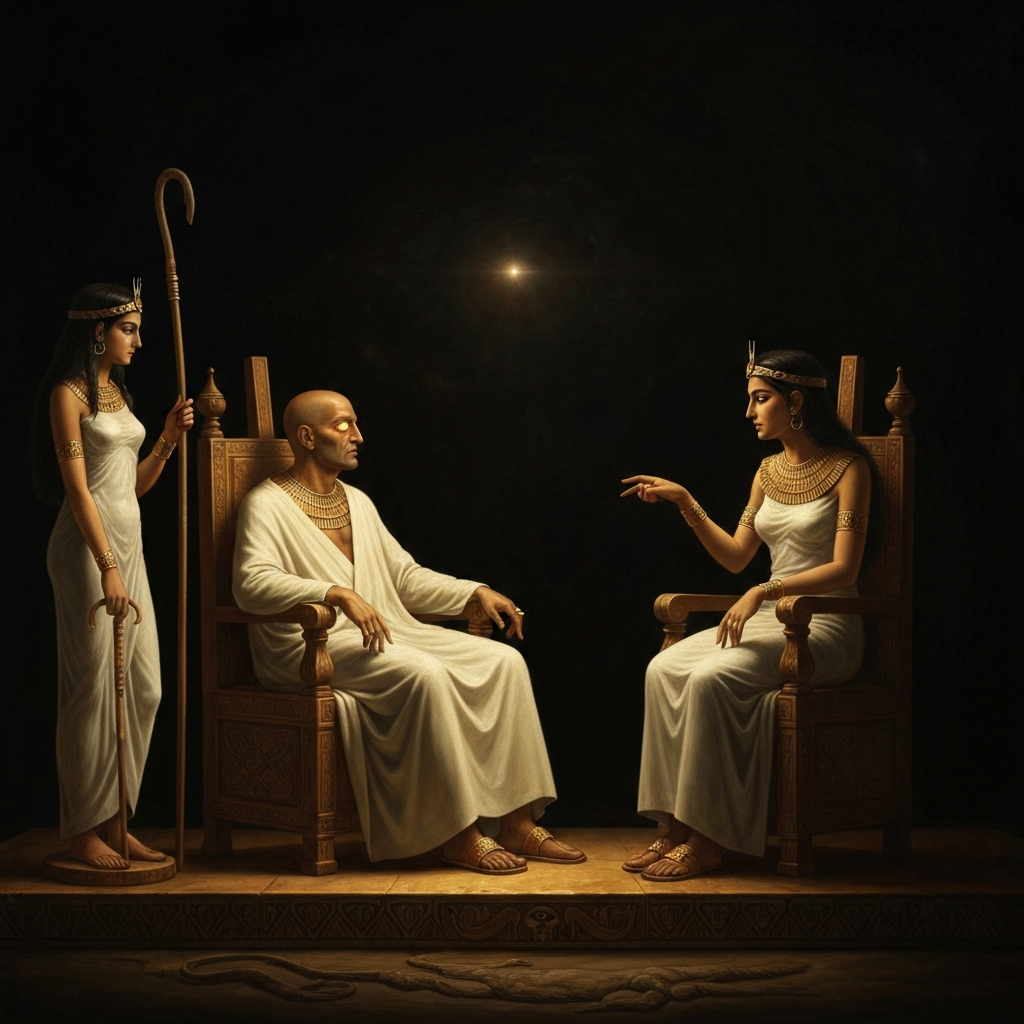
His servant Isimud, a god with two faces who looks both ways at once, announces her. Lord, Inanna of Uruk has come. She is at the gate. She is alone. She is dressed for a dinner. Enki considers. He likes Inanna. He is fond of his niece in the slightly nervous way that very wise older male gods are sometimes fond of brilliant younger female gods — alert that she is not predictable, conscious that her grandfather An respects her opinion in council, aware that her city is now larger than his. He decides to host her. He decides to be generous. He decides to demonstrate, perhaps, that he is not threatened.
He calls for the table to be set.
The table is set with the bread of Eridu, the cheese of Eridu, the dates, the dried fish from the lagoon, the salads of the herb gardens, and the beer. The beer is the famous beer of Eridu, brewed in the temple, brewed with prayers, brewed with the recipe Enki himself wrote down, brewed strong because Enki is a lord who likes a strong beer with his evening.
Inanna sits down. She thanks her uncle for the hospitality. She admires the hall. She compliments the brewers. She drinks.
She drinks like a goddess. She does not drink like a young goddess; she drinks like a goddess who has been drinking with her grandfather An since she could walk, who has matched her father Nanna cup for cup at the new moon festivals, who can put away the cellar of any temple in Sumer and walk home steady. She does not show the strain. She fills Enki’s cup. She refills it. She tells him stories about Uruk that flatter his own role in the city’s founding. She asks his opinion on the carpenter’s craft, the smith’s craft, the scribe’s craft. He gives long answers. He likes giving long answers. The beer is going faster on his side of the table than on hers.
The first Me he gives her, he gives her in pleasure. Take the lordship, he says, with the expansive gesture of a man who has had three cups of strong beer and is feeling the warmth of family. Take the priesthood. He laughs. He pours another cup. Take the godship. Take the high priestess of An. Take the kingship. Take the throne. The throne is for Uruk. Uruk should have a throne.
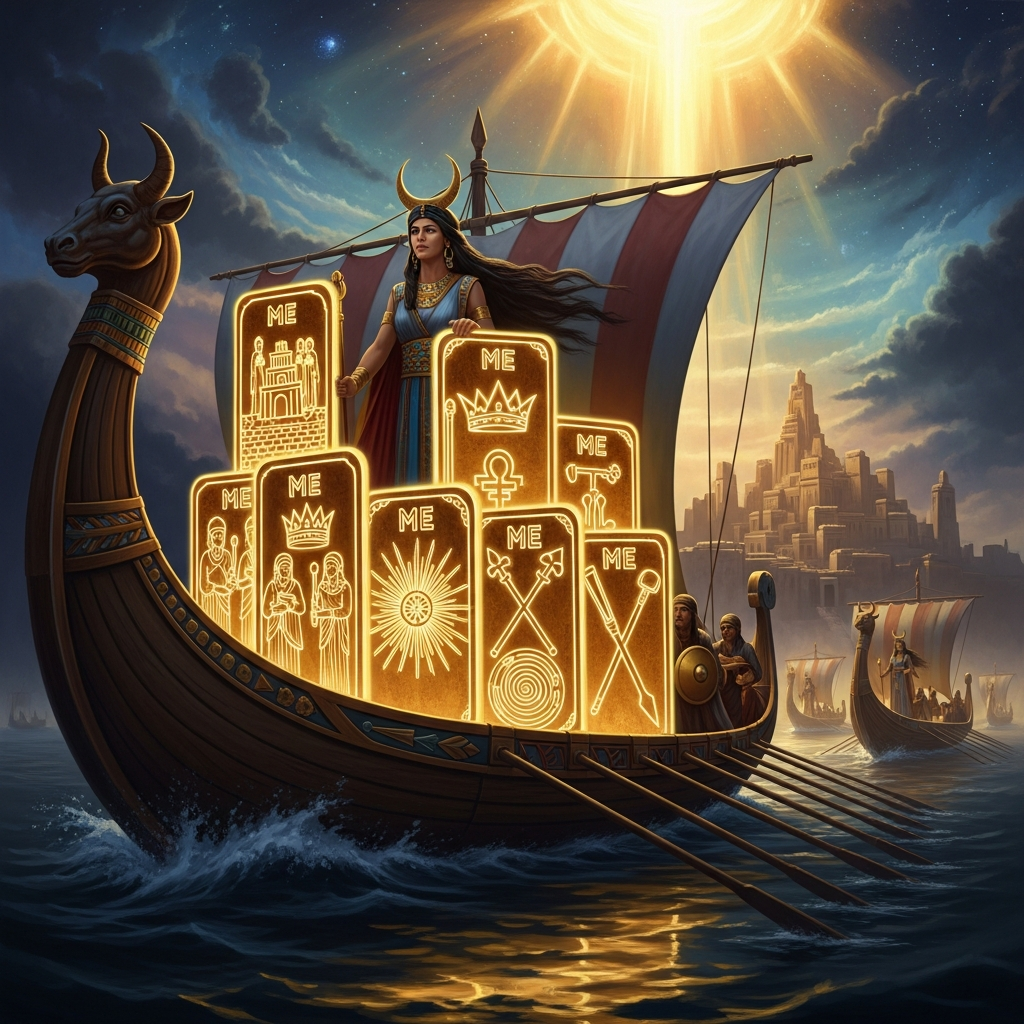
Inanna says: I take them. And she means it literally. She takes them. She gathers them up — the abstract decrees suddenly become objects, the way Sumerian thought lets abstract decrees become objects when a god has spoken — and she puts them in her boat, the Boat of Heaven, which is moored at the temple wharf at the edge of Eridu, and she returns to the table, and she pours another cup.
The second Me he gives her, he gives her in expansiveness. The truthful word. The descent into the underworld. The ascent from the underworld. The throwing-stick. The standard. Take them all, he says. Uruk is the great city. It deserves them. The beer is making him magnanimous. The Me are flowing across the table in a stream. Inanna takes them, sets them in the boat, returns. The hall of Eridu is emptying.
The third Me he gives her, he gives her in the fog of a man who has lost track of how many cups he has had. The kindling of strife. The kindling of peace. The lyre. The drum. The smith’s craft. The scribe’s craft. The art of the elder. The art of the youth. The art of the prostitute. The art of the priestess. The throne, again — she had already taken the throne, but Enki has forgotten. He gives her things he had given her two cups ago. He gives her things he had not yet given her and would not have given her sober. He gives her, finally, the most dangerous one: the descent into the underworld, the secret protocol of crossing the threshold, the one Me that would later let her walk into Ereshkigal’s house and walk out again.
She takes it. She puts it in the boat. She drinks one more cup with him. She kisses his hand. She thanks him. She tells him she must return to Uruk before dawn. He nods, smiling, beautifully drunk. She walks down to the wharf. She gets in the boat. She sails.
Enki wakes in the morning with the headache that all gods get from the beer of Eridu and the slow, dawning realization that comes to all gods who have given away too much.
He looks at the great hall.
The hall is empty.
The shelves are bare. The jars are gone. The substance of the building is somehow thinner, as if walls have been carrying invisible loads and the loads have been removed. Enki understands what has happened the way one understands a robbery: not in pieces but all at once, in a single sickening motion. He has given Inanna the Me. He has given her all of them. He has given her the throne and the priesthood and the kingship and the descent and the ascent and the lyre and the drum and the smith and the scribe. The protocols of civilization are now packed into the Boat of Heaven, sailing up the Euphrates, headed for Uruk.
He calls Isimud. Where is the Boat of Heaven? The two-faced god looks both ways and gives the answer that does not help: it is upriver. It is on the water. It is several leagues away by now. Stop her.
Enki sends the monsters of the abzu — the sea-creatures of his domain, the sea-monsters, the lahama-spirits, the udug-demons, the giants of the deep water. Wave after wave, he sends them. Take the Boat of Heaven from her. Bring it back. Tell her there has been a misunderstanding.
This is the part the tablet relishes. The Boat of Heaven, with Inanna at the rudder and the Me piled in the hold, is intercepted at the first stage of the river by Enki’s monsters. They surround the boat. They demand the Me back. Inanna’s servant Ninshubur — the loyal one, the messenger, the steward — repels them. The boat sails on.
It is intercepted at the second stage. More monsters. More demands. Ninshubur repels them again. The boat sails on.
It is intercepted at the third, fourth, fifth, sixth stage. Each time the monsters are larger. Each time the demands are louder. Each time Ninshubur, whose patience and competence the tablet emphasizes for an audience that knew the value of a good steward, repels them. The Me stay in the boat.
At the seventh stage, the boat reaches the wharf at Uruk.
Inanna disembarks. The people of Uruk have come out to watch. The Me are unloaded onto the temple platform — the lordship, the throne, the priesthood, the carpenter’s craft, the smith’s craft, the truthful word and the false word, the descent and the ascent, the lyre, the drum, the standard, the throwing-stick — and Inanna names each one as it leaves the boat, calling out the gift to her city. Uruk now has, formally and cosmically, what it had only had informally and de facto. Uruk is now a complete civilization. The transfer is permanent. The Me have moved from Eridu to Uruk and they are not going back.
Enki, in the great empty hall of Eridu, accepts what has happened. The tablet says he sends a message of reconciliation. He has been outwitted. He admires it, the way a master craftsman admires a piece of work that exceeds his own. He sends his blessing. He returns to his cup, which is now empty, and orders the brewers to bring more beer, which they do, because Eridu still brews the best beer in Sumer and that, at least, is a Me that cannot be loaded onto a boat.
The story records something that actually happened in history: the transfer of cultural prestige from Eridu, the oldest city, to Uruk, the rising city, sometime in the late fourth millennium BCE. The archaeology shows it. Eridu shrinks. Uruk explodes. The temple complex of Uruk, in the period the story describes, became the largest concentrated urban site in the world. The Sumerians knew their history was being made. They wrote a story about how it happened, and the story is a heist, and the heist is told with relish.
Inanna is not punished. The Sumerian moral imagination does not punish her. She has done what queens of heaven do: she has seen what her city needed, she has gone to the place that had it, she has used the tools available to her — beauty, charm, capacity for drink, sharp memory of who said what at which cup — and she has come home with the goods. Enki is not stupid. He simply lost. He lost to a younger god who had calculated his weakness and exploited it precisely. The losing is in the nature of the world. He returns to his beer.
The list of Me in the tablet is one of the most extraordinary documents in ancient literature — a complete inventory, by a thinking civilization, of what it considered the components of civilization itself. Kingship and priesthood are there. So are music and craft. So are the truthful word and the false word, sitting next to each other on the same shelf. So are the descent into the underworld and the ascent from it. So are the kindling of strife and the kindling of peace. The Sumerians understood that civilization is the bundle of all of these — that you cannot have the smith without the strife, you cannot have the priest without the false word, you cannot have the city without all of it together — and they put it on a list.
Inanna brought the whole list home. She did not edit it. She did not decide that Uruk should have only the nice Me and leave the dark ones in Eridu. She took everything, because everything is what a city needs to be a city, and she put it on the boat and sailed past the seven challenges and unloaded it at her own wharf.
Every later civilization is doing what Inanna did, in slower form: stealing the structural goods of an older culture, packing them onto the Boat of Heaven, sailing upriver before the previous owner sobers up.
Echoes Across Traditions
Entities
- Inanna
- Enki
- Isimud
- The Me
Sources
- Samuel Noah Kramer & John Maier (trans.), *Myths of Enki, the Crafty God* (Oxford University Press, 1989)
- *Inanna and Enki: The Transfer of the Arts of Civilization from Eridu to Erech*, Old Babylonian Sumerian composition
- Diane Wolkstein & Samuel Noah Kramer, *Inanna: Queen of Heaven and Earth* (Harper & Row, 1983)
- ETCSL: The Electronic Text Corpus of Sumerian Literature, 1.3.1