Lugalbanda and the Anzu Bird
Old Babylonian Sumerian, c. 2100–1800 BCE; legendary horizon c. 2700 BCE · The Zagros mountains, en route to Aratta, and the city of Uruk
Contents
On the road to war, a young warrior of Uruk named Lugalbanda falls dangerously ill and is left behind in the mountains. Alone, he prays, recovers, and meets the Anzu bird — the great divine eagle — and performs a kindness for its chick. In return, Anzu gives him supernatural speed.
- When
- Old Babylonian Sumerian, c. 2100–1800 BCE; legendary horizon c. 2700 BCE
- Where
- The Zagros mountains, en route to Aratta, and the city of Uruk
They leave him in the cave because they think he is dying.
The army of Uruk is on its way to Aratta, the rich city in the eastern mountains where the lapis lazuli comes from, where the carnelian is mined, where the great king Enmerkar wants to send a message that the time for tribute has begun. They have crossed seven mountains. Lugalbanda is the youngest of the warriors, the eighth and youngest of his brothers, the one who carries the standard at the front of the column. On the seventh mountain a sickness takes him. His arms go weak. His legs will not hold him. His head burns. His eyes will not focus.
The brothers stop the column. They look at him. They confer. The expedition cannot delay; Aratta is two more mountains away and the season for fighting is short. They cannot carry him. They cannot leave him in the open where the wolves will find him. There is a cave on the side of the seventh mountain. They lay him in it on a pile of skins. They put bread beside him. They put water. They put cheese. They put a small jar of honey for fever. They cover him with their cloaks. They tell him they will come back for him on the way home. They do not say what both they and he understand: that they expect to find a body, not a man, and they will give him the proper rites then.
They leave.
The army goes over the next ridge and the sound of their footsteps fades, and the wind takes over, and Lugalbanda is alone in the dark of the cave with the fever turning his bones into something molten.
He prays.
This is the part of Sumerian literature that the modern reader sometimes finds harder to inhabit than the gods and the eagles, because the prayers are long and ornate and patient and have a tone we have lost. Lugalbanda prays to Utu, the sun, when light comes through the cave mouth at dawn. Utu, shepherd of the land, father of the black-headed people, when you set in the evening, do not turn your face from me. He prays to Inanna, the morning star, when she rises in the east. He prays to Sin, the moon, when the cave fills with cold silver light. He prays to Ninkasi, goddess of beer, because beer is medicine and he has none. He prays to the dream gods who give true dreams and to the household gods of Uruk who are far away and to his own personal god whose name the tablet does not give, the small protective spirit who walks at the right shoulder of every Sumerian who is not abandoned by him.
The fever breaks on the third day.
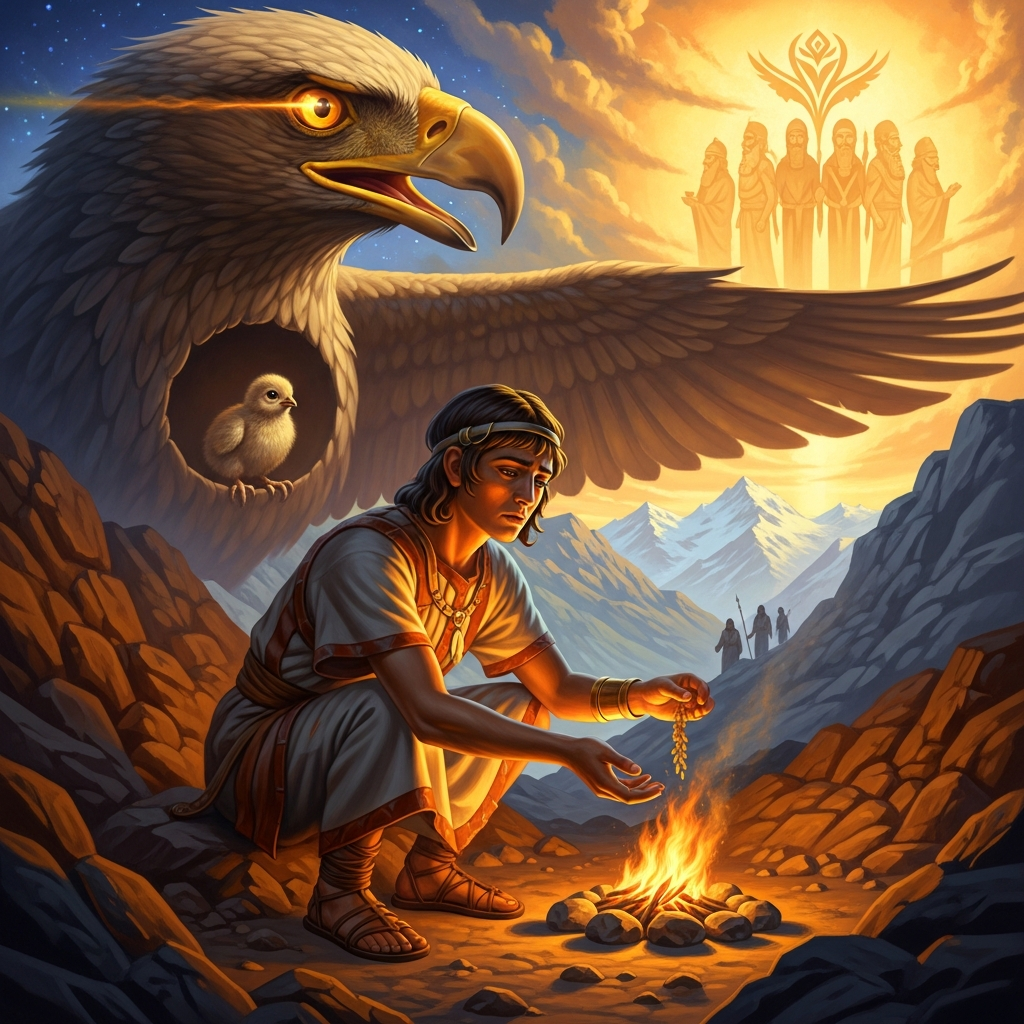
He is too weak to stand. He drinks the water. He eats a corner of bread soaked in the honey. He sleeps. He wakes. The fever does not come back. On the fourth day he can walk to the cave mouth and look at the mountain. On the fifth day he can walk to the spring below the cave. On the sixth day he hunts — a hare, slowly, with a stone, the way a child hunts. On the seventh day he hunts better. He kills a wild goat. He builds a fire with a flint and a piece of dry wood. He cooks the goat. He eats. He sets aside the best portion — the haunch — and roasts it slowly over the embers.
He has been raised properly. When you have meat, you offer it. When you have fire, you feed others. When you have recovered from a thing that should have killed you, you find someone to thank.
He sets out, with the haunch wrapped in leaves, to find someone to give it to.
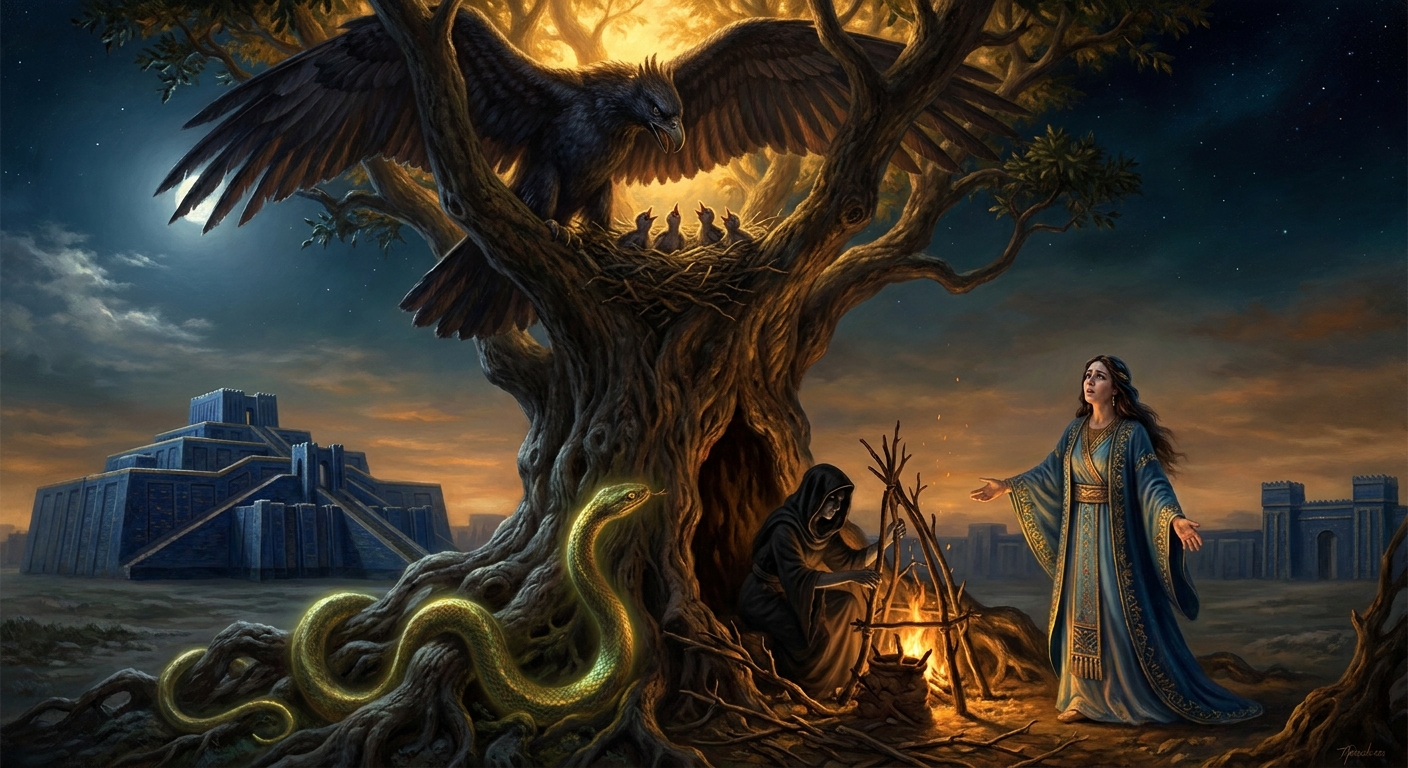
He climbs above the cave. He climbs above the timberline. The great juniper trees of the high country grow thinner and thinner, and then there is one tree, the largest tree he has ever seen, taller than the temple of Inanna in Uruk, its branches reaching out across a whole valley of stone.
In the top branches is the nest of the Anzu bird.
Anzu is the divine thunderbird of the Sumerian sky — vast, black-winged, lion-faced in some accounts, pure raptor in others, the bird whose flight makes thunder, whose cry makes storm, whose wings cast shadow over an entire kingdom when he passes overhead. He is older than Anu’s reign. The gods are nervous of him. There is a separate tablet about how he stole the Tablet of Destinies from Enlil and was killed for it by Ninurta — except in Lugalbanda’s story he is alive, in his nest, in the high mountains, with his mate away hunting.
The chick is alone in the nest.
It is enormous already, at the size where eagle chicks have appetites that cannot be filled by anything its parents can carry, and its parents have been gone a long time hunting in the lowland, and the chick is hungry and frightened and complaining in small thunderbird sounds that shake gravel loose from the cliff face. Lugalbanda climbs the tree. The bark is rough enough to climb. He reaches the nest. He looks at this chick — the size of a young ox, with a beak that could open his rib cage, with eyes the color of the storm — and he understands that this is the child of a god.
He does what his mother taught him.
He gives it the haunch of goat. He has brought the haunch wrapped in leaves and seasoned with juniper berries. He breaks it into pieces the chick can eat. He feeds it slowly, the way you feed a baby. He smooths down the chick’s feathers, which are sticking up everywhere with anxiety. He paints around its eyes with kohl, the way a Sumerian woman paints a child’s eyes for protection. He puts a small sweet-smelling leaf between its claws. He sings it the lullaby that the women of Uruk sing to the babies in the courtyards at night, the one whose tune has no name.
The chick falls asleep.
Lugalbanda climbs down from the tree, sits at the foot of it, and waits for the parents to come home.
Anzu and his mate return at evening with a carcass. They circle the tree. They see the chick asleep, fed, painted, smelling of juniper and bread. They see the man at the foot of the tree.
A normal eagle — a bird that did not understand language and obligation — would have killed him. Anzu is not a normal eagle. Anzu lands. The earth shakes when he lands. He looks at his sleeping child, and at the man who fed his sleeping child, and his great voice asks the question that is also a calculation: what do you want?
Lugalbanda is honest. He has been raised properly. He says: I want to find my brothers. They are at Aratta. I am alone in the mountains. I want to run faster than any man has ever run, so that I can catch them before the battle.
This is the right answer. He has not asked for wealth. He has not asked for immortality. He has not asked for power over kingdoms. He has asked for the thing he actually needs to solve the actual problem he is in, and asking specifically and humbly is, in the Sumerian universe, the correct etiquette for receiving a gift.
Anzu gives him the gift.
The tablets do not entirely agree on what the gift looks like. In one, Anzu blesses Lugalbanda with a blessing whose words confer the speed. In another, Anzu names him with a divine name that includes the property of speed. In a third, Anzu’s mate weaves a blessing into Lugalbanda’s clothes. The result is the same in all of them. Lugalbanda can run from Uruk to Aratta in a single day. He can run faster than the wind that carries Anzu. He can run faster than the river. He cannot fly — Anzu does not give wings, because wings would be a god’s possession — but his feet barely touch the ground.
He thanks Anzu. He thanks the chick, which is still asleep. He thanks Anzu’s mate. He goes.
He catches the army of Uruk before they reach Aratta. They are camped in the last pass. They see him coming up the road from the wrong direction, this brother they had left for dead, his cloak streaming behind him, his feet moving so fast that the dust does not have time to rise behind him. They drop their cups. They embrace him. He says nothing about Anzu. There is a story that he will never tell anybody — he is a man who has been adopted by a god’s family for an afternoon, and that is not a story you tell over a campfire.
The siege of Aratta proceeds. There is a complication: Inanna, patron of Uruk, has not been to her shrine at Aratta in a long time, and the message Enmerkar wants to send to the king of Aratta requires Inanna’s blessing, and to get Inanna’s blessing someone has to run from the seventh mountain to Uruk and back in time for the moon to set. The runners volunteer. None of them can do it. None of them can run that fast. The pass is too long.
Lugalbanda steps forward. He does not explain how. He says he can do it.
The army watches him go. The dust does not rise behind him. He crosses the seven mountains in the time it takes the army’s evening fire to burn down to embers. He reaches Uruk. He prays at Inanna’s temple. He receives the answer he needs to bring back. He turns around. He runs back over the seven mountains. The fire is still warm when he steps over its edge and tells Enmerkar what Inanna said.
Aratta falls. The lapis lazuli comes home. Enmerkar sends the message that Sumerian kings have been sending and will keep sending: the time for tribute has begun. Lugalbanda goes back to Uruk with the army, marries the daughter of a god (the standard finish for a Sumerian hero who has earned divine attention), fathers Gilgamesh, dies a king, and is remembered for a long time as the warrior who was abandoned in a cave and returned with a gift no one could explain.
Lugalbanda is the patron saint of every person who has been left behind. The story refuses the warrior code at the moment the warrior code expects to be honored — instead of dying nobly in the cave, he gets up and feeds an eagle’s chick. The Sumerian moral imagination understands that a man who has been abandoned by other men is not exempt from the requirements of kindness; he is, if anything, more obligated, because he has just been shown what it costs to be unkind.
The gift Anzu gives him is exactly proportional to what he gave the chick — care for care, food for food, a small protective ritual repaid with a large protective blessing. The Sumerians would not have called this karma. They had a different word for it. They believed that the universe was a system of obligations, exchanges, reciprocities, and that gods and humans were both bound by them, and that the gods watched the small things — what you did in a cave, what you did in a nest at the top of a tree — far more carefully than the large things.
The story is one of the oldest in the world. It was already old when it was first written down. The image of the lonely sick man at the top of the tree feeding the giant chick, the image of Anzu and his mate landing in the evening to find their child painted with kohl and smelling of juniper — these images survived the fall of Sumer and the fall of Akkad and the fall of Babylon and the fall of every empire that came after, because they tell something that does not change.
Strength is what you do in the cave. Kindness is what you do at the top of the tree. Speed is what is given to those who have done both.
Echoes Across Traditions
Entities
- Lugalbanda
- Anzu
- Enmerkar
- Inanna
- Utu
Sources
- Herman Vanstiphout (trans.), *Epics of Sumerian Kings: The Matter of Aratta* (SBL, 2003)
- *Lugalbanda in the Mountain Cave* and *Lugalbanda and the Thunderbird*, Old Babylonian Sumerian compositions
- Black, Cunningham, Robson, Zólyomi (trans.), *The Literature of Ancient Sumer* (Oxford University Press, 2004)
- ETCSL: The Electronic Text Corpus of Sumerian Literature