Inanna's Descent: The Queen Who Chose to Die
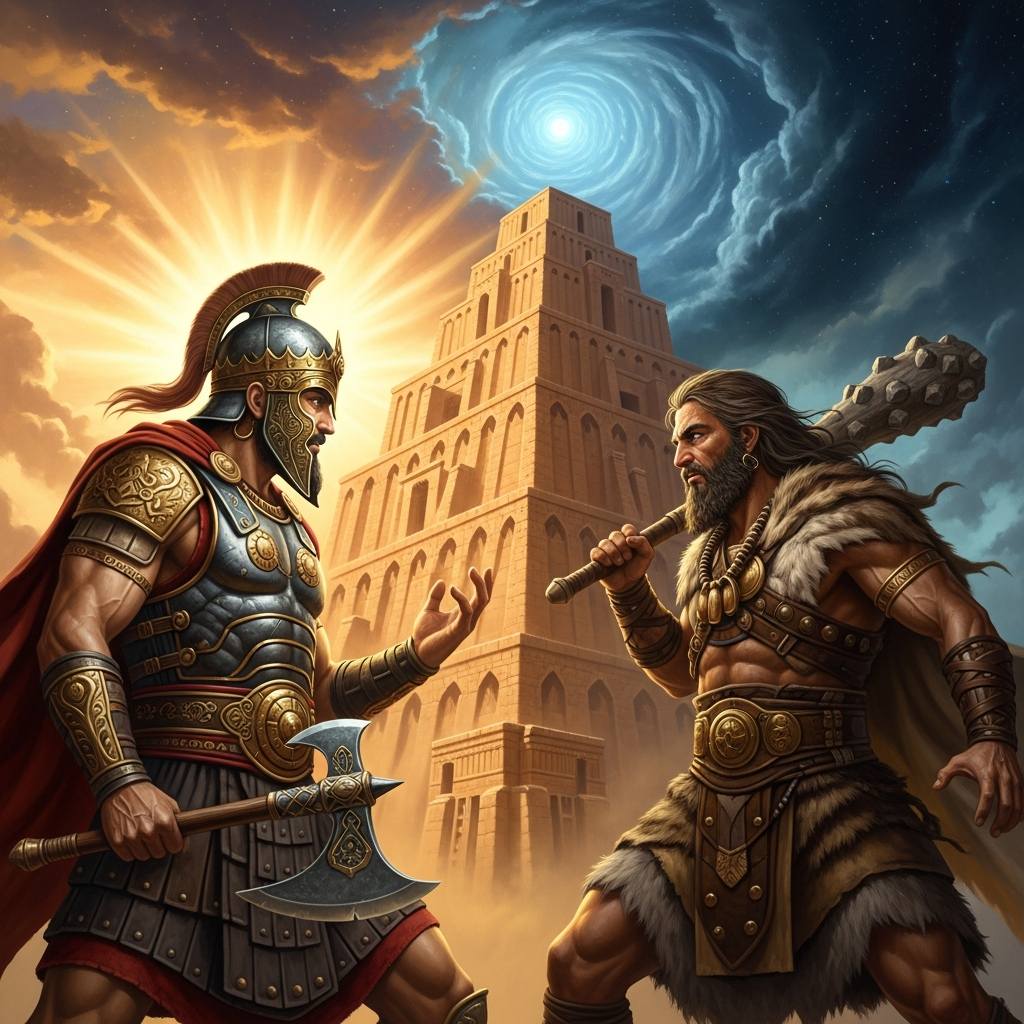
Canonical cuneiform sources date to c. 1750 BCE (Old Babylonian period); the tradition likely reaches back to c. 2100 BCE Ur III period · The Great Above (Uruk, Nippur — the cities of heaven); the seven gates of Kur, the Great Below, the throne room of Ereshkigal
Contents
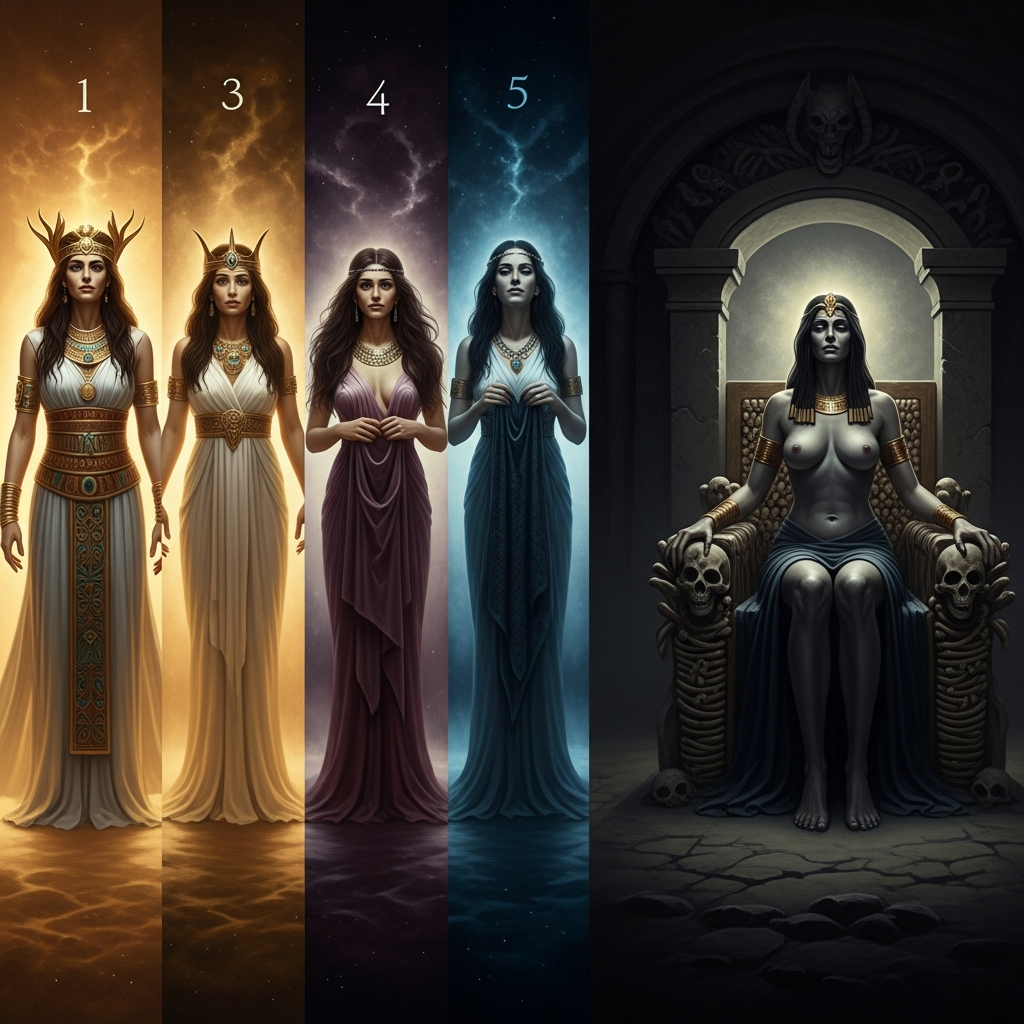
Inanna, Queen of Heaven, descends through seven gates into the underworld, surrendering crown, robes, and power at each threshold, until she stands naked before her sister Ereshkigal and is killed.
- When
- Canonical cuneiform sources date to c. 1750 BCE (Old Babylonian period); the tradition likely reaches back to c. 2100 BCE Ur III period
- Where
- The Great Above (Uruk, Nippur — the cities of heaven); the seven gates of Kur, the Great Below, the throne room of Ereshkigal
She goes down of her own will.
This is the first thing to understand about Inanna’s descent, and the thing that most distinguishes it from every death-and-resurrection story that came after. She is not taken. She is not tricked. She is not murdered in her sleep or abducted from a meadow. Inanna, Queen of Heaven, Mistress of the Me, the goddess who holds the divine laws of civilization in her hands — she packs her seven divine attributes, leaves instructions with her servant Ninshubar, and walks to the gate of the Great Below.
The cuneiform texts begin with two lines that have survived four thousand years: From the Great Above she opened her ear to the Great Below. From the Great Above the goddess opened her ear to the Great Below. In Sumerian, “to open the ear” means to pay attention, to set one’s intention, to decide. Inanna heard something from below, and she turned toward it.
What she heard was her sister.
Ereshkigal is the Queen of the Great Below. The two sisters are the poles of the Sumerian cosmos: Inanna rules the visible world of sky, grain, lovemaking, war, and civilization; Ereshkigal rules everything beneath it. Their relationship in the texts is not a warm one. They do not visit. They do not correspond. There is a hostility between them that the myth never fully explains — the older sister enthroned in darkness, the younger sister draped in light — and the descent will force a confrontation that the cosmos has been deferring.
Inanna arrives at the first gate.
The gatekeeper Neti stops her. He goes to announce her to Ereshkigal, who — in one of the text’s most arresting moments — slaps her thigh in rage at hearing her sister is coming. She is not pleased. She gives her orders: open the seven gates, one by one, but at each gate take something from her.
The process begins.
At the first gate, Neti removes the Shugurra crown from Inanna’s head.
What is this? Inanna asks.
Quiet, says Neti. The ways of the underworld are perfect. They may not be questioned.
At the second gate, the lapis lazuli beads at her neck are removed. At the third, the double-strand beads at her breast. At the fourth, the breastplate called “Come, man, come.” At the fifth, the golden ring from her wrist. At the sixth, the lapis measuring rod and line. At the seventh gate, the royal robe.
She stands naked before the throne.
The stripping is not humiliation for its own sake — or not only that. The seven objects are the me, the divine laws, the civilizational attributes that define Inanna’s power. The crown is her authority over the sky. The beads are her sexual power. The measuring rod is her governance of space and justice. With each gate she loses not just an accessory but a dimension of herself. She arrives in Ereshkigal’s throne room as something that cannot be named by its former name, because every marker of that name has been taken away.
This is what initiation means. The stripping precedes the transformation.
Ereshkigal fixes the eye of death on Inanna.
She speaks the word of wrath against her.
She strikes her.
Inanna dies.
Her corpse is hung on a hook on the wall of the underworld, where it begins, slowly, to rot. The text describes it with one of its most disturbing images: the green dough. The goddess who was the greening of spring, the reddening of grain, the sexual force of the growing world — she is now a piece of meat going bad in a dark room.
This is not symbolic. The Sumerians meant it materially. The Queen of Heaven is dead, and her body is hanging on a wall underground, and the world above is dying with her.
Three days pass.
Ninshubar, the faithful servant Inanna left with instructions before she descended, goes to the gods in sequence — Enlil, Nanna — and begs for help. Both refuse. The underworld has its own laws. Inanna made her choice. What has gone below stays below.
Ninshubar goes to Enki.
Enki, the god of wisdom and fresh water, the most clever of the divine council, does not refuse. He grieves. He creates two small beings from the dirt under his fingernail — the kurgarra and the galatur, genderless creatures too small to be noticed — and he gives them the food of life and the water of life and sends them below.
The small beings slip through the gates of the underworld undetected. They find Ereshkigal.
She is in labor. She is crying out in the pain of giving birth to something the text does not name. The kurgarra and the galatur do what they were told to do: they echo her cries back to her. When she cries Oh, my inside! they cry Oh, your inside! When she cries Oh, my outside! they cry Oh, your outside! They simply witness her pain. They reflect it back without judgment.
Ereshkigal stops crying.
She has been heard.
She offers the small beings a gift. They ask for the corpse on the hook. She gives it. They sprinkle the food of life, the water of life, sixty times each, and Inanna rises.
But the underworld has its law: no one leaves without sending a substitute.
The galla, the demons of the underworld, attach themselves to Inanna as she ascends. She moves through the seven gates in reverse, receiving her attributes one by one — robe, rod, ring, breastplate, beads, beads, crown — and at each gate the demons grip her elbow. You cannot go without a substitute. One of the living must take your place.
Inanna returns to the upper world trailing demons.
She moves through her cities. Ninshubar is outside the gate of the underworld, in mourning clothes, covered in dust. The demons say: give us this one. Inanna refuses. She moves to Umma and finds the god Shara in mourning clothes, in the dust. The demons say: give us this one. She refuses.
She arrives at Kulaba and finds Dumuzi.
Dumuzi is not in mourning clothes. He is sitting on his great throne in clean garments. He is not weeping for her.
Inanna fixes on him the eye of death. She speaks the word of wrath against him. Take him.
The demons take Dumuzi.
The myth does not end with cruelty — or not simple cruelty. Dumuzi’s sister Geshtinanna loves him enough to offer to share his sentence. The underworld negotiates. Dumuzi will spend half the year below, Geshtinanna the other half. The world above will mirror this: when Dumuzi is below, the shepherds are gone, the flocks are thin, the grain does not grow. When Geshtinanna is below, the same. The seasons are the alternating absences of two gods paying one debt.
Inanna’s descent produces the year.
Not as a side effect, but as its point. The Queen of Heaven had to go below. She had to be stripped, had to die, had to negotiate with her mirror-self in the dark. The world above depends on what happens in the underworld — on the grief of Ereshkigal, on the cleverness of Enki’s small creatures, on the love of a sister willing to share a sentence with her brother.
What the seven gates strip away, the resurrection restores. But the crown you receive at the seventh gate on the way back is not quite the same crown you were wearing when you gave it up. You have been the green dough on the hook. You have been what is left when everything is taken. And you know, now, in a way you could not know before you descended, exactly what you are.
The myth is about that knowledge.
It is the oldest written record of the thing religion is really for.
Echoes Across Traditions
Entities
- Inanna
- Ereshkigal
- Ninshubar
- Dumuzi
- Enki
- Geshtinanna


Sources
- Diane Wolkstein and Samuel Noah Kramer, *Inanna: Queen of Heaven and Earth* (1983)
- Thorkild Jacobsen, *The Treasures of Darkness* (1976)
- Samuel Noah Kramer, *Sumerian Mythology* (1944)
- Betty De Shong Meador, *Inanna, Lady of Largest Heart* (2000)
- Jeremy Black et al., *The Literature of Ancient Sumer* (2004)