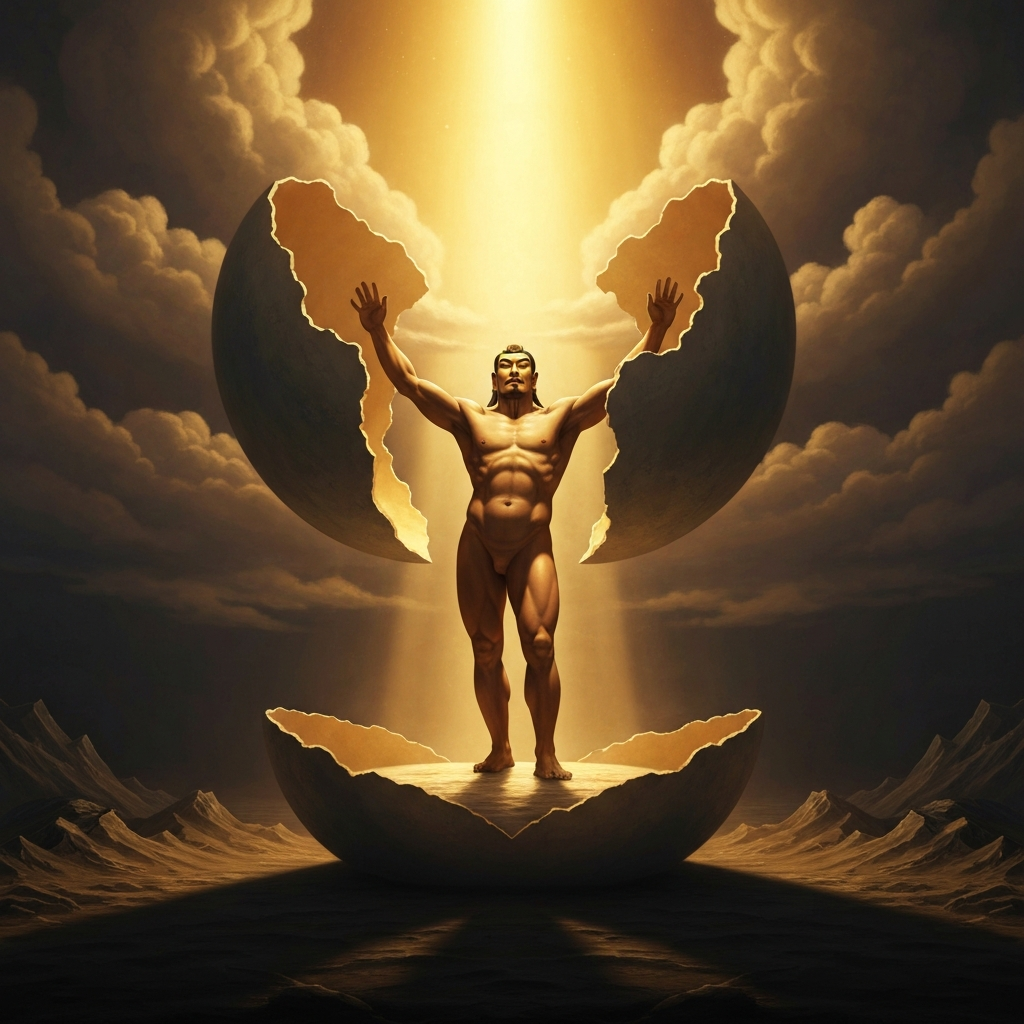
Nüwa Melts the Stones to Patch the Sky
Age of the first gods — before written history · The edges of the sky above ancient China, the broken pillar at the northwest corner of the world
Contents
After the pillar of heaven shatters and the sky tears open, the goddess Nüwa spends years smelting colored stones to repair the wound above the world.
- When
- Age of the first gods — before written history
- Where
- The edges of the sky above ancient China, the broken pillar at the northwest corner of the world
The world has broken before, and it will break again, but the breaking that matters is this one.
The water god Gong Gong has fought the fire god Zhurong and lost, and in his rage and shame he has driven his head into Buzhou Mountain — the pillar that holds the northwest corner of heaven aloft. The mountain shatters. The pillar falls. The sky tears open at the northwest seam, and the earth tilts toward the southeast where the seas have always drained. Fire pours from the wound in heaven. Water boils up from the cracked earth. The forests burn. The great beasts roam through the smoke. The people who have only just been made — Nüwa’s people, shaped from yellow clay, given breath by her own hands — run screaming from one end of the ruined world to the other and find no shelter.
Nüwa looks at what Gong Gong has done.
She does not weep. The hagiographies note this. She looks at the ruin with the eyes of someone who knows that grief is a luxury the maker cannot afford while the making is still undone. She begins to plan.
She goes first to the river beds and the mountain streams and the colored plains where the stone lies exposed in seams. She walks for a long time. She is looking for five colors of stone: red, yellow, blue, white, and black. The five colors correspond to the five phases — fire, earth, water, metal, wood — the five forces whose balance is the sky’s integrity. To patch the sky, you must match the sky’s grammar. You cannot repair the universe with random material.
She finds what she needs.
She builds a forge at the edge of the world, where the land meets the bottomless air, where the broken rim of heaven droops low enough to touch. She smelts the stones. This takes years. The texts do not tell us how many. They say only that Nüwa’s forge burned for a long time, and that the colored light of it could be seen from far away, and that the people who saw it understood that someone was working on their behalf.
She smelts the stones into a substance that is neither rock nor metal but something between — a celestial plaster, a material that can adhere to the fabric of heaven because it was made to match that fabric’s missing grammar. She carries it to the tear.
She fills the hole.
Stone by stone, handful by handful. The fire that poured through the wound is sealed. The floods slow. Where the sky was torn, it is now patched with colored stone, which is why the sky shimmers sometimes at dawn and at dusk with red and gold and the deep blue of deep water — because Nüwa’s patchwork is still there, visible if you know what you are looking at.
But the pillar is still down. Without the northwest pillar, heaven still tilts, and so she kills the black tortoise — the cosmic tortoise whose shell is strong enough to bear a world — and cuts off its four legs. She drives them into the earth at the four corners of the sky as substitute pillars. The sky holds.
The fires are still burning in the reed beds and the forests. She gathers the reeds and burns them to ash and uses the ash to dam the floods. Slowly, the waters obey.
The people come back to the places they had fled. They find the sky closed. They find the fires out. They find the floods receding. They do not know exactly what happened. They know someone repaired the world while they ran.
The texts record that after she finished, Nüwa did not announce what she had done. She simply stopped working. She laid down her tools at the edge of the forge and watched the restored sky for a while and then — the texts say — she transformed herself into something else, something that still drifts through the wind, though none of the scholars agree on what that something is.
The patched places are still there. You have seen them. They are the colors of the sky that do not quite match — the gold at sunset that is too warm, the band of crimson too vivid, the blue at zenith too deep. That is not decoration. That is the repair, holding, as it has held since before the first dynasty, since before the first word was written, since the goddess stood at the edge of the sky with her forge and her five colors of stone and her refusal to leave the world broken.
Echoes Across Traditions
Entities
- Nüwa
- Gong Gong
- Zhurong
- the black tortoise
- the great flood

Sources
- Huainanzi (淮南子), chapter 6, 'Lanming Training,' c. 139 BCE
- Liezi (列子), 'Questions of Tang,' c. 4th century BCE or later
- Anne Birrell, *Chinese Mythology: An Introduction* (Johns Hopkins, 1993)
- Lihui Yang & Deming An, *Handbook of Chinese Mythology* (Oxford, 2008)